
A T型ねじ込み式プラスチックエアプッシュ継手 チューブを抜いた後、見た目は変わらないように見えるかもしれませんが、安全な 再接続 いくつかの小さな接合部の状態に依存します。工具による負荷で分岐部が損傷したり、コレットの保持力が低下したり、シールが潰れたり、チューブ端に傷が付いて新しい継手にその傷が移ったりする可能性があります。そのため、再利用は自動的に許可されるものでも、自動的に禁止されるものでもありません。本ガイドでは、エンジニアが状態に基づいた点検と再接続を行うための手順を示し、交換の明確な基準も定めています。.
簡潔な回答:再利用する T型継手 供給業者が許可し、本体、分岐部、ねじ山、コレット、シール、およびチューブ端部が検査に合格した場合に限り行います。指示に従って空気を隔離・排気し、新たに四角形のチューブを切断します。ねじ山と配管経路を確認し、圧力を徐々に復帰させた後、承認済みの漏れ試験を実施してください。損傷または不確実な部品はすべて交換してください。再接続時には、全経路および機械の動作範囲に十分なチューブ長を確保する必要があります。張力が生じるような短縮は不十分です。.
ねじ込み式ティーは、3管用ユニオンティーと同じですか?
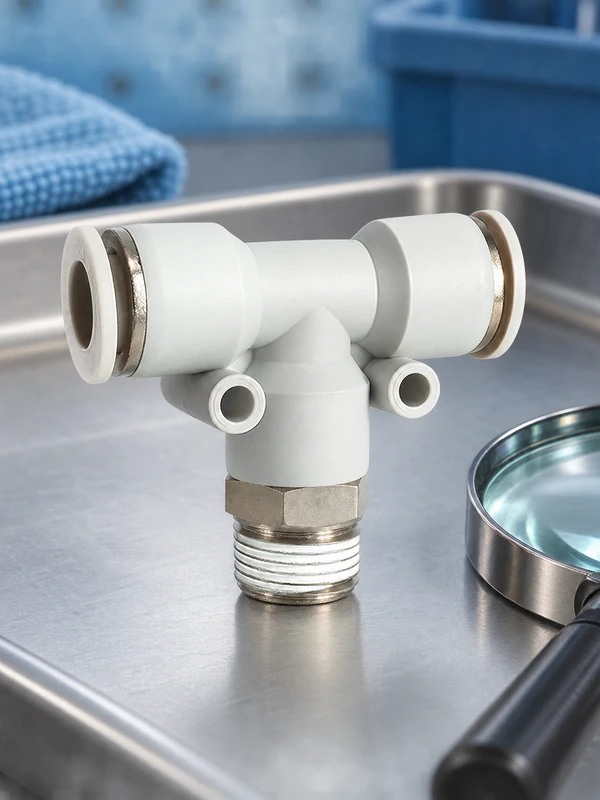
いいえ。ねじ込み式ティーは一般的に、機械用ポート接続とチューブ接続を組み合わせますが、ユニオン式ティーは3本のチューブを接続できます。シールの数を数えたり交換部品を選定したりする前に、実際の構成を確認してください。ラン部とブランチ部の位置は、配管経路やアクセス性、またラインを遮断するために必要な作業にも影響します。製品図面を参照し、どの開口部がねじ込み式で、どの開口部がチューブに対応しているか、および継手に指定された取付方向があるかどうかを確認してください。外観が似ているからといって、取り外した部品と同じ形状をしているだけで類似品を使用してはなりません。交換用の検索では、 PBオスねじT字継ぎ手 これは構成の参照であり、材質、管接続およびポート仕様については、同等と仮定するのではなく、元の部品と照らし合わせて確認する必要があります。.
再接続前に何を点検すべきですか?
シーリング面を研磨することなく、本体と分岐部が確認できる程度に継手を清掃してください。ねじ部周辺に亀裂、白化、変形、衝撃痕、歪みがないか点検します。指示に従ってリリースカラーを操作し、コレットが認証済みのチューブを確実に保持していることを確認してください。シールには切れ、潰れ、硬化、汚染、ずれがないか点検します。チューブについては、傷、楕円度、屈曲、損傷した目視確認マークがないか確認してください。T字継手には2つの分岐部と1つの主管がありますので、切断された分岐部だけでなく、すべての接続部を点検してください。.
ネジ付きポートに新しいシールが必要ですか?
製品図面に従ってください。一部のねじ込み式設計では、ワッシャー、面、またはOリングでシールしますが、他の設計では指定されたねじ山を使用します。シーリング方法. 損傷またはつぶれたワッシャーまたはOリングを交換し、ねじ山が合わない場合や面が損傷している場合にテープを追加すれば補えると決して考えないでください。確認してください。 BSPP、BSPT、またはNPT 組み立て前に。部品の履歴が不明で、接合部が重要である場合、元の施工者がどのようにシールしたかを推測するよりも、継手を交換する方が合理的なことが多いです。作業指示書に承認済みのねじおよびシール材の識別情報を添えておき、再接続時に過去の接合状態に依存しないようにしてください。.
再接続のためにチューブはどのように準備すればよいですか?
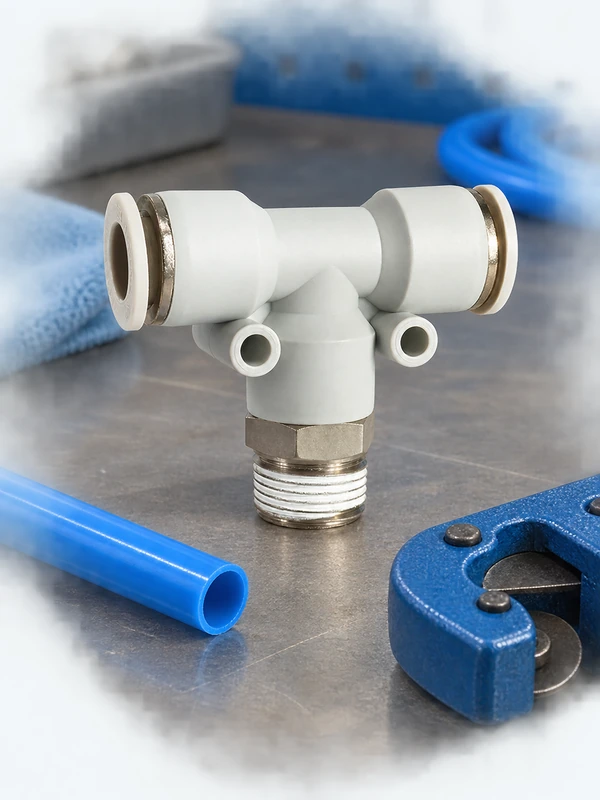
取り外し前に配管の減圧を行ってください。供給元が許可している場合 再接続, スクエアカッターで、傷のないきれいな部分まで切り戻してください。古い切れ込みを入れた端を単に押し込むだけではいけません。切りくずを取り除き、切断面が穴の軸と一直線になるようにしてください。両方の配管に、取り付け時に継手が曲がらないよう十分な直管長があることを確認してください。新しい切断は、コリエットやシールが摩耗した接続部を修復するものではありませんので、再組み立て前に必ず点検を完了してください。傷のある部分を除去することで別の配管ルート上の問題が生じる可能性があるため、新しいチューブ端の状態と残りの配管長を合わせて記録しておいてください。.
ルーティングに問題が生じる前に、チューブはどこまで短くできますか?
ユニバーサルなカットバック長は存在しません。チューブおよびコネクタの取扱説明書に従って、損傷したシール部を除去し、取り付け経路を再評価してください。短縮後のチューブは依然として真っ直ぐに挿入でき、記載された曲げ半径を遵守し、張力がかからずに機械が十分に動作できる余裕が必要です。これらの条件を満たさない場合は、適切に仕様が定められた交換用チューブを設置してください。交換を避けるために残りの長さを伸ばしたり、未承認のインラインジョイントを追加したりしないでください。端面がきれいであっても、完成したアセンブリ全体が十分な支持と保守作業のアクセスを備えていなければ意味がありません。.
T継手を損傷させる可能性のある配管上の問題にはどのようなものがありますか?
T字継手は、分岐がバルブやアクチュエータに向かう一方で、本管は別の機器へと続くことが多いため、配管経路の決定を集中させます。側面荷重、曲げ半径の不足、支持されない配管重量、振動などは、本体やコリットに負荷をかける要因となります。クランプは解放リングではなく配管本体に取り付け、各分岐を切り離したり取り外したりできるだけの余裕を確保してください。同一方向で継手が繰り返し破損する場合は、形状の異なるT字継手を選定する前に、配管経路と支持状況を見直してください。見直し チューブの配線およびサポート 再接続前に、各分岐が直線状に入り、承認された機械の動作経路を通じて引き続きアクセス可能であるようにします。.
再接続はどのようにテストすべきですか?
ガードや工具が確実に外れていることを確認した後、圧力をゆっくりと復帰させてください。該当する試験条件下で、現場で承認された漏れ検査または圧力検査手法を用い、3つの接続部すべてを点検してください。T字継手は、ラン部分またはねじ込みポートで漏洩していても、分岐部のチェックを通過することがあります。部品番号、チューブの状態、シール判定、ねじ規格、および試験結果を記録してください。コネクタが動いたり、漏れたり、表面に損傷が見られる場合は、締め付けたり樹脂本体に接着剤を塗ったりせず、再び隔離して交換してください。.
When should the entire fitting be replaced?
Replace the fitting when any branch is cracked, whitened or deformed, when the collet does not retain the correct tube, when the seal or thread is damaged, when chemical exposure is suspected, or when the service history is unknown in a critical circuit. Replacement is also appropriate when the supplier prohibits reuse or the part has exceeded its documented duty. Do not file, sand, heat or glue the fitting; those actions change the controlled interface and make later verification harder.
Can replacing an internal seal restore every damaged fitting?
Only perform a seal replacement if the manufacturer documents the fitting as serviceable and provides the approved part and procedure. Many small push-in fittings are replaced as complete assemblies rather than repaired internally. A new O-ring cannot repair a distorted body, damaged retention feature or incorrect thread. Avoid disassembly that exposes an internal part which the supplier does not authorise technicians to service. When the construction or repair policy is unknown, replacing the complete fitting preserves a controlled configuration and avoids inventing a repair process. External inspection cannot prove that inaccessible internal features remain sound. If the supplier does not provide a permitted way to assess them, do not dismantle the fitting merely to satisfy a checklist. Record the inspection limitation and select replacement according to the machine’s failure consequences. A short static test may establish that the assembled joint is not visibly leaking at that moment, but it cannot certify an unauthorised internal repair or prove indefinite retention.
What information should maintenance leave behind?
Record why the tube was removed, which interfaces were inspected, whether a seal was renewed, the thread and tube identity, the test method and the final result. If the fitting was replaced, record the new part number and any adapter. A short note such as “reconnected OK” does not explain whether the body, collet and tube passed inspection. Consistent records help determine whether a recurring problem is caused by reuse, routing, contamination or an unsuitable material.
What makes a reuse decision defensible?
The maintenance record should show supplier permission, the exact part identity, the inspection outcome, tube preparation, seal decision and acceptance result. Note any history that is unknown, especially after overheating, cleaning-agent exposure or an impact. If a leak appears only during motion, investigate side load and routing rather than declaring reuse successful from a stationary check. Use the approved machine cycle for functional verification after local testing. The component’s low purchase price is not the whole comparison: isolation time, repeated shutdown and the consequence of tube release can outweigh the saving from reuse. Make the choice from documented condition and failure consequences, not from an assumption that plastic fittings are either disposable or indefinitely reusable.
Which inspection findings rule out tee fitting reuse?
| 検査ポイント | Accept when | Reject when |
|---|---|---|
| Plastic body and branch | Clean, undamaged and not deformed | Crack, whitening, impact or distortion |
| Collet and seal | Moves and retains the specified tube | Sticking, cut, flattened or contaminated |
| チューブ端 | Square, clean and free of scoring | Oval, kinked, scored or too short |
| Thread and test | Standard verified and test passed | Cross-threading, unknown seal or persistent leak |
インストーラーは何を記録すべきですか?
- Isolate and exhaust the complete branch before removal.
- Inspect the body, three interfaces, collet, seal and tube end.
- Verify the thread and sealing method from the product record.
- Support all branches and restore pressure gradually.
- Record the decision and repeat the approved leak test.
よくある質問
Can every T fitting be reused?
No. The supplier’s instructions and condition of each interface determine reuse. Confirm the configuration and service history, then inspect the body, retention features, seals and threads. Unknown condition in a critical circuit needs resolution before reconnection.
Should the old tube end be reinserted?
Only if it remains undamaged and meets the product instructions. Where cutting back is required or permitted, remove the damaged section with a square cut. Recheck route length and bend radius so shortening does not introduce tension.
Can a cracked branch be glued?
No. Replace the fitting and investigate the load or exposure that caused the damage. Adhesive does not restore the manufacturer’s controlled structure or documented pressure boundary, and a successful short leak test cannot prove that repair.
Does a leak prove thread mismatch?
No. Thread mismatch is one possible cause alongside tube damage, poor seating, a worn seal or side load. Identify the leaking interface and inspect under isolation. Correct the confirmed cause and repeat the acceptance check.
Can reconnection be tested at full pressure immediately?
Follow controlled pressure restoration and the site-approved test procedure. Check that personnel, tools and guards are correctly positioned and that all tee interfaces are included. Do not use a test condition above the complete assembly’s approved limit.
What standard helps with safe isolation?
ISO 4414:2010 addresses pneumatic-system safety at system level. The machine’s energy-control procedure and applicable local requirements determine the actual isolation steps. For covered U.S. servicing, OSHA 1910.147 also addresses stored energy and possible reaccumulation.
参考文献
- SMC, archived KQ2 One-touch Fittings catalogue: construction and configuration illustrations; historical reference, not a specification for ANMASPC/Oulu fittings.
- U.S. Department of Energy, Minimize Compressed Air Leaks, Compressed Air Tip Sheet 3, revised August 2004: leak identification, repair and verification; historical maintenance guidance.
- OSHA 29 CFR 1910.147, Control of hazardous energy: applicable U.S. servicing requirements, including stored energy. Other jurisdictions require their own regulatory review.
結論
Reuse is acceptable only when the evidence supports it. Inspect the T body and all interfaces, renew the tube end when permitted, verify the thread and sealing method, support the branches and test before returning the line to service. A fitting that looks clean can still have a worn collet or damaged seal, so visual similarity is not an acceptance criterion. ANMASPC/Oulu can help identify a replacement configuration, but the supplier instruction, machine risk controls and recorded test result should decide whether the connection is returned to operation. Review the pneumatic parts range with the verified tube, port and service requirements when requesting a configuration.



