
A maintenance team can replace a leaking connector in minutes and still restart the same fault. The trap is treating every push-in fitting as interchangeable because the tube enters and the thread engages. An outside-diameter mismatch, thread error, tube side-load or restricted flow path can turn a quick repair into repeat downtime. The real question is which connector matches the tube, port, airflow, environment and inspection plan as one documented assembly.
요약: Choose 공기압 피팅 after confirming tube outside diameter and material, port thread and sealing method, flow demand, environment, and maintenance method. ISO 4414 gives general pneumatic-system safety rules, while ISO 6358-1 defines a flow-characteristic test approach; neither makes a fitting suitable automatically. Compare current documentation for the exact fitting, tube and port, and isolate and depressurize the system before work.
Check Tube Size and Thread Type Before Choosing a Pneumatic Fitting
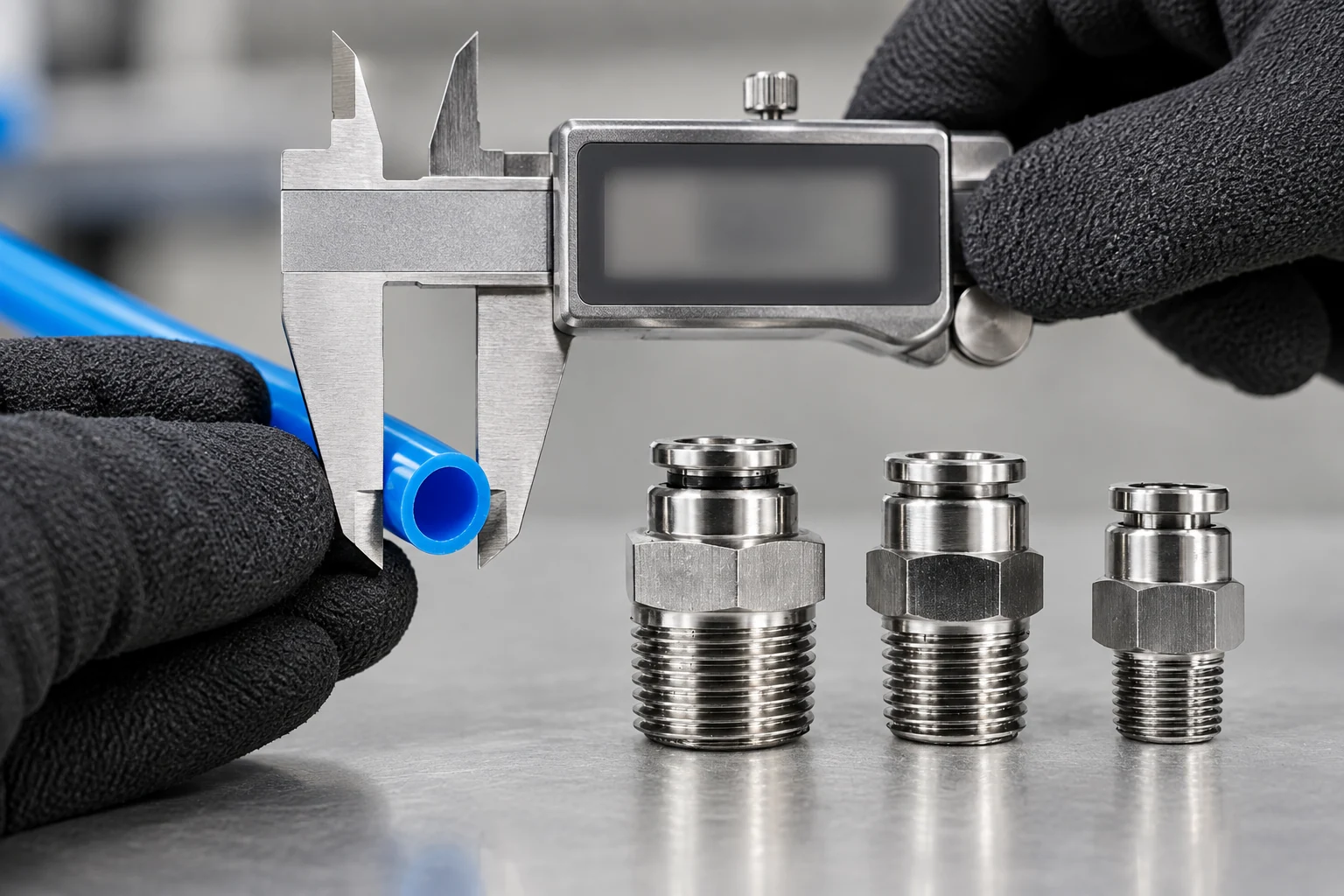
A push-in Pneumatic Fitting uses a collet to grip the tube and an internal seal to close the air path. Both depend on specified outside diameter, surface condition, roundness and permitted material. Measure the OD, distinguish metric from inch tubing, and verify the tube series against the fitting datasheet.
Check the port independently because a wrong thread can still start. ISO 228-1 covers pipe threads where pressure-tight joints are not made on the threads; ISO 7-1 covers threads where they are. NPT is a separate inch-based taper family under ASME B1.20.1. Use a thread gauge, measure the major diameter, check taper, and confirm the equipment drawing or port marking before selecting a seal.
| Selection point | 확인해야 할 사항 | Why it matters in maintenance | 요청할 증거 |
|---|---|---|---|
| 튜브 인터페이스 | Actual OD, metric or inch series, tube material and condition | Wrong size or a damaged surface can defeat both grip and sealing | Tube and fitting datasheets; approved pairing |
| 포트 인터페이스 | Thread family, size, pitch, taper and sealing method | Look-alike threads may engage but fail to seal or damage the port | Port drawing, thread gauge result and fitting drawing |
| 작동 범위 | Pressure, temperature, medium and ambient exposure | Body, seal and tube suitability must be checked together | Current manufacturer limits for the exact part numbers |
| Flow requirement | Required downstream pressure and cycle demand | A small bore or complex path can add avoidable pressure loss | Flow data measured under a stated method and conditions |
Check Flow Direction and Pressure Loss Under Working Conditions
Plain straight connectors may be bidirectional, but fittings with control, check or exhaust functions can be directional. Read the symbol, arrow and documentation, then trace the supply-to-actuator path on the schematic. If the body has no marking, the datasheet must establish permitted use.
Pressure loss cannot be judged from thread size alone; it varies with pressure, mass flow, internal bore, elbows, reducers, tubing length and demand. ISO 6358-1 describes steady-state testing for flow-rate characteristics using compressible fluids. Use supplier data under stated conditions or measure immediately upstream and downstream at repeatable operating demand. A no-flow reading is not sufficient.
A restrictive fitting can slow an actuator or trigger unnecessary downstream replacement. Treat the repair as a system change: record the original geometry, compare flow data, and confirm behavior after restart under the approved procedure.
Choose the Fitting Material for the Air, Environment, and Duty
Plastic-bodied, brass and stainless-steel fittings serve different product families, but material name alone does not establish pressure, temperature, corrosion resistance or compatibility. A buyer searching for Pneumatic fittings plastic must still verify body resin, seal compound, tube pairing and operating limits. A metal body likewise does not remove the need to inspect seals and interfaces.
| Construction option | Potential selection reason | Questions that remain open | Maintenance focus |
|---|---|---|---|
| Polymer-bodied fitting | Low mass, compact routing or frequent configuration changes | Resin, seal, pressure, temperature, chemical and UV limits | Cracks, deformation, collet movement and tube side-load |
| Brass-bodied fitting | Metal threads or established plant standardization | Alloy, plating, seal, media and environment suitability | Thread condition, corrosion signs, seal condition and torque procedure |
| Stainless-steel-bodied fitting | Projects whose documented environment calls for a specified stainless grade | Actual grade, seal compound, process compatibility and cleaning rules | Thread galling risk, contamination control and seal inspection |
For a deeper material-screening framework, see the site’s guide to choosing plastic pneumatic fittings. A catalog phrase such as fittings pneumatic is only a search label; procurement should be based on a controlled part description and verified data.
Prevent Tube Release by Checking Retention and Routing
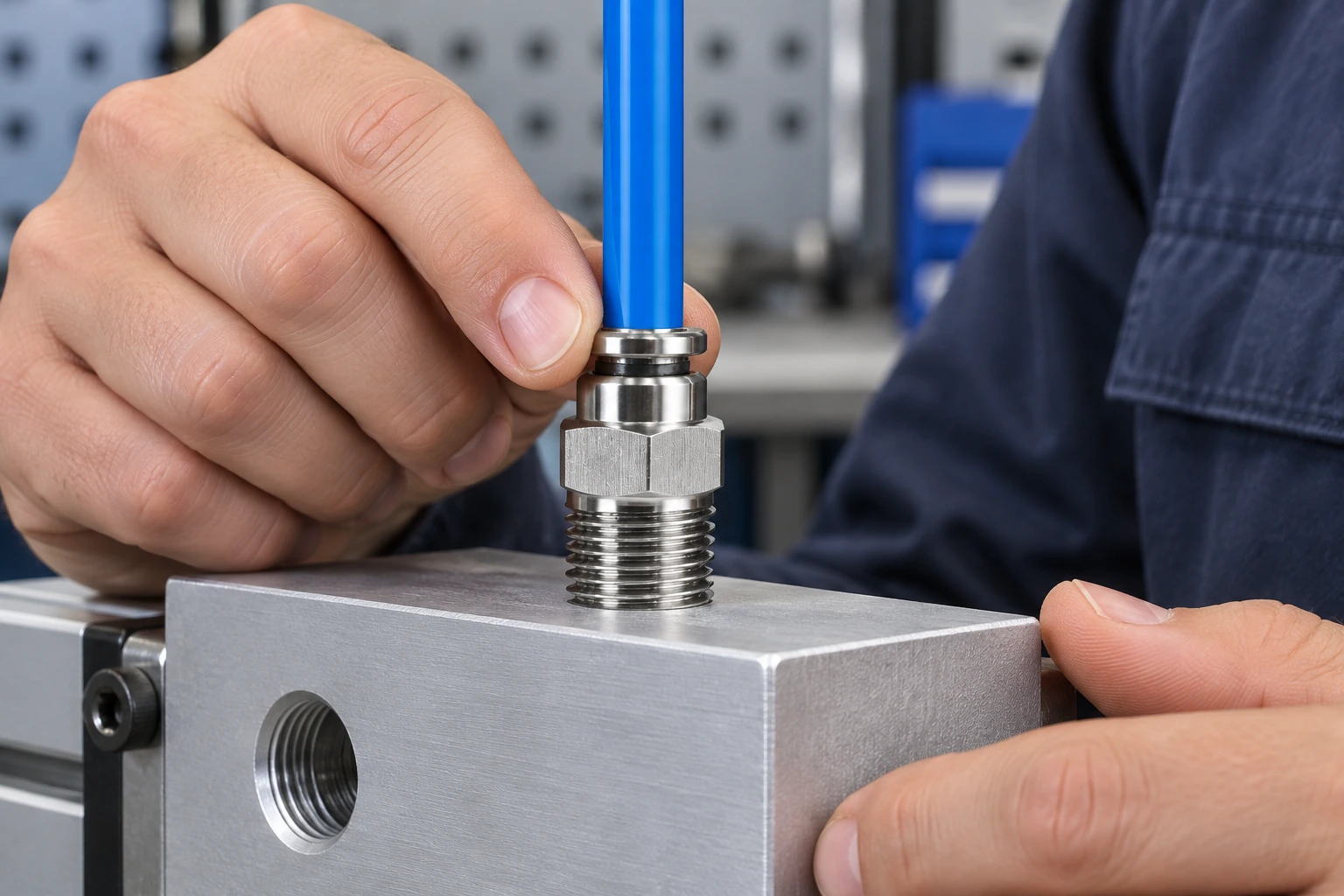
Vibration can expose a marginal installation as side-load and bending act near the collet. Contributors include incomplete insertion, an angled or damaged tube end, unsupported tubing, a bend too close to the fitting, or an unapproved tube pairing. A locking clip does not correct wrong sizing or poor routing.
During shutdown, follow the site’s isolation procedure and fully depressurize. Release the tube as instructed; inspect the collet for uneven movement or damaged grip features and examine the accessible seal area without scratching it. Reinsert a sound, square-cut tube to documented depth, perform any specified pull check, restore pressure in a controlled manner and complete the approved leak check.
Replace rather than improvise when the collet sticks, the release ring is cracked, the seal is cut or displaced, leakage returns after correct preparation, or the body or threads are damaged. Substitute an O-ring only when the manufacturer supplies an identified service part and procedure.
Use Pneumatic Standards to Verify the Assembly
ISO 4414 addresses general rules and safety requirements for pneumatic fluid-power systems and components. ISO 6358-1 supplies a test method for flow-rate characteristics. ISO 228-1 and ISO 7-1 distinguish two BSP-related thread standards with different pressure-tightness concepts, while ASME B1.20.1 covers general-purpose inch pipe threads commonly associated with NPT. These documents define scopes, interfaces or methods; citing one is not proof that a product is certified or suitable for a particular machine.
Procurement should state the applicable standard and edition, tube OD and series, thread designation, sealing method, duty, medium, environment and flow evidence. Confirm local safety rules and machine instructions. Similar labels do not prove interchangeability.
Use This Five-Step Routine for Pneumatic Fitting Replacement
- Freeze the interface data. Record tube OD, metric or inch series, port thread, installation envelope and machine tag before removing the old fitting.
- Define the duty. Capture operating pressure and temperature range, medium, flow demand, vibration, cleaning agents and external exposure without rounding beyond the source data.
- Compare documented options. 검토 PCF straight connector page, a PC-type male-thread fitting page, or the PU fitting for air hose page only as starting points; request the current datasheet for the exact variant.
- Plan the installation. Specify tube cutting, insertion, thread sealing, tightening and support methods from the applicable instructions.
- Make the repair traceable. Record the installed part, verification results and next inspection point so the next technician does not have to reverse-engineer the choice.
Frequently Asked Questions About Pneumatic Fitting Selection
What causes a tube to release from the Pneumatic Fittings under vibration
Likely causes include the wrong tube OD or material, incomplete insertion, a damaged or angled tube end, worn gripping parts, and unsupported routing that transfers repeated side-load to the collet. Depressurize the system, verify the approved tube–fitting pairing, inspect both components and correct the routing before restart.
Is plastic, brass or stainless steel better for the Pneumatic Fittings application
No material is universally better. Select from documented pressure, temperature, medium, corrosion, cleaning, weight and mechanical requirements, then verify the precise body material and seal compound offered for the exact part.
How do you check flow direction and airflow loss through the Pneumatic Fittings
Check the schematic, body arrow or symbol and datasheet to establish whether the component is directional. Compare manufacturer flow data under stated conditions, or measure upstream and downstream pressure at a repeatable operating demand; a static, no-flow reading cannot show working pressure loss.
What signs show that the collet or O-ring in the Pneumatic Fittings needs replacement
Uneven or sticking collet movement, damaged gripping features, a cut or displaced accessible seal, recurring leakage after correct tube preparation, or unreliable tube retention are warning signs. Replace the complete fitting unless the manufacturer provides an identified service part and an approved replacement procedure.
How do you match tube outside diameter to the Pneumatic Fittings
Read the tube marking, measure the actual OD, distinguish metric from inch series and match the result to the fitting’s specified tube size and allowable tube type. Do not use inside diameter, approximate conversion or insertion feel as proof of compatibility.
How can you tell whether a Pneumatic Fittings uses BSP, BSPT or NPT threads?
Check the part drawing or marking first, then verify diameter, pitch and taper with suitable gauges. BSPP follows a parallel-thread concept under ISO 228-1, BSPT is associated with the pressure-tight thread system in ISO 7-1, and NPT is specified under ASME B1.20.1; similar appearance does not make them interchangeable.
What to Record Before Approving a Pneumatic Fitting
A maintenance replacement is ready for approval only after the tube OD and series, port thread, sealing method, operating envelope, flow requirement and inspection access are written down. Material selection follows those interface and duty checks; it does not replace them. The fiber-connector procurement checklist offers a useful parallel for evidence control, while the solutions overview helps place a pneumatic fitting request in its wider equipment context. If the drawing, thread or seal information is missing, pause the substitution rather than forcing a near match.
참고문헌
- ISO 4414:2010, Pneumatic fluid power — General rules and safety requirements for systems and their components.
- ISO 6358-1:2013, Pneumatic fluid power — Determination of flow-rate characteristics of components using compressible fluids — Part 1.
- ISO 228-1:2000, Pipe threads where pressure-tight joints are not made on the threads — Part 1.
- ISO 7-1:1994, Pipe threads where pressure-tight joints are made on the threads — Part 1.
- ASME standards catalog search for B1.20.1, Pipe Threads, General Purpose, Inch.
Before approving a replacement, write down the tube OD and series, thread standard, sealing method, operating conditions, flow requirement and inspection access. Material choice comes after those interface checks, and a near match is not a safe substitute when the thread or seal is uncertain. A fitting selected from a complete part description is easier to install, inspect and replace than one chosen from appearance alone.


