Fiber-optic and copper cabling are two ways to carry network traffic, and both are physical cables. The useful comparison is between optical transmission and a specified metallic medium, such as twisted-pair copper or coaxial cable. They should be compared for the actual interfaces, distance, environment and endpoint requirements rather than treated as two universal performance categories.
What changes when information travels as light instead of an electrical signal?
Optical fiber carries information as light through a glass fiber. Copper links use electrical signals in conductors. This difference affects the interfaces at each end, the installation method and the tests needed at handover. Capacity and reach depend on the complete link design, including the cable and active equipment; a material name alone does not specify either result.

Electromagnetic interference is an important selection factor. The optical transmission medium is not affected by electromagnetic interference in the way a metallic signal path can be, but the network still contains powered electronics and site-specific installation requirements. Review the full arrangement instead of treating a fiber cable as proof that every connected device is protected from all electrical or operational problems.
Fiber does not carry electrical power to a remote device through the glass itself. Where cameras, access points or similar endpoints need power, the design must include a suitable power arrangement. Copper Ethernet with supported PoE equipment can combine data and power in applicable installations, so endpoint power belongs in the comparison from the beginning.
Neither transmission medium removes the need for network security, access control or maintenance. Likewise, environmental performance should be assessed from evidence about the actual equipment, power consumption, materials and service life rather than inferred from the absence of an electrical signal in glass. The following sections compare the practical decisions that determine which link is appropriate.
How do fiber and copper differ in data transmission and endpoint power?
Search-intent update: the useful comparison is not whether fiber is always “faster,” but which medium satisfies reach, capacity, electromagnetic environment, power delivery, pathway and maintenance requirements. Fiber-optic transmission carries light and is immune to electromagnetic interference in the cable itself. Copper data cabling can provide short-reach connectivity and electrical power through technologies such as PoE, which fiber does not provide without separate conductors or powered endpoints.
| 決定要因 | Fiber is often investigated when | Copper is often investigated when |
|---|---|---|
| Reach and upgrade headroom | The route is long or future optical capacity is important | The run is short and the installed equipment uses copper interfaces |
| Electromagnetic environment | EMI, ground-potential differences or lightning-path isolation matters | The environment and grounding design support copper cabling |
| Endpoint power | Power can be supplied separately | A single data-and-power link is valuable |
| Installation and repair | Splicing, cleaning and optical testing resources are available | Field termination and familiar copper test tools are preferred |
Why are data centers and broadband networks investing in optical links?
CableLabs’ OFC 2026 review reports that optical technologies are becoming central to both AI infrastructure and broadband networks, highlighting optical circuit switching, coherent optics and new uses of deployed fiber. This supports the direction of travel, but it does not mean every short cable should be replaced. Link-level latency and energy also depend on transceivers, switches, protocol processing and utilization-not only the propagation medium.
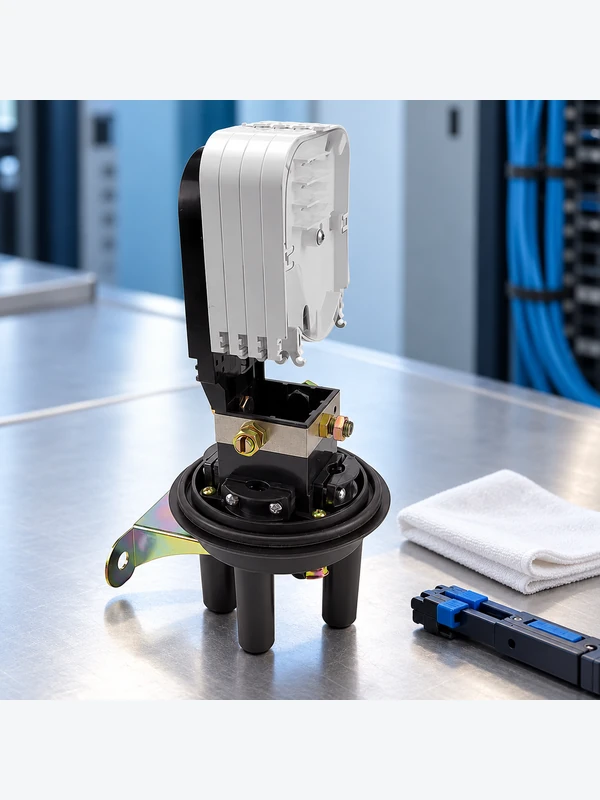
For access networks, the site’s FTTH guide, air-blown fiber guide そして HDPE microduct pathway show why transmission media and physical route design must be planned together.
When do reach, equipment and pathway costs justify fiber?
Fiber optic transmission is often investigated for long or interference-prone routes, while copper transmission can remain practical for short links with existing plant or power needs. The useful comparison is the complete link: distance, interfaces, pathway, power, environment, test plan and upgrade horizon.
| Decision field | What to document |
|---|---|
| Capacity and distance | Bandwidth, latency, route length, topology and expected upgrades. |
| 環境 | EMI, temperature, moisture, mechanical exposure and access. |
| ライフサイクル | Active equipment, power, connectors, tests, repairs and future expansion. |
For ducted fiber, include the site’s マイクロダクトコネクタ and pathway test method in the design. A medium choice that ignores installation and maintenance is not a complete cost comparison.
Fiber is not automatically the better answer for every link. It is often investigated for longer reach, higher capacity, electromagnetic isolation and future optical upgrades. Copper may remain attractive for short runs, familiar termination and endpoint power through PoE. Eaton’s public comparison highlights bandwidth, distance and interference advantages for fiber, while the practical decision still includes transceivers, switches, power, pathway, testing and maintenance.
| 決定要因 | Fiber often fits when… | Copper often fits when… |
|---|---|---|
| Reach and capacity | Distance or upgrade headroom dominates | The run is short and the equipment is copper-native |
| EMI and grounding | Electrical isolation reduces risk | Grounding and the environment are controlled |
| Power | Separate power is available | PoE simplifies endpoint installation |
| メンテナンス | Optical cleaning and test capability exists | Field teams are equipped for copper termination and test |
Compare the complete link, not the cable alone. Fiber needs compatible transceivers, patching, cleaning and optical-loss testing; copper needs category, length, shielding, grounding and a valid certification test. Neither medium is immune to installation error. For an access route, pair the transmission decision with the FTTx planning discussion and the handover checklist.
How should the comparison be turned into an installation plan?
Begin with a link schedule that names both endpoints, the service requirement, the route and any power requirement at the remote device. Compare complete options for that schedule. A fibre option includes its optical interfaces, cable pathway and endpoint power arrangements; a copper option includes the corresponding interfaces, cable and permitted installation conditions. Quoting only the cost of cable leaves out decisions that can change the practical choice.
For a fiber-versus-copper installation plan, separate the requirements that are mandatory from those that are preferences. Reach, the supported interface and the site’s electrical or environmental constraints may eliminate an option before price is compared. Where both options remain viable, compare installation access, testing resources, repair arrangements and future additions under the same assumptions. Avoid assigning an upgrade advantage to an option without checking the existing pathway and equipment.
Next, identify what the installer will hand over. Record endpoint and cable identifiers, the actual interfaces, pathway changes and the specified test results. Keep data-link testing separate from proof that a remote device has the required power arrangement. A functioning connection at handover is useful evidence, but it does not establish every future speed or equipment configuration.
Finally, document why the selected medium fits this link. That explanation should refer to the route, service and maintenance requirements rather than a universal claim that one medium is always superior. If the endpoints or service change later, the recorded assumptions show which parts of the decision need to be reviewed.
よくある質問
Is fiber always faster?
Performance depends on the interfaces and system design. Fiber is often chosen for distance and capacity, but compare the complete equipment set.
When can copper remain sensible?
Short, controlled links with existing infrastructure or a need for power delivery may still favour copper.
What should be tested after installation?
Use the project-approved continuity, loss, connector, splice and documentation checks for the chosen system.
Is fiber always lower latency than copper?
Not automatically. Medium, distance, transceivers, switching and processing all contribute to end-to-end latency, so compare the complete link design.
Why is fiber preferred in high-EMI environments?
The optical signal is not carried as electrical current in the fiber, so the cable is immune to electromagnetic interference; endpoint and power designs still require review.
Can fiber deliver power to cameras or access points?
Standard optical fiber does not provide PoE. The endpoint needs separate power or a purpose-designed composite cable and compliant power system.
What should a buyer compare besides bandwidth?
Compare reach, connector type, transceiver cost, pathway, power, EMI, redundancy, testing, repair skills and lifecycle upgrade plans.
How should an organization choose between fiber and copper?
Classify each link by distance, capacity, environment and endpoint needs, then apply the relevant cabling standard and equipment specifications.
参考文献
These sources support the 2026 optical-network context and the microduct pathway discussion. Product pages are manufacturer-specific references and should not be read as market-wide performance proof.
- CableLabs. OFC 2026: Broadband Trends. Industry research and standards-organization perspective.
- International Telecommunication Union. ITU-T L.108: Optical fibre cable elements for microduct blowing-installation application. Official ITU publication.
- ANMASPC. Telecom HDPE Microduct for Fiber-Optic Cable Laying. Manufacturer product reference.
- IEC 60794-5-10:2014 – official outdoor microduct cable publication.
- IEC 60794-5-20:2014 – official microduct cabling publication.
- ITU-T L.108 (08/2026) – official recommendation for blowing-cable characteristics and tests.
- Eaton fiber-versus-copper advantages overview
- Fiber Optic Center comparison of fiber and copper
Summary
Fiber and copper should be compared at link and lifecycle level. Distance, interference, interfaces, power, pathway work and maintenance can change the answer. Fiber is often a strong fit for longer or upgrade-sensitive routes, while copper can remain practical for short, established links. Define the route, components and acceptance tests before purchase so the technology choice can be reviewed by both designers and installers.