
設置中に回しにくくなったステンレス製継手は、ねじ山の噛み合わせ不良、汚染、または焼き付きの初期段階にある可能性があります。長めのレンチを使用すると、本来なら修復可能な組み立て上の問題が、ねじ山の損傷や保守不能な接続へと悪化するおそれがあります。また、漏れの原因がねじ継手ではなくチューブソケットにある場合もあり、過度に締め付けると本来の不具合を見逃してしまうことがあります。信頼性の高い設置には、ねじの互換性、想定されるシール方法、工具の位置決め、およびチューブの準備を個別に管理する必要があります。本ガイドでは、これらの確認項目を解説し、組み立てを中止すべきタイミングを示すとともに、万能のトルク値を設定したり、ステンレス鋼を腐食から無縁であるかのように扱うことなく、接続の健全性を検証する方法を説明します。.
インストール ステンレス製空気圧継手 正確なチューブ接続部、嵌合ねじおよび使用条件を確認した後でのみ行ってください。清掃済みで損傷のないねじ山を点検し、認証済みの嵌合相手を手で締め始め、指定されたシール材または面密閉を使用し、所定のレンチ掛け面を用いて、メーカーが示す指示どおりに規定の締め付けトルクで締めます。異常な抵抗を感じた場合は直ちに停止してください。ガリの発生を防ぐには、単に締め付け力を増すのではなく、摩擦および接触条件を適切に制御することが重要です。認証済みの配管を別途準備して完全に挿入し、側方荷重から保護したうえで、安全に圧力が復帰した後に、制御された漏れ試験および機能試験を実施してください。.
なぜステンレス鋼のねじは組み立て時に焼き付きを起こすことがあるのでしょうか?
ねじの焼き付き 金属表面が荷重下で滑動する際に生じる可能性のある接着損傷です。ASSDAの 技術に関するFAQ 5 摩擦によって保護酸化膜が破壊され、局所的な金属接触や冷間溶接が生じることがあります。汚れ、バリ、不適切な嵌合、過度の接触応力は組み立てを複雑にします。ガルディングは、不適切なシール構成を選択したことによる漏れとは異なります。.
ASSDAの文書は、ステンレス製締結部品全般について取り扱っています。同文書に記載されているボルトの締め付けトルク表は、空気圧工具による取り付け時の値ではありません。清浄な嵌合面、適切な潤滑、制御された締め付け力に関する基本的な教訓はそのまま適用できますが、実際の継手やポート、表面の状態に応じたトルクまたは回転数の指示は別途入手してください。シーラントの使用によって摩擦係数が変化するため、乾燥状態での組み立てを想定した指示を、潤滑済みの組み立てにそのまま適用することはできません。.
304部品と316部品を併用しても、必ずしも対策となるわけではありません。ASSDAは、両者の硬度差だけではガリの発生を防ぐのに十分でない可能性があると明確に指摘しています。圧力境界の設計、流体の種類および清浄度に関する要件を確認せずに、材料の代替や作業現場でのアンチセize剤の使用を行わないでください。.
最初のねじが噛み合う前に、何を確認する必要がありますか?
標準、サイズ、ピッチ、テーパーを含む、完全なオスねじおよびメスねじの指定を特定してください。ポート仕様とチューブ外径を区別してください。シールがテーパーねじ、ワッシャー、Oリング、ガスケット、または規定のシートで行われるかどうかを確認してください。「ステンレス 1/4 インチ」だけでは、接続部品の購入や組み立てに必要な情報が十分ではありません。.
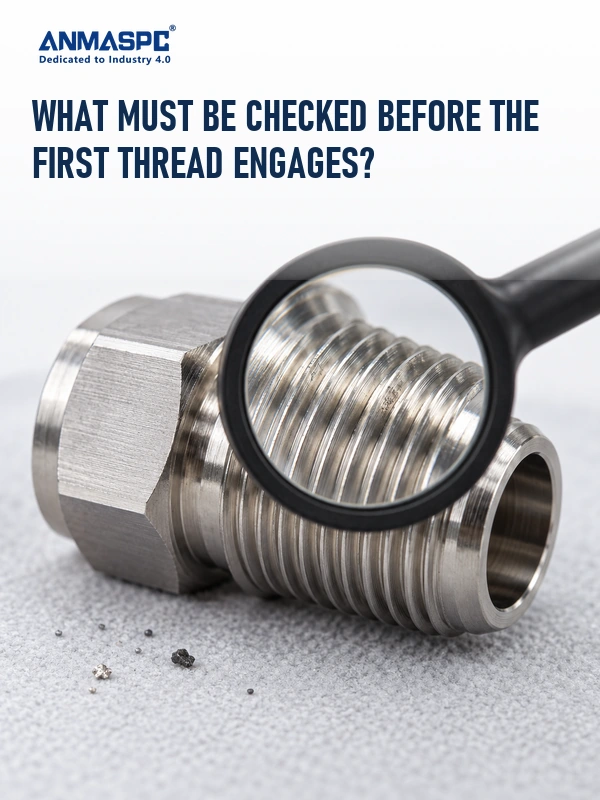
損傷、バリ、汚染、および過去の焼き付きの痕跡がないか点検してください。準備中は、チューブやポートの開口部に異物が混入しないよう保護してください。製造元の設計が許す場合、正しく位置合わせされたペアを手で締め始めます。予期せず固く締まってしまう場合は、直ちに作業を停止し、安全な手順に従って取り外して原因を特定してください。締め付け力をねじのゲージとして使用しないでください。現場の スレッド適合ガイド インターフェースの識別とシールの選定を分離するのに役立ちます。.
| 事前インストール項目 | 必要な証拠 | 停止する理由 |
|---|---|---|
| スレッドペア | 標準および承認済みの嵌合指定の照合 | Uncertain profile, crossed start or damaged thread |
| Seal arrangement | Drawing and approved sealing instruction | Missing seat, incompatible sealant or damaged face |
| Tool access | Identified wrench flats and clearance | Tool would load a release ring or swivel body |
| チューブインターフェース | Approved OD, tolerance, material and insertion depth | Scored, oval or unsuitable tubing |
Which sealant and tightening method should be used?
Follow the exact connector and port instructions. A pre-sealed fitting may have limits on adjustment and reuse. A face-sealed parallel thread may need a specified gasket rather than tape on the thread. A tapered joint may use an approved coating or compound applied so fragments cannot enter the pneumatic passage. Excess material can contaminate downstream valves and instruments.
Controlled tightening means using the instruction for the named combination of thread, material and surface condition. For example, the SMC KQG2 catalogue gives different tightening ranges for different NPT/R sizes in that series. That demonstrates why one workshop number is inadequate. Those values must not be used as Oulu specifications or applied to an unrelated thread. If the supplier has not provided an installation limit, obtain it before standardizing assembly.
Apply the tool to the intended hexagon and support the mating component as instructed. Do not grip the release button, distort the cylindrical body or transmit torque through an unsupported tube. SMC’s KQG2 precautions also distinguish a joint that may be positioned after connection from a rotary joint designed for continuous movement. Similar-looking elbows are not automatically swivels for dynamic service.
How should the tube be inserted without creating another leak?
Identify the tube OD and approved material, then cut a clean square end. Remove debris without scratching the sealing surface. Follow the connector’s insertion depth and retention-check method. A tube that passes the gripping feature but does not reach the required seat may feel secure while still leaking. A softened or enlarged used tube may no longer match the original interface.
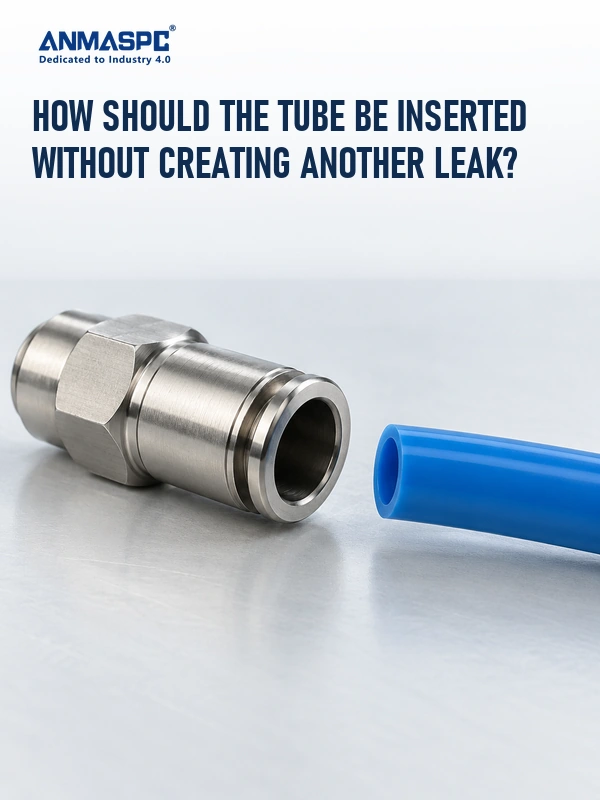
SMC’s KQG2 specific precautions warn that soft polyurethane can fold during insertion in its grease-free construction. They also advise replacing tubing whose OD has enlarged after high-temperature or extended use. These observations support inspection of the tube, but they do not justify lubricating a fitting against its instructions. The 空気圧コネクタの取り付けガイド gives related preparation and routing checks.
Provide a suitable straight approach and independent tube support. Do not use the connector as a structural anchor for hose weight or actuator motion. Check tool and tube-release clearance before closing the cabinet or panel. If a connection cannot be accessed for inspection, redesign the layout rather than relying on a difficult blind assembly.
Does choosing 316 make a fitting suitable for washdown or chemicals?
No body grade establishes the suitability of the complete assembly. Identify the external cleaner as well as the internal medium, concentration, temperature, dwell time and rinse conditions. Check seals, tube, retaining parts and thread treatment against the operating envelope. ASSDA’s general corrosion guidance explains why contaminants, crevices and chemical conditions change stainless performance.
Grade 316 may merit consideration where chloride exposure challenges 304, but it is not immune to pitting or every cleaning chemical. A visual surface finish cannot establish hygienic certification or food-contact approval. Specify the exact material and required documentation for the selected model. Do not claim a stainless pneumatic fitting is suitable for direct food contact merely because it will be installed near a washdown line.
| Assembly condition | 何を検証すべきか | Unsupported shortcut |
|---|---|---|
| Dry compressed air | Complete pressure-temperature range and tube approval | Body strength sets every component’s limit |
| Water or cleaning exposure | 本体、シールおよびチューブの適合性 | 316 means universally corrosion-proof |
| Clean process area | Cleanliness and contact-zone restrictions | Metal appearance proves food suitability |
| Repeated service removal | Reuse limits, seal replacement and thread condition | More sealant restores every used joint |
What should the installation test and handover include?
Use the machine’s energy-control procedure before assembly or any remedial work. After the connection is complete and access is safe, restore pressure in a controlled way within the approved operating range. Use an application-compatible leak-detection method and inspect the relevant joints. Do not overtighten a pressurized joint in an attempt to stop bubbles.
Check representative temperature and motion conditions, not just a brief stationary test. A pressure-decay result may include other connected volumes and temperature effects; interpret it under an agreed procedure. If there is low flow without a local leak, investigate tubing ID, fitting passage and other restrictions. Repeating the leak test does not diagnose a flow bottleneck.
Record the component code, installation instruction revision, seal arrangement and accepted test condition. Oulu’s メスねじストレートプッシュフィット継手 illustrates why both ends need specification: the tube socket and mating male thread must be identified separately. Request the current drawing and operating limits for the quoted variant. Include the approved combination in the site’s pneumatic maintenance schedule so later repairs preserve the installation method.
よくある質問
Why choose stainless steel pneumatic fittings instead of plated fittings?
Consider stainless when the documented exposure and maintenance requirements justify it. Compare the entire assembly, including seals and tubing, rather than assuming body material alone determines durability. Plating condition and cleaner compatibility also need evaluation.
How do you match tube OD and thread type to stainless steel pneumatic fittings?
Identify tube OD, units, material and tolerance separately from the equipment thread. Confirm the complete thread designation and seal location from the drawings. Similar outside dimensions do not establish an approved mating pair.
腐食性環境や洗浄エリアには、どのステンレス鋼種が適していますか?
Select from the actual chemical, concentration, temperature and exposure pattern. Grade 316 is worth evaluating for some chloride conditions, but neither 304 nor 316 is universally suitable. Obtain confirmation for the complete fitting and its cleaning conditions.
ステンレス製の空気圧継手を取り付ける際、焼き付きを防ぐにはどうすればよいですか?
Use clean undamaged matching threads, correct alignment, an approved sealing or lubrication method and controlled tightening at the designated flats. Stop if resistance is abnormal. Do not apply generic bolt torque values or unapproved anti-seize.
What pressure and temperature rating should the fitting have?
Its permitted range must cover the actual medium, local temperature and maximum pressure including transients, together with the tube and port. Use the exact model’s current data. Proof and burst pressures are not continuous operating limits.
Can stainless steel pneumatic fittings be used with compressed air, water and chemicals?
Only when the manufacturer approves the exact model and materials for those conditions. Evaluate body, seals, tubing and thread treatment together. A stainless body and a chemical-resistance chart do not establish complete product performance.
参考文献
- ASSDA: Technical FAQ 5, Galling and its Control — mechanism and friction/assembly controls; fastener torque tables are not fitting ratings.
- SMC: KQG2 catalogue and specific product precautions — series-specific tightening, tube insertion, mechanical-load and fluid limitations.
- ASSDA: Technical FAQ 8, General Corrosion Resistance — chemical and environmental limits.
要約
Installing a stainless pneumatic fitting correctly means controlling two different interfaces. Match and inspect the threaded port, use its approved sealing method and tightening instruction, and stop when resistance suggests damage or galling. Prepare the approved tubing separately and remove side load before testing. Stainless steel can address a material requirement, but it cannot correct an incompatible seal, unsuitable tube or wrong port. Keep the selected model, assembly instruction and test conditions with the maintenance record so future replacements follow the same method. Oulu can review a fitting enquiry against the supplied tube and port details; the decision should remain tied to the exact component and operating conditions rather than a generic stainless description.



