
A プラスチック製ダクトカップラー 定められたルート環境に応じて選定すべきであり、単に屋外用とされるだけでは不十分です。屋内設置のキャビネット、湿潤なアクセスチャンバー、地中埋設の接続部では、それぞれ異なる環境条件にさらされます。適切なコネクタには、実際の設置場所における寸法互換性、防水・防塵性能、保持力および保護機能が文書で証明されている必要があります。.
ダクトおよびケーブルの経路から始め、次に水、日光、温度、機械的条件を確認してください。該当製品および必要な付属品に関する具体的な証拠をご提示ください。黒色であることや本体が厚みのある外観であること、あるいは製品名に「地下」を含むだけでは、適合性は保証されません。.
プラスチック製ダクト継手は、機器室に設置されますか、それとも直接埋設されますか?
継ぎ目が太陽光にさらされているか、筐体内で保護されているか、チャンバー内に設置されているか、または直接地中に埋設されているかを記録してください。想定される保守点検のアクセス経路や、滞水の可能性も含めて記載してください。輸送中、保管時、および設置時の環境条件は、最終的な稼働場所とは異なる場合があります。.
チャンバーは、後続のネットワーク作業中に水にさらされたり取り扱われたりする状況下で、コネクタを直射日光から保護することがあります。地上設置型キャビネットは、直接的な降雨への曝露を軽減できますが、それでも温度変化や配線の混雑が生じる可能性があります。直接埋設には、それ自体固有の機械的要件および施工上の要件が伴います。これらの条件は、購入依頼書において個別に記載する必要があります。.
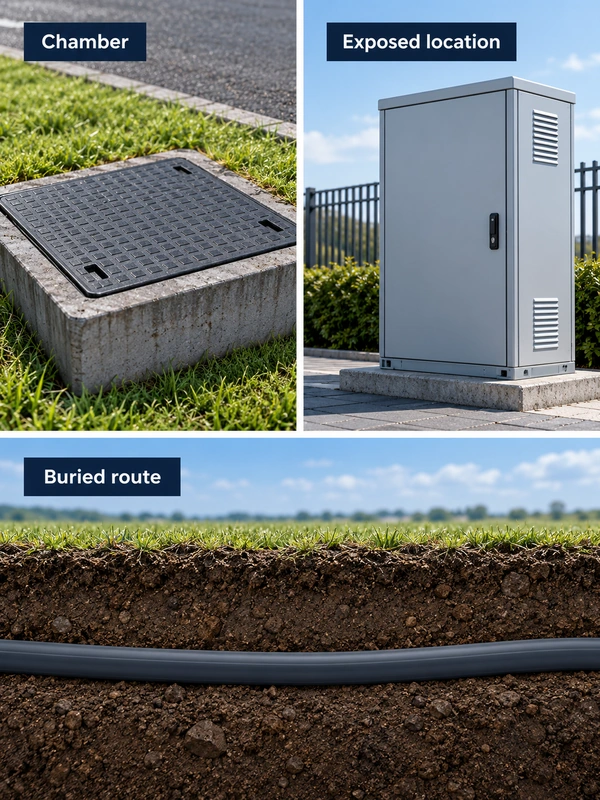
| 場所 | 調査すべき質問 | リクエスト用ドキュメント |
|---|---|---|
| 保護されたキャビネット | 温度、結露および保守点検用アクセス | 動作限界および設置クリアランス |
| アクセスチャンバー | 水への曝露、経路のサポート、および繰り返しの取り扱い | シーリング条件と保護構成 |
| 露出設置 | 日差し、気象条件および温度変動 | モデル固有の曝露証拠 |
| 直接埋設 | 土壌接触、設置荷重および必要な保護 | Approval for the complete buried assembly |
Do not assume that protection against one exposure answers another. A water-related rating does not automatically establish UV resistance, and a UV claim does not demonstrate resistance to installation loads. Make each requirement traceable to the part and configuration actually being supplied.
Which duct dimensions must match the plastic coupler?
Record the outside diameter, inside diameter, material and approved tolerance of each duct end. A straight coupler normally serves equal compatible interfaces; a reducer needs two separate size descriptions. Check the internal passage where cable clearance or a transition is relevant.
For an upgrade, measure and identify the existing duct rather than relying only on an old drawing. Deformation, damage or undocumented substitutions can make a nominal size misleading. Use sound material for measurement, and verify the duct construction against the connector manufacturer’s approval.
ザ direct-buried microduct connector guide provides related selection context, but the exact model still needs to be matched to the actual route. A component advertised for burial is not automatically compatible with every duct that can be pushed into its entry.
What evidence confirms a duct coupler’s water, UV and load resistance?
Environmental suitability requires more than a list of attractive material properties. Request information covering water exposure, temperature, sunlight where relevant and mechanical conditions. Ask how the tests relate to the connector size, duct material and accessories in the quotation.
Hexatronic’s MPB30601+ documentation is a useful example of configuration-specific requirements: its direct-buried use involves an external cover. That does not make the cover optional, and it does not qualify another manufacturer’s uncovered connector. The complete tested or approved assembly matters.
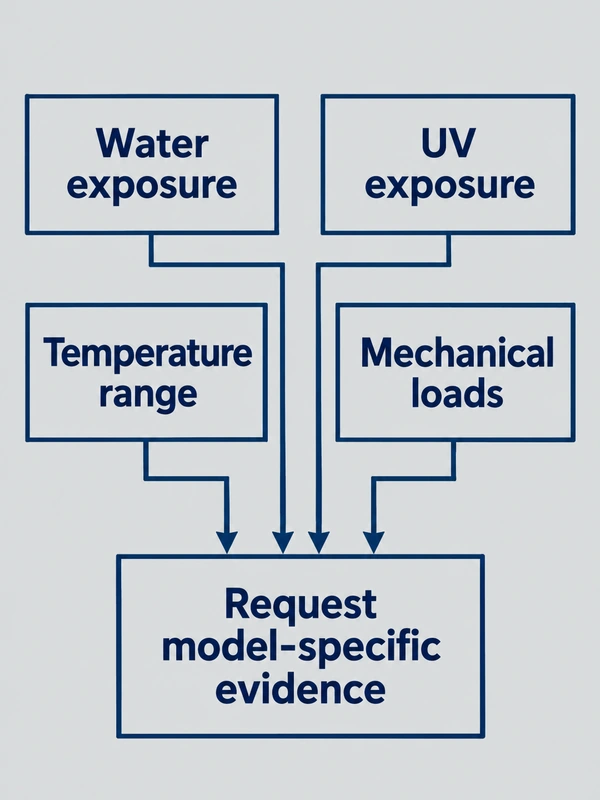
When a supplier cites a standard, ask for the applicable scope and report. A standard number alone does not demonstrate independent certification, coverage of every size or equivalence to another product. Record the document revision so purchasing and installation teams are using the same information.
| Claim in a listing | Useful follow-up question | Insufficient substitute |
|---|---|---|
| Water resistant | Under what conditions and for which assembly? | A photograph of the part near water |
| UV resistant | What evidence covers this material and variant? | Black body colour alone |
| 直接埋設 | Are a cover or other protective measures required? | The words underground in a title |
| Pressure rated | Working, proof, burst or sealing pressure? | An unexplained maximum number |
| Tested to a standard | Which model, method, conditions and results? | A standard number without supporting scope |
Where evidence is missing, request it before approving the part. Do not fill gaps by borrowing ratings from a visually similar connector. Product-specific data is especially important when a family includes several body materials, sizes or protective configurations.
Does the route need a duct coupler, a cable seal or both?
A coupler joining the outside surfaces of two ducts can leave the space around the cable open. If the route requires control of gas or water migration along that space, specify a separate sealing function. Emtelle describes its gas-block connector as sealing between connector, tube and fibre cable.
Its gas-block datasheet also separates tube dimensions from fibre-unit or cable ranges and distinguishes gas sealing from pressure information associated with fibre installation. These distinctions matter at building entries and other defined boundaries. They do not mean that every coupler needs a gas block or that a gas block replaces a building penetration seal.
Assess a suitable マイクロダクト用ガス遮断コネクタ when the route design calls for cable-annulus sealing. Confirm cable diameter, activation sequence, location and sealed-state conditions. Do not infer those properties from the outdoor rating of the adjacent straight coupler.
When does a microduct coupler need a protective cover and supports?
An external shell can be part of a connector’s approved protective arrangement, but it cannot correct a wrong duct diameter or damaged seal. Install the specified accessory and check that it closes correctly without trapping debris or pressing a release mechanism.
ザ microduct cover-shell troubleshooting guide discusses common protection and fit issues. Investigate the underlying joint before covering it. If a shell repeatedly opens or does not seat, confirm the model pairing and route loading instead of improvising a fastening method.
Support the duct to avoid continuous tension, sharp bending and unintended loads at the connector. Keep the final arrangement accessible where maintenance is expected. A well-protected body can still be undermined by a duct forced into a misaligned route or a collar pressed against nearby hardware.
Which connector checks should be completed before burial or enclosure?
Check component identity, duct dimensions, cut quality, outside sealing surfaces, insertion and retention according to the manufacturer’s instructions. Complete the route’s approved passage and leakage checks before handover. Keep them separate: a pressure-tight joint does not prove an unobstructed cable route.
Use the project-defined pressure, duration, temperature conditions and acceptance criteria within the limits of every component in the test assembly. Check temporary adapters and closures as well as installed joints. Isolate and release pressure before making adjustments; never use a catalogue burst figure as a routine operating instruction.
Record whether tests were completed before or after final placement. If subsequent handling, covering or burial can affect the joint, follow the project requirement for inspection or verification at that stage. A record should identify the final configuration, not just a successful bench assembly.
Can the existing duct coupler accommodate a future cable upgrade?
Network maintenance planning begins with an identifiable joint. Record location, connector variant, duct dimensions, accessories and acceptance results. Include cable details where a reducer or cable seal makes them relevant. Future crews should be able to determine what was installed without excavating solely to identify it.
For a hypothetical upgrade to a larger cable, an existing coupler might remain compatible with the duct outside diameter while the smaller route bore becomes limiting. A gas seal may also need replacement because of the new cable diameter. Review the whole route rather than approving the upgrade from the coupler’s external appearance.
Follow the manufacturer’s reuse and release policy during repairs. Inspect previously gripped duct surfaces and preserve enough length for a supported replacement. If cutting back creates tension, use an approved repair arrangement rather than stretching the remaining duct into the joint.
What to include when requesting an outdoor duct coupler quotation
A useful enquiry includes both duct dimensions, cable details, installation location, water and sunlight exposure, temperature requirements, operating conditions and required documentation. State whether the quote must include covers or other accessories. This prevents two suppliers from pricing different assemblies under the same coupler name.
よくある質問
Can a plastic duct coupler be used outdoors and underground?
Only when the exact variant and configuration are documented for the location. Distinguish exposed, chamber and direct-buried conditions. Required covers, supports and installation methods are part of the approval rather than optional extras.
What should be inspected on a plastic duct coupler before cable installation?
Check identification, dimensions, cut and surface condition, seating, retention, supports and protective accessories. Verify the approved passage and leak-test records. Investigate damage or uncertainty before cable installation rather than using the installation itself as a test.
How does a plastic duct coupler differ from a standard telecom coupler?
Plastic describes the body material, while standard telecom coupler is an imprecise category. Compare actual function, interfaces, bore, sealing, retention and environment. Two differently named products can serve the same role, while two similarly named ones can differ substantially.
How is a plastic duct coupler replaced during a network upgrade?
Plan access and isolation, follow the release instructions and inspect the remaining duct. Install a documented compatible replacement without route tension, reassess cable passage and any cable seal, then complete the specified acceptance checks and update the route record.
Which materials protect a coupler from moisture and UV?
Suitability depends on the exact formulation, seal system, configuration and exposure evidence. A broad resin name or black colour is insufficient. Request model-specific documentation rather than treating a material category as an unconditional performance guarantee.
Which installation errors can cause a plastic duct coupler to fail?
Wrong dimensions, damaged or dirty duct ends, incomplete insertion, unsupported loads, accidental release contact and missing required protection are all concerns to investigate. A site-specific examination is needed to identify the cause; appearance alone cannot establish it.
参考文献
- ヘキサトロニック、MPB30601+コネクタおよびエンドストップ: application, construction and external-cover conditions.
- Emtelle, Gas Block Connector: sealing around the fibre cable as a separate requirement.
- Emtelle, Gas Block Connectors, Issue 5: separate duct and fibre interfaces and sealing information.
要約
Select an outdoor duct coupler by the actual route: dimensions, cable passage, water, sunlight, temperature and mechanical exposure. Confirm the complete protective configuration and keep cable sealing separate from duct joining. Document installation and acceptance before access becomes difficult so future repairs begin with reliable information.
ザ black direct-buried microduct connector is a product to assess against those requirements. Request the exact size, current installation instructions and environmental evidence. Its intended application provides a starting point, while the project-specific confirmation determines whether it belongs in the route.



