
圧力試験のスケジュールは一見完璧に見えても、最も重要な疑問――どの接続部を試験しているのか――が依然として未解決のままです。ケーブル吹込用に準備された空のマイクロダクト、ダクトを保持するコネクタ、および既設ケーブル周囲の作動済みシールは、それぞれ異なる構成です。製品のキャッチコピーからそのまま引用した圧力をこれら3つすべてに適用すると、安全でない試験結果や、誤った内容を証明する受け入れ記録が生じる可能性があります。施工業者にとっては、こうした曖昧さが再訪問、引渡し時の証拠に関する紛争、不要な継手の交換を招く要因となり得ます。本ガイドでは、試験の目的を明確に定義し、評価区分を区別し、変化する計器値を適切に解釈し、ルート承認前に必要な文書を要求する方法について説明します。.
簡潔な答えは、テストすることです HDPEブロックマイクロダクトコネクタ その正確な組み立て方法、媒体、および密閉状態について、承認された手法にのみ従う場合に限ります。試験システム全体で適用される最も低い承認限度が優先されます;ブローイング評価は、自動的にケーブルの密閉性評価や耐圧試験の評価にはなりません。EN 50411-2-8:2009 は、設置済みのブローイング光ファイバーマイクロダクト用コネクタを対象としていますが、その規格範囲には一般的な現場試験圧力が含まれていません。運用開始前に、選定したコネクタの取扱説明書と評価証明書を入手し、受け入れるインターフェースを特定するとともに、責任機関に条件および合格基準を承認してもらってください。限度値が欠落している場合は、推測するのではなく、作業を停止する理由となります。.
圧力試験は、実際に何を証明すべきでしょうか?
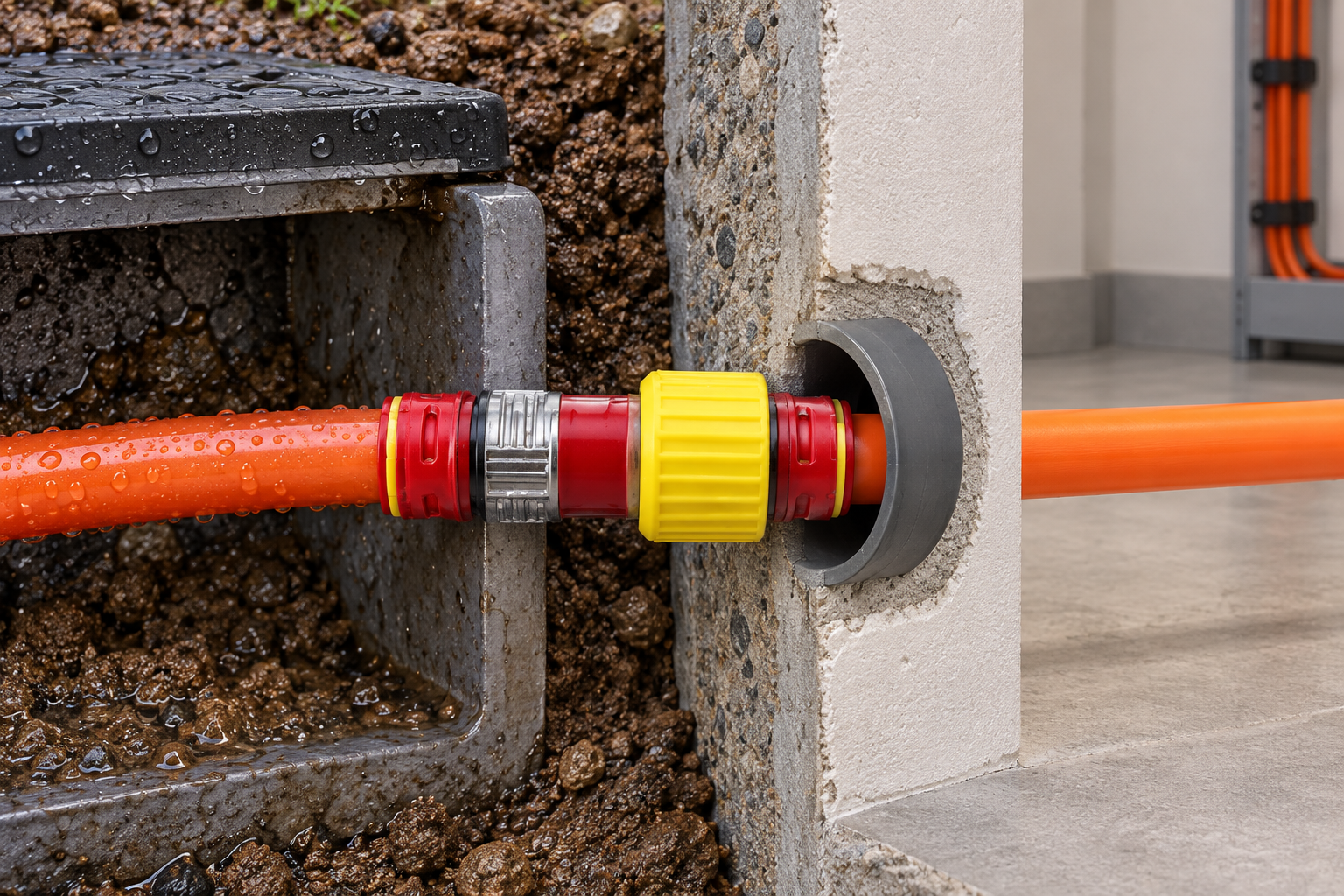
機器を選定する前に、受け入れ基準を明確に定義してください。ダクトとコネクタの間のシールは、配管接続部における経路を遮断します;ケーブルが通っているアンニュラス用のシールは、ケーブル周囲の空間を密閉します。空のダクトに対する試験では、後者を確認することはできません。同様に、コネクタの試験だけでは、個別の壁貫通部が建築物の進入要件を満たしていることを証明することはできません。.
EN 50411-2-8:2009 [1] のNEN要約には、ダクトの接続、送風設備へのアクセス、ファイバー周辺のシーリング、および開放されたダクトの閉鎖が含まれています。また、保護された設置済みコネクタに関する初期要件を記述しており、直射日光にさらされる用途向けのコネクタは対象外としています。この範囲は部品の機能を特定するものですが、モデル認証や試験結果の証明ではありません。.
| 受け入れに関する質問 | 識別するための設定 | 証拠が必要 | それが確立しないもの |
|---|---|---|---|
| そのルートはケーブル吹き込みに対応していますか? | 承認済みの吹き出し状態 | 適用可能な設置制限および方法 | ケーブルシールの作動圧力耐性 |
| ダクト接続は要件を満たしていますか? | 正確なダクトおよびコネクタの組み立て | 指定された媒体および受入基準 | 設置済みケーブルの周囲のシーリング |
| ケーブルの環状部は要件を満たしていますか? | シールが作動した互換性のあるケーブル | シール固有の定格および試験条件 | 建物全体のガスまたは火災防護 |
| この組立品は水の移動に関する要件を満たしていますか? | 定義済みのエクスポージャーとインターフェース | 適用可能な水質試験証拠 | 水の観測のみによる気密性 |
媒体と圧力のカテゴリはどのように選択すればよいですか?
要件が耐圧試験、使用時圧力、漏れ試験、耐証明試験、または破裂試験のいずれを対象とするかを明記してください。使用時圧力は許容される運転条件を示し、耐証明試験および破裂試験はそれぞれ異なる認証基準を満たすことを確認するものです。いずれも、その圧力を現場で日常的に適用することを許可するものではありません。ルート受入圧力はプロジェクト固有の要件であり、実際の試験構成に適用される限界値の範囲内に収めなければなりません。.
マイクロダクトコネクタの圧力試験 また、特定の媒体も必要です。空気に関する試験結果は、水の遮断性能や特定のガスに対する性能を自動的に保証するものではありません。要求される機能に関連する証拠、例えば使用条件や合格基準などを提示するよう求めましょう。媒体を変更すると、単に認証書の記載事項が変わるだけでなく、試験そのものが変わります。.
ダクト、コネクタ、ケーブルシール、閉塞部および試験装置を一括して点検してください。選択した媒体、温度および状態に対して、文書化された最低許容限界値を適用してください。部品の限界値が不明な場合、正当性を担保できるシステム限界値は存在しません。 connector size and pressure-rating guide supports selection, but cannot replace a code-specific approved test method.
What conditions belong in the test record?
A useful record connects a result to a reproducible configuration. Record the route section, component codes and lots, duct OD and ID, cable OD, seal range, assembly state and the documents used. Add the procedure revision, medium, instrument identification and calibration status. Record pressures, times and temperatures as required by the method, rather than supplying generic values.
The blank guide below is a documentation aid, not a test procedure. Complete it from approved instructions before testing. Do not turn an empty field into an assumed hold duration, pressure ramp, acceptable decay or temperature-correction formula.
| Record field | Project entry | Condition to resolve |
|---|---|---|
| Route, part codes and lots | ________ | Identify the actual supplied assembly |
| Duct/cable dimensions and seal state | ________ | Confirm fit and the interface being tested |
| Purpose, medium and rating sources | ________ | Separate blowing, service, seal and qualification duties |
| Approved procedure and acceptance criteria | ________ | Resolve pressure, timing and interpretation with the authority |
| Instrument and temperature observations | ________ | Provide traceable measurement context |
| Result, correction and retest approval | ________ | Link the decision to the recorded configuration |
Compressed-air testing involves stored energy. Equipment suitability, restraints, access controls and controlled depressurization belong in the authorized safety plan. This article does not prescribe how to pressurize a route. Do not release, adjust or troubleshoot a fitting under pressure; follow the approved isolation and release instructions.
Does a falling gauge prove that the connector leaks?
No. Temperature change and settling of the pressurized system can affect the reading, so pressure drift alone does not identify a leak. Conversely, an apparently stable gauge does not prove every interface satisfies its requirement. Interpret the observations using the approved method and its treatment of stabilization and temperature; do not invent a correction calculation or retrospectively change the acceptance threshold.
Investigate measurement conditions and assembly separately. FCST’s August 2025 installation guidance [2] notes that a tube can be gripped without being fully seated, causing leakage. It also discusses clean, round, undamaged ducts, square cuts, burr removal and appropriate locking clips. These are attributed maker examples, not universal dimensions or release instructions for every connector.
After safe isolation, have qualified personnel inspect the identified interface using the selected maker’s instructions. Document any incorrect fit, incomplete insertion, contamination or damage and the approved correction. Retesting must cover the required assembly condition; a local observation after repair should not be substituted for the specified acceptance test.
Which ratings and documents should the buyer request?
The current Oulu 防水エアガスブロック製品ページ illustrates why state matters: it lists 10 bar blowing pressure and cable sealing up to 0.3 bar. The connector is opened for blowing and the ring is rotated afterward to seal. These values concern different functions and interfaces. Neither authorizes testing the activated cable seal at the blowing pressure, and neither establishes a universal 16 bar field prescription.
Request confirmation for the exact code, cable range, supplied seal and assembly. For gas-block cable-seal verification, ask specifically for the occupied-annulus evidence, not merely a duct connection or empty-pathway result. The エンドストップとガスブロックの比較 explains the different closure duties.
IEC 60794-5:2014 [3] covers blowable microduct cabling more broadly; it is not a substitute connector qualification. IEC TR 63431:2025 [4] adds current guidance on microduct technology, including repairs, environmental expectations and installation. As a Technical Report, it supports planning rather than assigning a universal component pressure. Procurement should require the relevant evidence and revision, avoiding repeat testing caused by mismatched documents.
What do installers need to know before accepting the result?
How do you install an HDPE block microduct connector at a building entry point?
Follow the exact connector instructions for duct preparation, insertion, cable placement and seal activation. Confirm building-entry and wall-penetration requirements separately; a gas-block fitting is not automatically a certified firestop.
What pressure rating is suitable for an HDPE block microduct connector in an outside-plant network?
Select ratings matching the required duty, medium and environment. Confirm every component’s applicable limit; a blowing or proof value cannot replace the required cable-seal rating.
How can you test an HDPE block microduct connector for air, gas and water leakage?
Use approved medium-specific methods and acceptance criteria for the intended interfaces. Do not assume an air-decay result demonstrates water exclusion or suitability for a particular gas.
Can an HDPE block microduct connector be reopened for cable maintenance?
Only where the exact maker permits release and reuse. Follow its depressurization, inspection and reassembly instructions, then obtain the required retest evidence; no universal reuse-cycle allowance applies.
Which duct sizes and cable diameters are compatible with an HDPE block microduct connector?
Check the exact part’s duct dimensions and cable-seal range against the supplied duct and cable. Duct OD, ID or wall construction, and cable OD are separate checks.
What happens if the seal is tightened before cable blowing?
It creates a different assembly state from the specified open-for-blowing configuration. Stop and obtain the maker’s instructions for inspection and restoration rather than forcing the cable through.
Does an empty-duct test validate sealing around the cable?
No. It cannot establish performance of an occupied cable annulus that was absent from the test. Document and verify the final compatible cable-and-seal assembly separately.
Who should approve a test when supplier and project pressures differ?
The responsible project authority should reconcile the requirement with component evidence and supplier clarification. Do not raise pressure beyond an applicable limit or lower acceptance requirements without approval.
Which primary sources support these distinctions?
- NEN: EN 50411-2-8:2009 connector scope
- FCST: Installation Instruction For Microduct Connector, 2025-08-22
- IEC 60794-5:2014 microduct cabling specification
- IEC TR 63431:2025 microduct technology guidance
How can the team make a defensible acceptance decision?
A defensible pressure result starts with the right question, not the highest number on a brochure. First identify whether the route needs blowing verification, a duct seal check, occupied cable-annulus evidence or a defined water-migration assessment. Then confirm the exact geometry, assembly state, medium and applicable limits before approving the method. Finally, retain the conditions and observations that allow another reviewer to understand the result. Do not skip temperature interpretation, missing component evidence or the distinction between installation and sealing ratings merely to complete a handover. Oulu / ANMASPC’s マイクロダクトコネクタカタログ can support product selection; send the supplier the exact duct and cable details and request code-specific documentation before placing a pressure requirement in the purchase order.



