
Raspored ispitivanja pod pritiskom može izgledati potpun, a da pri tome ostavi neodgovorenim najvažnije pitanje: koju se međusobnu površinu testira? Prazna mikrocev pripremljena za puhanje kabela, spojnica koja drži cev i aktivirana brtva oko ugrađenog kabela predstavljaju različite konfiguracije. Primjenom istog pritiska preuzetog iz opisa proizvoda na sve tri mogućnosti može se doći do nesigurnog ispitivanja ili zapisnika o uspješnom ispitivanju koji dokazuje nešto što nije tačno. Za izvođače to nejasnoće mogu značiti ponovne posjete, sporna dokumenta o primopredaji i nepotrebnu zamjenu armatura. Ovaj vodič objašnjava kako definisati svrhu ispitivanja, razlikovati kategorije nosivosti, tumačiti promjene na manometru i zatražiti potrebnu dokumentaciju prije odobravanja trase.
Kratki odgovor je da se testira Konektor za mikrocevke od HDPE-a samo pod odobrenom metodom za njegovu točnu montažu, sredstvo i stanje zaptivanja. Najniža primjenjiva odobrena granica u cijelom ispitnom sistemu je presudna; ocjena otpornosti na puhanje nije automatski ocjena zaptivanja kabla ili ocjena probnog testa. EN 50411-2-8:2009 se bavi instaliranim konektorima za mikrocevi s puhanim vlaknima, ali njen katalogski opseg ne pruža univerzalni poljski testni pritisak. Prije puštanja u rad, nabavite uputstva i dokaze o ocjeni za odabrani konektor, identifikujte prihvaćenu međusobnu vezu i neka nadležno tijelo odobri uvjete i propusne kriterije. Nedostajuće granice su razlog za zaustavljanje, a ne razlog za nagađanje.
Šta zapravo treba da pokazuje ispitivanje pritiska?
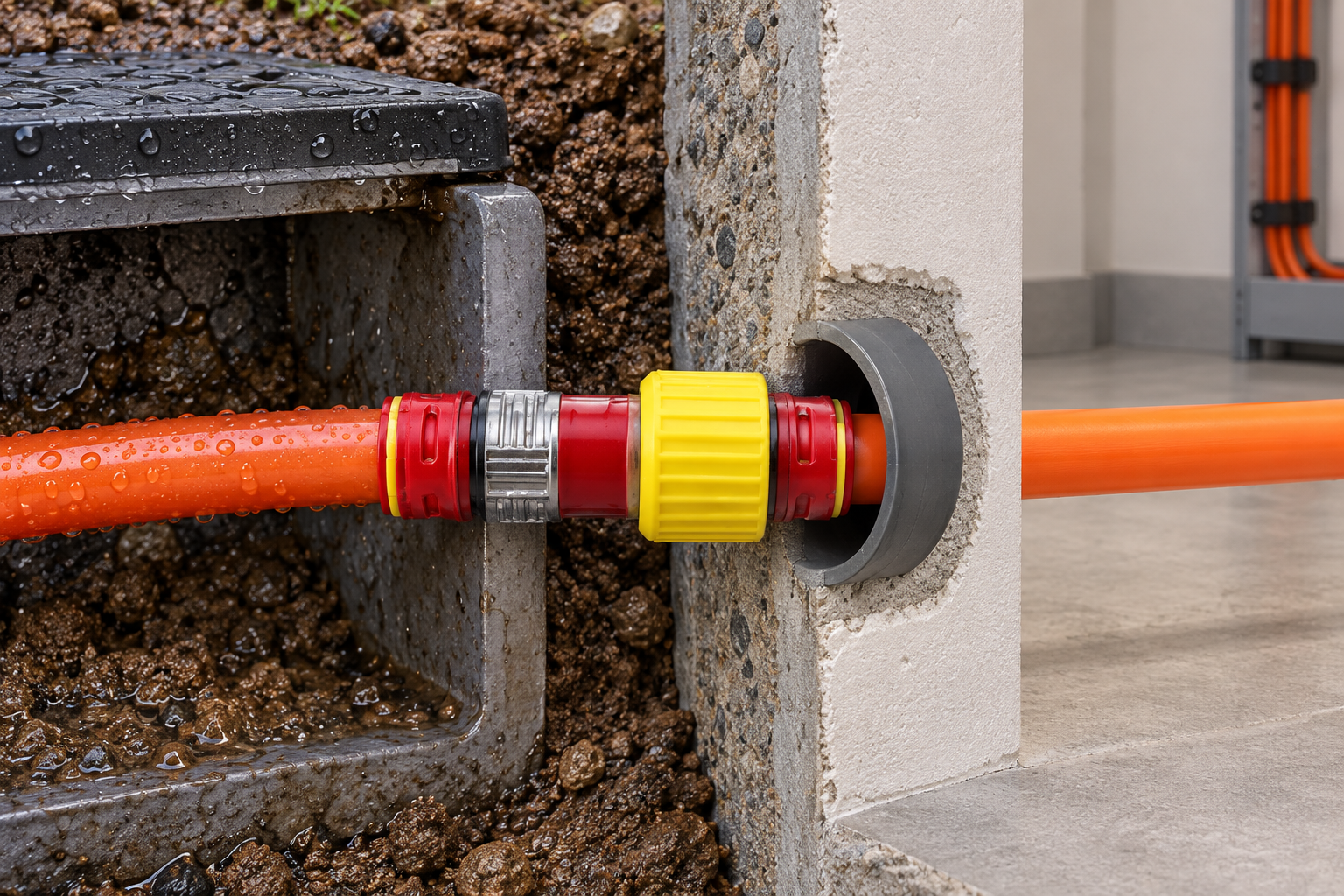
Definirajte pitanje prihvatljivosti prije odabira opreme. Brtva između cijevi i konektora zatvara prolaz na spoju cijevi; brtva za ispunjen kabelski prsten zatvara prostor oko kabla. Test prazne cijevi ne dokazuje potonje. Slično tome, test konektora ne može utvrditi da odvojeno prodiranje kroz zid zadovoljava propise za ulaz u zgradu.
Sažetak NEN-a za EN 50411-2-8:2009 [1] uključuje spajanje kanala, pristup opremi za puhanje, zatvaranje oko vlakana i zatvaranje otvorenih kanala. Opisuje početne zahtjeve za zaštićene instalirane konektore i isključuje konektore namijenjene direktnom sunčevoj svjetlosti. Taj obuhvat identifikuje zadatke komponenti, ali nije certifikacija modela niti dokaz o rezultatu ispitivanja.
| Pitanje prihvatanja | Konfiguracija za identifikaciju | Potrebni su dokazi | Šta ne utvrđuje |
|---|---|---|---|
| Da li ruta može podržati puhanje kablova? | Odobreno stanje puhanja | Primjenjiva ograničenja i način instalacije | Aktivirana sposobnost kabla-seala za pritisak |
| Da li spoj cijevi ispunjava zahtjev? | Tačna montaža kanala i spojnice | Navedeno sredstvo i kriteriji prihvatanja | Zatvaranje oko instaliranog kabla |
| Da li kabelski prsten ispunjava zahtjev? | Compatible cable with seal activated | Seal-specific rating and test conditions | Whole-building gas or fire protection |
| Does the assembly meet a water-migration requirement? | Defined exposure and interfaces | Applicable water-test evidence | Gas tightness from water observations alone |
How should the medium and pressure category be chosen?
Specify whether the requirement concerns blowing, working service, leakage, proof or burst. Working pressure describes an allowed operating condition; proof and burst evidence answer different qualification questions. Neither gives permission to apply that pressure routinely on site. A route acceptance pressure is a project requirement that must remain within the limits applicable to the actual test configuration.
Microduct connector pressure testing also needs a named medium. An air result does not automatically validate water exclusion or performance with a particular gas. Ask for evidence relevant to the claimed duty, including exposure conditions and acceptance criteria. Changing the medium changes the test, rather than merely changing one entry on a certificate.
Check the duct, connector, cable seal, closures and test equipment together. Apply the lowest documented allowable limit for the selected medium, temperature and state. If a component’s limit is unknown, there is no defensible system limit. The connector size and pressure-rating guide supports selection, but cannot replace a code-specific approved test method.
What conditions belong in the test record?
A useful record connects a result to a reproducible configuration. Record the route section, component codes and lots, duct OD and ID, cable OD, seal range, assembly state and the documents used. Add the procedure revision, medium, instrument identification and calibration status. Record pressures, times and temperatures as required by the method, rather than supplying generic values.
The blank guide below is a documentation aid, not a test procedure. Complete it from approved instructions before testing. Do not turn an empty field into an assumed hold duration, pressure ramp, acceptable decay or temperature-correction formula.
| Record field | Project entry | Condition to resolve |
|---|---|---|
| Route, part codes and lots | ________ | Identify the actual supplied assembly |
| Duct/cable dimensions and seal state | ________ | Confirm fit and the interface being tested |
| Purpose, medium and rating sources | ________ | Separate blowing, service, seal and qualification duties |
| Approved procedure and acceptance criteria | ________ | Resolve pressure, timing and interpretation with the authority |
| Instrument and temperature observations | ________ | Provide traceable measurement context |
| Result, correction and retest approval | ________ | Link the decision to the recorded configuration |
Compressed-air testing involves stored energy. Equipment suitability, restraints, access controls and controlled depressurization belong in the authorized safety plan. This article does not prescribe how to pressurize a route. Do not release, adjust or troubleshoot a fitting under pressure; follow the approved isolation and release instructions.
Does a falling gauge prove that the connector leaks?
No. Temperature change and settling of the pressurized system can affect the reading, so pressure drift alone does not identify a leak. Conversely, an apparently stable gauge does not prove every interface satisfies its requirement. Interpret the observations using the approved method and its treatment of stabilization and temperature; do not invent a correction calculation or retrospectively change the acceptance threshold.
Investigate measurement conditions and assembly separately. FCST’s August 2025 installation guidance [2] notes that a tube can be gripped without being fully seated, causing leakage. It also discusses clean, round, undamaged ducts, square cuts, burr removal and appropriate locking clips. These are attributed maker examples, not universal dimensions or release instructions for every connector.
After safe isolation, have qualified personnel inspect the identified interface using the selected maker’s instructions. Document any incorrect fit, incomplete insertion, contamination or damage and the approved correction. Retesting must cover the required assembly condition; a local observation after repair should not be substituted for the specified acceptance test.
Which ratings and documents should the buyer request?
The current Oulu Stranica proizvoda „Vodootporni zatvarač za zrak i gas“ illustrates why state matters: it lists 10 bar blowing pressure and cable sealing up to 0.3 bar. The connector is opened for blowing and the ring is rotated afterward to seal. These values concern different functions and interfaces. Neither authorizes testing the activated cable seal at the blowing pressure, and neither establishes a universal 16 bar field prescription.
Request confirmation for the exact code, cable range, supplied seal and assembly. For gas-block cable-seal verification, ask specifically for the occupied-annulus evidence, not merely a duct connection or empty-pathway result. The Upoređivanje završnog zatvarača i gasnog bloka explains the different closure duties.
IEC 60794-5:2014 [3] covers blowable microduct cabling more broadly; it is not a substitute connector qualification. IEC TR 63431:2025 [4] adds current guidance on microduct technology, including repairs, environmental expectations and installation. As a Technical Report, it supports planning rather than assigning a universal component pressure. Procurement should require the relevant evidence and revision, avoiding repeat testing caused by mismatched documents.
What do installers need to know before accepting the result?
How do you install an HDPE block microduct connector at a building entry point?
Follow the exact connector instructions for duct preparation, insertion, cable placement and seal activation. Confirm building-entry and wall-penetration requirements separately; a gas-block fitting is not automatically a certified firestop.
What pressure rating is suitable for an HDPE block microduct connector in an outside-plant network?
Select ratings matching the required duty, medium and environment. Confirm every component’s applicable limit; a blowing or proof value cannot replace the required cable-seal rating.
How can you test an HDPE block microduct connector for air, gas and water leakage?
Use approved medium-specific methods and acceptance criteria for the intended interfaces. Do not assume an air-decay result demonstrates water exclusion or suitability for a particular gas.
Can an HDPE block microduct connector be reopened for cable maintenance?
Only where the exact maker permits release and reuse. Follow its depressurization, inspection and reassembly instructions, then obtain the required retest evidence; no universal reuse-cycle allowance applies.
Which duct sizes and cable diameters are compatible with an HDPE block microduct connector?
Check the exact part’s duct dimensions and cable-seal range against the supplied duct and cable. Duct OD, ID or wall construction, and cable OD are separate checks.
What happens if the seal is tightened before cable blowing?
It creates a different assembly state from the specified open-for-blowing configuration. Stop and obtain the maker’s instructions for inspection and restoration rather than forcing the cable through.
Does an empty-duct test validate sealing around the cable?
No. It cannot establish performance of an occupied cable annulus that was absent from the test. Document and verify the final compatible cable-and-seal assembly separately.
Who should approve a test when supplier and project pressures differ?
The responsible project authority should reconcile the requirement with component evidence and supplier clarification. Do not raise pressure beyond an applicable limit or lower acceptance requirements without approval.
Which primary sources support these distinctions?
- NEN: EN 50411-2-8:2009 connector scope
- FCST: Installation Instruction For Microduct Connector, 2025-08-22
- IEC 60794-5:2014 microduct cabling specification
- IEC TR 63431:2025 microduct technology guidance
How can the team make a defensible acceptance decision?
A defensible pressure result starts with the right question, not the highest number on a brochure. First identify whether the route needs blowing verification, a duct seal check, occupied cable-annulus evidence or a defined water-migration assessment. Then confirm the exact geometry, assembly state, medium and applicable limits before approving the method. Finally, retain the conditions and observations that allow another reviewer to understand the result. Do not skip temperature interpretation, missing component evidence or the distinction between installation and sealing ratings merely to complete a handover. Oulu / ANMASPC’s katalog konektora za mikrocevi can support product selection; send the supplier the exact duct and cable details and request code-specific documentation before placing a pressure requirement in the purchase order.



