
Cuando un comprador del proyecto en Oulu se encontró con paquetes de conectores de acero no coincidentes durante la salida del almacén, el equipo realizó una prueba de ajuste de los primeros soportes y descubrió que la disposición de los orificios no se alineaba con la estructura de acero aprobada. La falla aparente parecía deberse a una confusión por parte del proveedor; sin embargo, la revisión reveló que dibujos incompletos, especificaciones ambiguas sobre el recubrimiento y la ausencia de un plan de inspección de recepción habían permitido la adquisición de un requisito incorrecto.
Respuesta rápida: Conectores de acero Deben adquirirse como componentes definidos de una trayectoria de carga, no como herrajes intercambiables. Asegúrese de que la geometría, el material base, el entorno de corrosión y el método de fijación coincidan con la revisión del plano antes de emitir el pedido; luego inspeccione la identidad y el estado al recibirlos. La norma ASTM A123/A123M se ocupa de los recubrimientos galvanizados por inmersión en caliente en piezas fabricadas de hierro y acero, mientras que la norma ASTM A153/A153M se ocupa de los recubrimientos galvanizados en herrajes: una distinción útil en cuanto al alcance, pero no una certificación de producto.
Lectura relacionada: Visión general de la selección de conectores.
En la contratación de obras de construcción, el término “conector de acero” puede referirse a ángulos, placas, colgadores, ménsulas, acoplamientos, tacos y ensambles de unión patentados. El nombre es menos importante que la función prevista. Un conector destinado a sujetar el revestimiento presenta información de diseño, requisitos de exposición y evidencia de aceptación distintos a los de un conector que transmite fuerzas entre elementos estructurales. La base de diseño aplicable la determinan el ingeniero responsable y los documentos del proyecto aprobados.
¿Este conector soporta carga o solo une piezas?
Pregunte qué debe conectarse, restringirse, alinearse o soportarse. Registre los miembros, el patrón de orificios, el espesor, la interfaz del elemento de fijación, la orientación y las restricciones de acceso. Un elemento de fijación nominal M12 no constituye una especificación completa: el diámetro no dice nada sobre el grado, el recubrimiento, el tipo de orificio, el método de apriete ni el detalle de la conexión. AISC 360 establece los requisitos de diseño para edificios de acero estructural; no convierte un conector genérico en adecuado para todos los proyectos.
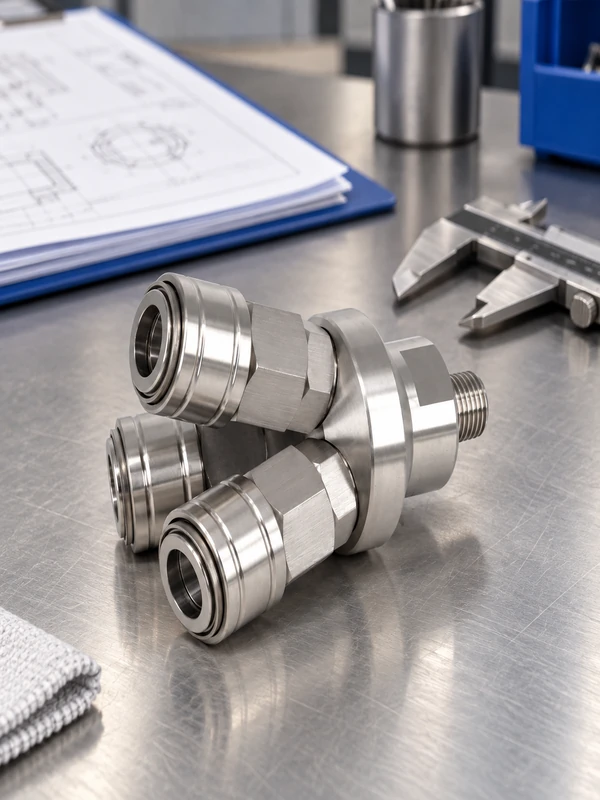
Separe los artículos de catálogo de la fabricación específica del proyecto. Las placas personalizadas o los conjuntos soldados requieren planos controlados y un estado de revisión definido. Un sustituto visualmente similar puede provocar retrabajo en el ensamblaje y una brecha en la documentación, incluso cuando no se observe ningún defecto.
| Familia de conectores | Rol típico en la construcción | Información a especificar | Riesgo común de contratación pública |
|---|---|---|---|
| Ángulos, placas y tacos | Unir o colocar miembros de acero | Revisión del dibujo, dimensiones, agujeros, material, acabado | Cambio de fabricación no controlado |
| Soportes o colgadores atornillados | Admite artículos o servicios secundarios | Interfaz, detalle de sujeción, acceso, exposición | Incongruencia con el miembro de soporte |
| Acoplamientos y manguitos | Combina componentes lineales compatibles | Requisito final de geometría, medio, sellado o restricción | Suponiendo que todos los tamaños nominales encajan |
| Embedded or site-fixed items | Transfer a defined project action | Approved detail, placement control, inspection points | Late discovery after concrete or finishes |
Choose steel and coating for the site conditions
Base steel and finish should follow the project environment and design documents. Dry interiors, wet locations, coastal atmospheres, and process areas have different corrosion conditions. Describe the coating system, preparation, repair method, and touch-up limits; “galvanized” alone leaves room for interpretation.
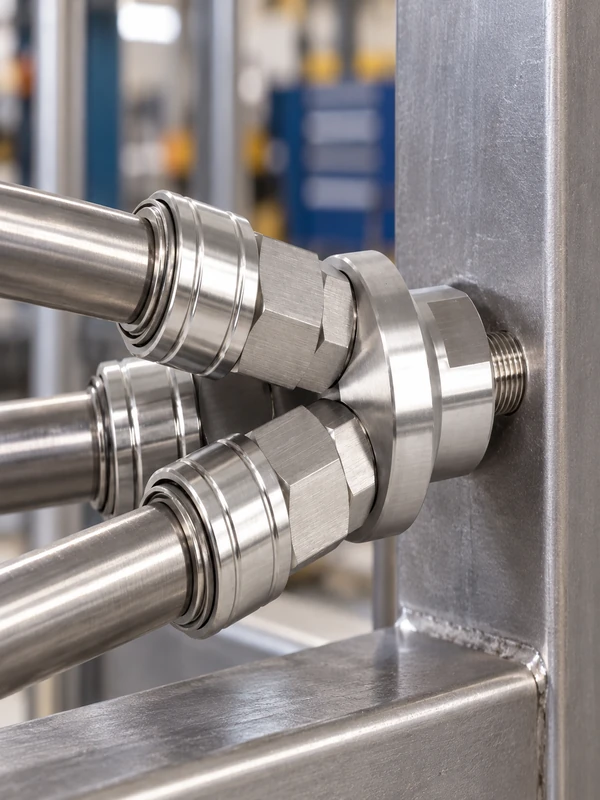
ASTM A123/A123M covers hot-dip zinc coatings on fabricated iron and steel; ASTM A153/A153M covers hot-dip zinc coatings on hardware. Their scopes guide the question, but neither replaces a project review of geometry, exposure, and installation damage. The design team should also address moisture traps, isolation, and dissimilar metals.
For utility, duct, or service-installation packages, connector selection also depends on the material being joined. The site’s overview of HDPE compression fittings is useful when a construction scope includes polyethylene routes; it should not be used to infer requirements for a steel structural connection.
| Requested item | Por qué importa | Receiving check | Cost if absent |
|---|---|---|---|
| Approved drawing and revision | Controls form and interfaces | Match pack labels and dimensions to revision | Fit-up rework or rejected delivery |
| Material and finish statement | Defines ordered construction and exposure intent | Compare marking and documents with purchase order | Uncertain substitution decision |
| Fastener schedule | Links connector to installation detail | Check quantities, size, and package segregation | Site stoppage or mixed hardware |
| Inspection and packing list | Supports traceable receiving control | Count, photograph damage, quarantine discrepancies | Late shortage and claim disputes |
Check dimensions and coating before delivery
Inspect before parts are distributed. Verify the purchase-order line, drawing revision, quantity, visible distortion, corrosion, coating damage, burrs, and hole pattern. Measure features identified in the approved drawing with calibrated tools, and segregate questionable lots before they reach site.
ASTM F3125/F3125M covers high-strength structural bolts and assemblies; the project connection detail still governs the requirement. ISO 898-1 specifies mechanical properties for certain carbon and alloy steel fasteners, not blanket approval for every connector assembly. Request documents identifying what was supplied and have the responsible project party assess compliance with the contract documents.
Unit price rarely represents full commercial impact. Illustratively, a low-cost lot requiring remobilization, sorting, or field modification can cost more than a documented alternative. Compare complete scope-drawings, finish definition, pack separation, inspection support, lead-time reliability, and discrepancy resolution-not piece price alone.
Include drawings and inspection records in the order
- Issue the latest approved drawing, connection schedule, and bill of materials with the enquiry.
- State the member interfaces, material, finish, fastener requirements, intended environment, and any project hold points.
- Ask the supplier to identify exclusions, substitutions, minimum order constraints, and document availability before confirmation.
- Define packaging, labelling, delivery sequence, and the receiving-inspection process for each lot.
For conduit or air-service work, keep each connection family in context. These primers on stainless-steel joints and one-touch fittings help distinguish service-connection terminology from structural detailing. OULU can discuss products and documents; the approved project specification remains the selection basis.
Lectura relacionada: fitting interface explanation.
Do not treat all steel connectors as structural parts
The word “connector” covers several products: structural bolts and plates, pipe or tube couplings, cable supports, and general-purpose hardware. They cannot share one generic acceptance rule. Before requesting a quotation, state the load path, connection geometry, design standard, steel grade, coating, weld or bolt requirement, exposure and installer access. If the connector is not part of a structural calculation, say so; this prevents a catalogue item from being treated as a load-rated component.
| Procurement question | Evidencia a solicitar | Why it matters on site |
|---|---|---|
| What carries the load? | Drawing, design basis and specified grade | Prevents a general connector being substituted into a structural joint |
| What exposure is expected? | Coating system, galvanizing details or corrosion specification | Controls early rust and premature maintenance |
| How will fit be checked? | Dimensions, tolerances, thread or hole details | Reduces drilling, shimming and rework at installation |
| What follows the batch? | Mill, coating and inspection records tied to the order | Keeps receiving decisions traceable |
Use the applicable AISC specification or project standard for structural work, and treat ASTM coating documents as evidence for the stated coating scope, not as a universal approval for every environment.
How should buyers separate structural connectors from general joining hardware?
The first question is whether the connector transfers a designed structural load or simply joins, positions or protects parts. A structural application needs an engineer-defined load path, material grade, geometry, fastener or weld detail and the governing design standard. A catalogue description such as heavy-duty or construction connector is not a structural qualification. If the part is non-structural, state that boundary so a buyer does not apply a structural claim to it.
Coating evidence has a similarly narrow scope. ASTM A123/A123M and ASTM A153/A153M are relevant to different hot-dip galvanizing product categories, while ASTM F3125/F3125M addresses structural bolts and assemblies. The buyer must match the standard to the product, process and inspection record. A coating certificate does not prove load capacity, and a bolt certificate does not prove the connector body or installation is suitable. Keep the drawing, lot, coating thickness or visual acceptance method and delivery inspection together.
| Procurement boundary | Evidencia a solicitar | Claim that remains unproven |
|---|---|---|
| Load-bearing connector | Design basis, material, dimensions and installation method | Market-wide structural suitability |
| Corrosion protection | Applicable coating standard, lot and inspection record | Service life in every environment |
| General joining part | Fit, finish, material and intended use | Structural approval without engineering review |
Preguntas frecuentes
What steel connectors are used in construction?
Construction uses steel angles, plates, brackets, cleats, hangers, couplings, sleeves, and bolted or welded assemblies. The correct category depends on whether the item supports, aligns, restrains, or joins specific components. Use the approved detail rather than a generic name as the purchasing reference.
How do I choose a steel connector for a structural project?
Start with the engineer-approved connection detail, member interfaces, fastener arrangement, material, and exposure conditions. Confirm that the supplier can provide the specified geometry and documentation. Do not select by visual similarity or assumed capacity.
What information should I request from a steel connector supplier?
Request the drawing revision, dimensions, material and finish description, fastener interface, quantity, packing plan, and any agreed inspection records. Ask suppliers to flag substitutions and limitations in writing. This makes technical review possible before shipment.
Are galvanized steel connectors suitable for outdoor use?
They may be appropriate when the selected coating system and connector detail match the exposure and project specification. Outdoor suitability depends on location, moisture retention, installation damage, adjacent materials, and maintenance expectations. Confirm the applicable standard’s scope instead of treating “galvanized” as a universal durability claim.
How do I inspect steel connectors before installation?
Check identity, quantity, drawing revision, visible condition, critical dimensions, hole pattern, finish condition, and package segregation against the purchase documents. Quarantine discrepancies and document them before release to site. Follow the project’s stated inspection and acceptance process.
What is the difference between a coupling and a connector?
A connector is a broad term for an item that joins, supports, or interfaces components. A coupling more specifically joins two compatible ends, often along the same line. The terms can overlap in catalogues, so drawings and functional descriptions should control the order.
Lectura relacionada: Información de la empresa Oulu Connector.
Referencias
- AISC 360 – specification scope for structural steel buildings.
- ASTM A123/A123M-24 – zinc coating on iron and steel products.
- ASTM A153/A153M-23 – zinc coating on hardware.
- ASTM F3125/F3125M-24 – structural bolts.
Resumen
A steel connector purchase starts with the duty: load-bearing, alignment, joining, protection or another defined function. Only then should the team set the steel grade, geometry, coating, fastener details and inspection record. AISC and ASTM references are useful when their exact scope matches the product and design; a galvanizing or bolt document cannot certify the complete connection. Ask for the drawing revision, lot identity and acceptance method before delivery, and keep installation conditions with the file. Avoid treating a catalogue photograph or a broad construction label as structural evidence. Oulu can review a documented industrial connection requirement when the buyer provides the duty and environment.



