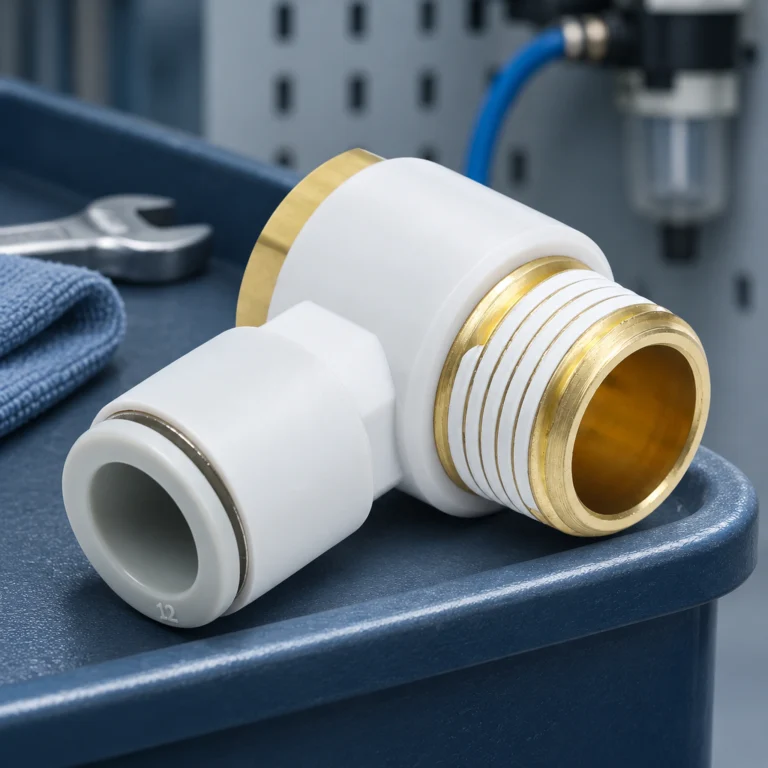
Choosing plastic or metal starts with the complete connection
Choosing plastic tube fittings means choosing a connection system, not simply a lightweight replacement for brass or stainless steel. The fitting body, seals, tube, retaining mechanism and any threaded adapter must all suit the medium and operating conditions. A chemically resistant body cannot compensate for an incompatible seal or tubing that softens at operating temperature.
Plastic can offer low weight, corrosion resistance and convenient routing. Metal may be preferable where mechanical abuse, temperature or connection loads exceed a polymer assembly’s documented limits. Neither category is universally better. Maintenance technicians need a serviceable joint; buyers need a specification that identifies the actual tube, connection and environment rather than relying on appearance or a broad material name.
How nylon, PP, PTFE and PVDF differ
Polyamide, usually called PA or nylon, is common in pneumatic components because it combines useful strength and toughness. However, nylon absorbs moisture, which can affect dimensions and mechanical behavior. Different PA grades do not behave identically. Specify the grade where relevant, and evaluate nylon tube fittings against the intended fluid, humidity, temperature and mechanical loading.
Polypropylene, or PP, is often considered for aqueous chemical service because of its resistance to many acids and alkalis. It is not universally resistant to solvents or oxidizing media. Its stiffness and long-term resistance to deformation also matter: a chemically acceptable fitting can still be unsuitable if heat or sustained loading compromises joint retention.
PTFE offers broad chemical resistance, but that does not make every PTFE connection mechanically suitable. Creep and deformation under sustained load require attention to the joint design and assembly instructions. PVDF offers useful chemical resistance and mechanical properties for many demanding liquid applications, but fluid concentration, temperature and grade remain decisive. Neither material automatically establishes cleanliness or regulatory suitability.
| Materijal | Reason to consider it | Selection concern |
|---|---|---|
| PA / nylon | Strength and toughness in suitable service | Moisture effects, grade and fluid compatibility |
| PP | Resistance to many aqueous chemicals | Temperature, creep and unsupported loads |
| PTFE | Broad chemical resistance | Deformation and connection-specific retention |
| PVDF | Chemical resistance with useful rigidity | Exact chemical conditions and grade |
| Metal | Mechanical robustness and potentially higher temperature capability | Alloy compatibility, corrosion and weight |
These are material tendencies, not product approvals. Reinforcement, additives, manufacturing method and geometry affect the finished part. Likewise, “metal” includes alloys with very different corrosion behavior. Compare documented assemblies rather than treating either plastic or metal as a single performance class.
Which dimension matters for a barb, collet or ferrule?
A hose barb is normally selected by the hose’s inside diameter, or ID. The hose stretches over the barb, while its wall thickness, hardness and elasticity influence assembly and retention. Any required clamp must match the hose and barb design. Do not substitute an arbitrary clamp or assume that every barbed joint needs the same retention method.
A push-in connection normally matches tube outside diameter, or OD. Its seal contacts the tube exterior, while a retaining element grips the tube. OD tolerance, roundness, hardness and surface condition therefore matter. Metric and inch dimensions that appear close are not interchangeable unless the manufacturer explicitly permits them. Plastic push to connect fittings must also accept the selected tube material, not just its nominal diameter.
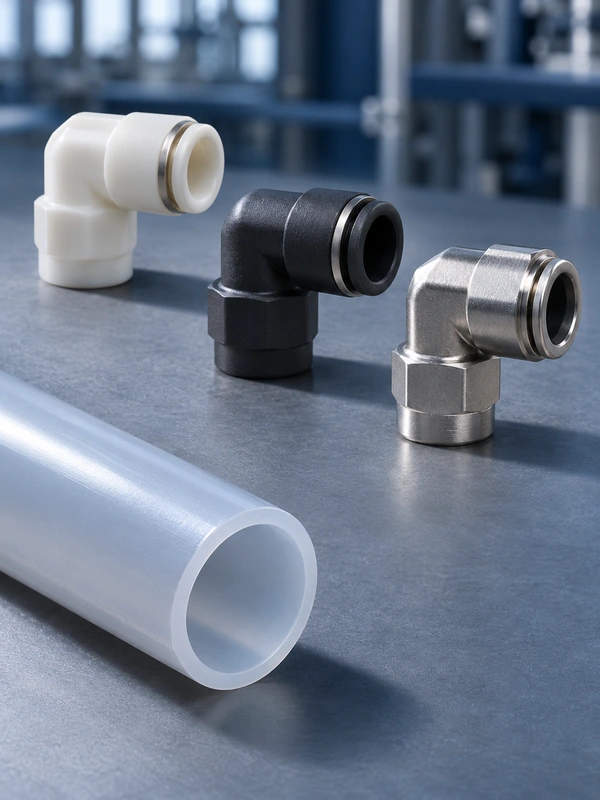
Tube compression fittings also commonly specify tube OD, but “compression” covers different designs. A nut loads a ferrule, sleeve or other compression element; some polymer tubing requires a manufacturer-specified support insert. Confirm wall thickness and tube suitability. Separately, a threaded port has its own nominal size, thread form and sealing method. A tube OD designation does not identify an NPT, BSP or metric port thread.
| Veza | Primary tube dimension | What must also match |
|---|---|---|
| Hose barb | Usually hose ID | Wall, elasticity, barb profile and specified retention |
| Push-in / collet | Vanjski promjer cijevi | OD tolerance, hardness, surface and approved tube material |
| Tube compression | Usually tube OD | Wall, ferrule design and any required support |
| Navojni adapter | Independent nominal port designation | Thread standard, sealing method and mating material |
Connection style and routing shape solve different problems
Barbs suit appropriately flexible hose that can conform around the profile. Push-in connections offer convenient assembly and release where the specified tubing and service conditions permit. Compression connections are useful when a controlled mechanical grip is appropriate, including certain polymer tube systems expressly designed for them. They are not a universal remedy for tubing rejected by a push-in fitting.
The SMC KQ2 One-Touch Fittings catalog identifies nylon, soft nylon and polyurethane tubing for the documented series and describes its chuck and collet arrangement. That is evidence for that series, not permission to use those materials in every push-in product. Manufacturer-specific acceptance matters even when connectors look similar.
A straight union joins aligned tube runs; an elbow changes direction; a tee creates a branch. Choose the shape independently of the retention style. Elbows can avoid an excessively tight tube bend, but additional fittings introduce joints and flow resistance. Support branches so that a tee does not carry the weight or leverage of attached tubing.
What a material compatibility review needs from the buyer
Provide the medium’s full identity, concentration, operating temperature range and possible contaminants. For compressed air, include lubricant carryover, moisture and cleaning exposure. For liquids, identify mixtures and flushing agents, not merely the main ingredient. A fitting acceptable during normal operation may be attacked during maintenance cleaning or an occasional process upset.
Then document operating pressure, vacuum duty if applicable, cycling, vibration, outdoor exposure and expected movement. Check the published limits for the assembled fitting and tubing at the actual temperature; do not combine unrelated catalog maxima. Include the seal material and any wetted metal components in the compatibility review. A polymer body does not necessarily mean an all-polymer wetted path.

The SMC TU Polyurethane Tubing catalog identifies tubing by series and OD and provides its own fluid and temperature information. Its limits must be checked independently from the fitting catalog. A connection is only acceptable when both components cover the intended service.
For the handling differences that influence routing and tube selection, compare poliuretanska i najlonska pneumatska cijev before fixing the tube specification.
For push-in joints, also review tube and push-in fitting compatibility when checking material, dimensions and retention requirements.
A 6 mm tube and a 4 mm hose barb are different orders
Suppose a maintenance buyer needs to replace a damaged elbow connecting a machine port to polyurethane pneumatic tubing. The tube marking states 6 mm OD and 4 mm ID. These dimensions are hypothetical, not a recommendation for any listed product. A push-in elbow would need an expressly approved 6 mm OD tube connection; a 4 mm hose barb is not an equivalent replacement.
The buyer records the tube series, measures the isolated mating port and confirms its thread standard from machine documentation or suitable gauges. The purchase description then names the elbow configuration, tube OD, verified port thread, tube material and service conditions. Approval remains conditional on the supplier’s published compatibility and operating limits. If the thread cannot be identified, ordering stops rather than choosing the nearest-looking adapter.
Inspect safely and distinguish damage from incompatibility
Before disconnecting, cutting, measuring or reseating tubing, isolate the circuit, release stored pressure and verify a safe condition. During permitted in-service observation, use the site’s approved leak-detection procedure without loosening joints or operating release collars. A suspected leak is not justification for manipulating a pressurized connection.
On the isolated assembly, inspect for an angled cut, scratches, ovality, contamination, insufficient insertion or side loading. The Swagelok Tubing Data document emphasizes tubing surface finish and dimensional condition in its own fitting context. Those considerations are valuable engineering principles, but its assembly requirements must not be transferred to unrelated polymer fittings. Use the actual fitting manufacturer’s instructions for insertion, tightening and reuse.
Često postavljana pitanja
Which types of plastic tube fittings are available?
Common connection families include hose barbs, push-in connectors and tube compression fittings. They appear as straight unions, elbows, tees, reducers and threaded adapters. Configuration describes routing; connection family describes how the tube is retained and sealed. Neither identifies the body polymer or approved medium.
How are plastic tube fitting sizes measured?
Hose barbs generally reference hose ID, while push-in and many tube compression fittings reference tube OD. Confirm the manufacturer’s dimensional drawing. Threaded ends use a separate designation: nominal port size is not a measurement of the connected tube, and thread standards must match exactly.
What is the difference between a plastic hose barb and a push-to-connect fitting?
A barb fits inside flexible hose and retains it through its profile, hose deformation and any specified external restraint. A push-to-connect fitting receives the tube exterior into a seal and retention mechanism. The two designs impose different requirements on tube dimensions, stiffness and surface quality.
When is a plastic compression fitting used?
Use one when its documented design accepts the selected tubing and service conditions and a nut-actuated compression joint suits the installation. Confirm whether a support insert is required. Follow that fitting’s assembly instructions; tightening guidance from another brand or fitting family is not transferable.
How do I choose a plastic fitting for flexible tubing?
Identify the tube material, ID, OD, wall thickness and hardness where specified. Then match the connection design, medium and temperature limits. Very soft tubing may need a barb or supported compression arrangement rather than an unapproved push-in connection. Provide enough bend radius and support to prevent side loading.
What should I compare between nylon and other plastic fitting materials?
Compare chemical resistance under actual conditions, moisture sensitivity, stiffness, temperature limits and long-term deformation. Include the seals and tube in that comparison. PA, PP, PTFE and PVDF offer different balances; none is automatically best because of a broad chemical-resistance claim or a higher purchase price.
Which application details should I check before choosing plastic instead of metal fittings?
Check fluid composition, pressure and temperature together, vibration, impact, mounting loads, ultraviolet exposure and maintenance chemicals. Consider thread loading, available support and required service approvals. Choose metal when its documented assembly better addresses those demands, not simply because it feels stronger; verify alloy and seal compatibility too.
Reference
- SMC KQ2 One-Touch Fittings catalog — series-specific tubing acceptance and connection construction.
- SMC TU Polyurethane Tubing catalog — tube identification, dimensions and service information.
- Swagelok Tubing Data — tubing selection, surface finish and dimensional considerations.
Sažetak
For an inline connection rather than the hypothetical elbow, consider the Pu union ravni plastični spoj as a contrasting fitting to evaluate for purchase. Its title alone does not establish body polymer, tube acceptance, seals, dimensions or service limits; request those details before ordering.
Choose the connection mechanism around the tube, then verify every wetted material against the medium and operating conditions. The concrete next step is to send the supplier a dimensioned connection description, tube identification and service envelope, and obtain confirmation for the exact part before releasing the order.