
Когда инженер по техническому обслуживанию в Оулу заменил протекающий отвод на упаковочной линии, цилиндр по‑прежнему работал с задержками. Утечка была устранена, но на ответвлении всё ещё оставался соединитель малого диаметра, длинный трубка бег, а также ненужные изменения направления. Простая замена деталей не решала проблему; ключевым было определение траектории потока.
Краткий ответ: Пневматический прямые фитинги Можно сохранить имеющееся давление, соединяя выровненные участки трубопровода без искусственного поворота. Они не являются автоматически “высокопроизводительными”: на результат влияют эффективный внутренний диаметр, внутренний диаметр трубы, уплотнения и номинальная пропускная способность компонента. Укажите всю трассу и сравните с публикуемыми данными. ИСО 6358-1 Сначала проанализируйте данные о расходе, затем проверьте перепад давления и наличие утечек в эксплуатационном режиме.
Связанное чтение: Руководство по поиску и выбору фитингов для воздушных шлангов.
Почему прямые фитинги всё же могут ограничивать поток воздуха
Сжатый воздух Жидкость проходит через систему очистки, клапаны, трубопроводы, фитинги и порты, прежде чем достигнет исполнительного механизма. Фитинг с меньшим проходным сечением, чем у трубы, может стать узким местом. Прямой фитинг устраняет один из источников геометрических изменений в выровненном трубопроводе; однако он не исключает потери, вызванные недостаточным размером портов, длинными магистралями, клапанами, фильтрами или загрязнениями.

При покупке важна повторяемость характеристик привода при требуемой частоте циклов — а не внешний диаметр или маркетинговое описание. Запросите характеристики расхода, диапазон давлений, совместимый материал трубки и инструкции по монтажу. ISO 6358-1 описывает характеристики расхода компонентов при работе с сжимаемыми жидкостями; этот стандарт более полезен, чем бездоказательное обозначение “высокий расход”.
Предотвращение утечек — это часть того же решения. Министерство энергетики США считает утечки одной из наиболее распространённых причин потерь в системах сжатого воздуха, поэтому соединение, которое правильно обрезано, полностью вставлено, надёжно закреплено и дополнительно проверено, играет роль не только в обеспечении надёжности, но и в снижении эксплуатационных расходов. Используйте соответствующую категорию пневматических компонентов, чтобы при закупках сохранить согласованность требований к фитингам, трубкам и рабочим условиям.
Когда использовать прямой фитинг вместо колена
Прямой фитинг обычно является первым выбором для прямолинейного участка трубопровода, где не требуется поворот. Колено может оказаться более целесообразным с инженерной точки зрения, если оно позволяет избежать слишком резкого изгиба трубы, защищает трубу в зоне подвижного сочленения или облегчает доступ при обслуживании. Цель — обеспечить чистый и достаточно широкий проход с минимальным количеством избыточных ограничений, а не вводить повсеместный запрет на использование колен.
| Фактор принятия решений | Прямой фитинг | Отвод локтевой | Проверка закупок |
|---|---|---|---|
| Маршрут трубопровода | Лучше всего подходит для выровненных последовательных участков | Изменяет направление на соединении | Подтвердите требуемую маршрутную и доступную зону |
| Путь потока | Может снизить количество излишних поворотов | Может внести дополнительное изменение направления | Сравните опубликованные данные по расходу для конкретного размера и серии. |
| Защита трубопровода | Может потребовать изгиба после фитинга. | Можно избежать резкого изгиба трубопровода вблизи патрубка. | Соблюдайте минимальный радиус изгиба, указанный производителем трубопровода. |
| Обслуживание | Простое визуальное отслеживание линий | Полезно там, где ориентиры облегчают доступ. | Оставьте место для доступа к отпускному кольцу или гаечному ключу. |
| Общая стоимость | Потенциально меньшее количество компонентов маршрутизации | Может предотвратить образование зажимов или повреждение трубопроводов. | Оцените совокупные затраты на монтаж, время простоя и усилия по проведению испытаний на герметичность. |
Соответствуйте размерам труб, отверстий и патрубков.
Начните с цилиндра или конечного устройства: требуемое усилие, ход, количество циклов в минуту, рабочее давление и режим работы определяют потребность в сжатом воздухе. Затем установите минимальное эффективное проходное сечение через порт клапана, фитинг, трубку и порт цилиндра. Не следует выбирать соединитель только по размеру резьбы; внешний диаметр трубки определяет тип соединения, а информация о внутреннем диаметре и паспортные характеристики потока помогут оценить его пригодность для заданной задачи.
Выбор трубки также влияет на монтаж. Сравнение воздушных шлангов из полиуретана (PU) и полиамида (PA) актуально, поскольку такие параметры, как гибкость, допустимое давление, температурный режим и устойчивость к химическим воздействиям, должны соответствовать конкретному применению. Уточняйте у производителя трубки её допустимое рабочее давление и минимальный радиус изгиба, а не исходите из предположения, что технические характеристики фитинга автоматически распространяются на все типы трубок.
| Ввод для сбора | Why it affects fitting selection | How to verify |
|---|---|---|
| Tube OD, ID, and material | Determines retention interface, line volume, and permissible bend | Read the tube data sheet and measure the actual tube |
| Port thread and sealing method | Prevents thread mismatch and incorrect sealing practice | Confirm drawing callout and supplier instructions |
| Operating pressure and temperature | Defines the component and tube working envelope | Use maximum and minimum operating conditions, not nominal only |
| Cycle rate and stroke demand | Shows whether restrictions affect response and recovery | Observe a representative production cycle |
| Air quality and environment | Influences seal life and material compatibility | Specify the ISO 8573-1 air-quality class required by the equipment |
Check for pressure loss and leaks after installation
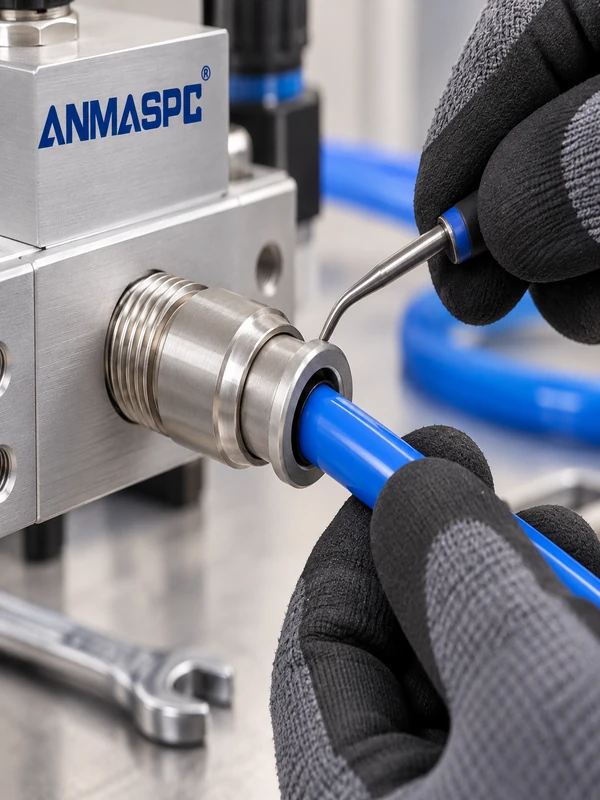
Make a square, burr-free tube cut using the tubing maker’s method. Insert to the stated depth, avoid side loading, and secure moving runs. After assembly, perform a controlled leak test and compare supply pressure with pressure at the actuator during a representative cycle. A rising differential identifies where investigation should start; it does not prove that one component is defective.
For safety and compliance, ИСО 4414 sets general rules and safety requirements for pneumatic fluid-power systems and components. ISO 8573-1 classifies compressed-air contaminants. They guide system design and air-quality specification; they are not blanket product certifications. In the United States, OSHA’s 30 psi limit in 29 CFR 1910.242(b) concerns compressed air used for cleaning, not normal automation-circuit pressure. Applicability depends on destination market, intended use, and claims.
What to put in the order and inspection sheet
- Map each branch from regulator to actuator and remove only genuinely unnecessary turns or adapters.
- Specify tube OD, tube material, port thread, sealing method, pressure and temperature range, and required flow data on the purchase order.
- Request drawings and instructions, then inspect the first article for cut quality, insertion depth, orientation, and tube support.
- Record baseline pressure behavior and leak-test results after commissioning; investigate changes during preventive maintenance.
Microduct Connector can support buyers who need pneumatic components alongside cylinder-related application information. A complete operating brief lets a supplier match interfaces and documentation rather than guess from a photograph or nominal thread.
Check the fitting before blaming the compressor
A straight fitting can remove an unnecessary direction change, but it does not guarantee higher flow. Pressure loss also depends on the passage, tube length, internal surface, thread transition, air demand and the condition of nearby filters and valves. When a cylinder or tool slows down, compare pressure at the supply side and at the point of use under the same operating demand. This separates a fitting restriction from a wider air-system problem.
Связанное чтение: Руководство по применению высоконапорного воздушного шланга.
| Наблюдение | What to check first | Useful record |
|---|---|---|
| Pressure falls only at high demand | Passage size, tube length and quick-connect profile | Gauge readings at rest and under load |
| Pressure is stable but motion is slow | Flow-control setting, cylinder load and valve condition | Cycle condition and valve setting |
| Compressor runs more often | Leaks at fittings, hoses and drains | Leak location and repair date |
| Leak returns after replacement | Thread form, seal method and side-load on the tube | Part number and installation method |
Use one-touch fitting guidance when the line uses push-in tube connections, and compare the wider air-fitting families before standardizing a spare.
How should pressure loss and leakage be measured in an automation line?
Use two observations rather than one gauge reading. Record supply pressure at rest and at the actuator or tool while it performs the representative cycle, then repeat after the connection has stabilized. A difference that appears only under demand points toward passage, tube length, valve or coupler restriction; a compressor that cycles more often with no change in machine demand suggests a leak investigation. The measurement does not identify the failed component automatically, so keep the route map and test condition with the result.
Leak work also needs a safe boundary. Isolate and depressurize before touching a joint, inspect the tube cut and insertion, and check the thread and seal at the port. CAGI’s public resource library provides compressed-air industry context, while ISO 4414 remains the system-safety reference. Use the project method for leak detection and do not increase compressor pressure to compensate for a restriction before confirming that every component is within its working range.
| Наблюдение | Likely question | Next check |
|---|---|---|
| Loss only under load | Is the smallest passage limiting flow? | Compare fitting, tube, valve and coupler data |
| Stable pressure, slow motion | Is the cause downstream of the fitting? | Check flow control, cylinder load and valve state |
| Repeated compressor cycling | Is air escaping at a connection? | Isolate branches and record the leak location |
Часто задаваемые вопросы
Do pneumatic fittings affect air flow efficiency?
Yes. Passage, geometry, seal condition, and relation to tube and port can contribute to pressure drop. Compare the complete circuit at the required flow using published data from a defined method where available.
How do I reduce pressure drop in pneumatic lines?
Shorten unnecessary runs, avoid undersized passages, maintain filters, and avoid sharp bends. Measure supply and actuator pressure under load before changing parts, because the largest loss may be elsewhere in the circuit.
What causes pneumatic fitting leaks in automation?
Causes include damaged or oval tubing, incomplete insertion, contamination, incompatible materials, thread-sealing errors, vibration, and side load. Isolate the branch safely, inspect the tube end and seal area, and follow the assembly procedure.
Should I use straight or elbow fittings?
Use a straight fitting for an aligned, adequately sized path. Use an elbow when it prevents a tight tube bend, improves access, or protects tubing; then verify its flow and installation limits.
How do I size tubing and fittings for a cylinder?
Begin with cylinder bore, stroke, force, operating pressure, cycle rate, and response time. Select tube and fittings whose interfaces, working limits, and flow characteristics match the circuit; trial the intended cycle.
How often should pneumatic fittings be inspected?
Set the interval by duty cycle, vibration, temperature, contamination, accessibility, and failure consequences. Inspect at commissioning and planned maintenance; investigate audible leakage, tube damage, pressure change, or erratic actuator motion promptly.
Связанное чтение: Информация о компании Oulu Connector.
Ссылки
- ISO 4414:2010 – pneumatic system safety.
- ISO 6358-1 – flow-rate characteristics.
- ISO 8573-1 – compressed-air contaminants.
- CAGI public compressed-air resources.
Краткое содержание
Straight fittings can help an aligned route, but efficiency is a property of the complete point-of-use circuit. Match the tube, bore, port and seal, then compare flow information with its stated test conditions. Measure both static and under-load pressure so a fitting restriction is not confused with a valve, filter, tube or compressor problem. For leakage work, isolate and depressurize before inspection and record the exact joint, part number and repair. ISO 4414 and ISO 6358-1 provide useful system and measurement context; they do not certify a generic fitting. Oulu’s pneumatic parts range can be reviewed with the cycle demand, route length and approved interface details.



