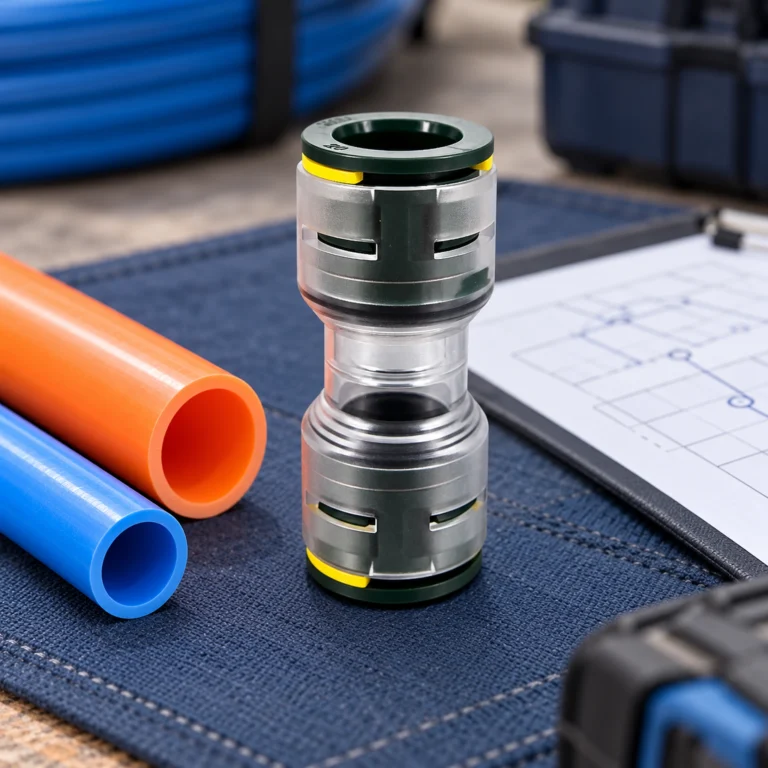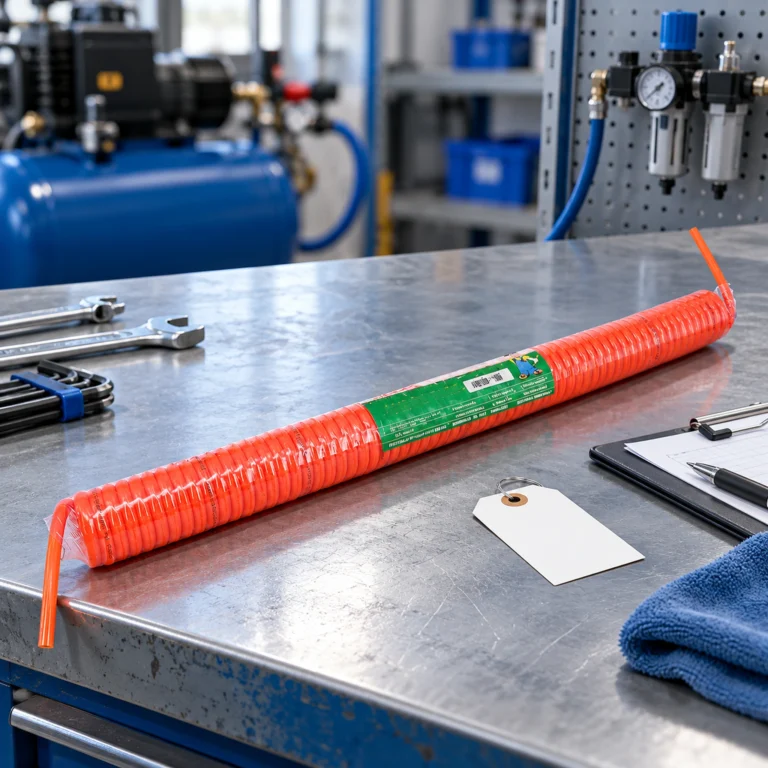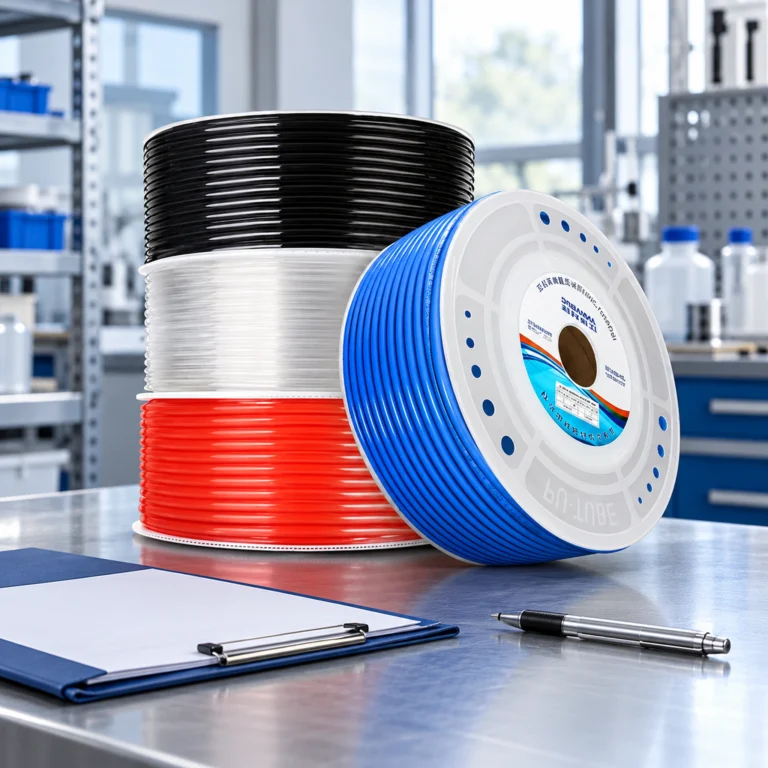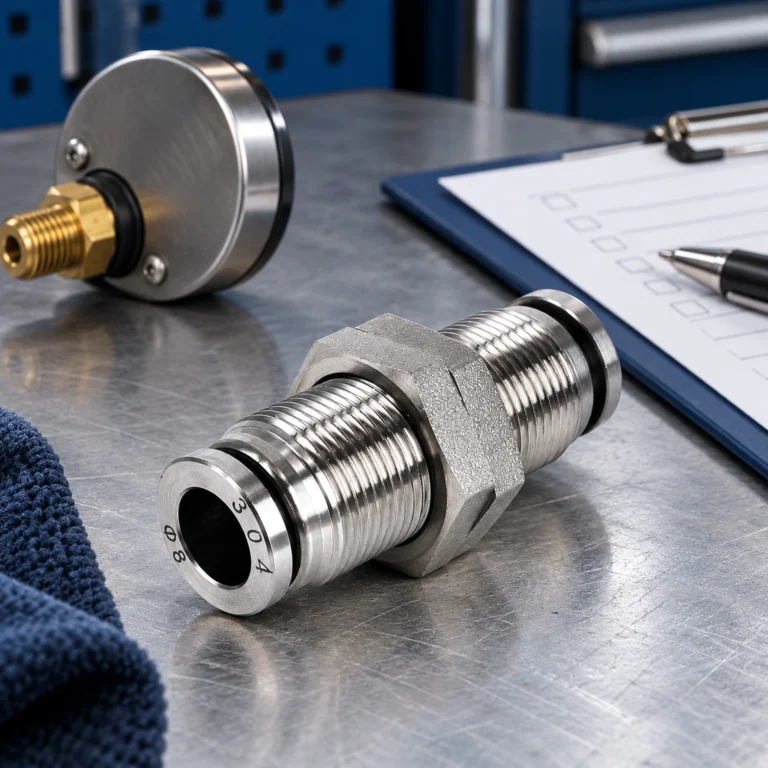
A pneumatic pipe connector can be assembled in seconds and still fail during the first pressure cycle. The usual causes are not mysterious: the tube was cut at an angle, its outside diameter was assumed rather than measured, the port thread was mixed, or the bend was allowed to load the connector. These mistakes create nuisance leaks, actuator drift and repeat maintenance. This guide gives installers and maintenance engineers a complete sequence for a push-in connection, explains what evidence to record, and shows where a supplier drawing must override generic advice.
Quick answer: isolate and exhaust stored energy, verify tube OD, material, wall and port thread, make a clean square cut, remove chips, push the tube fully home, protect the bend from side load, and perform the approved leak or pressure check. ISO 4414:2010 supports safe pneumatic system planning, while the connector drawing controls the actual component limits and insertion instructions. Treat tube retention and port sealing as separate checks, and make the acceptance record specific enough for another technician to repeat the work.
Which checks matter before opening the package?
Read the part number and drawing before cutting anything. Match the tube outside diameter and material to the connector specification, then identify whether the port is BSPP, BSPT or NPT. Check the working medium, temperature, pressure cycles, vibration, chemical exposure and available space for the release collar. A nominal label such as “6 mm” is not enough when different wall constructions or tolerances are available. Inspect the connector for a cracked body, contaminated seal, damaged thread or a collet that does not move freely. If any of these checks fail, quarantine the part rather than trying to make it fit. Record the verified thread designation and sealing arrangement together; nominal size alone cannot tell the installer which interface has been approved.
Does a threaded push-in connector need sealant on both ends?
No. Its tube-side and threaded-port connections perform different jobs. The tube must meet the specified outside diameter and provide a clean surface for the internal seal; tape on the tube interferes with that interface. At the port, use the seal arrangement specified for that exact part. A parallel thread may use a washer or O-ring, while a tapered connection may specify a compatible thread sealant. Factory-applied sealant also needs its own installation instructions. Do not add layers of tape simply because the last fitting leaked. First establish where the leak originates and whether the thread, seating face or tube end is damaged.
How should the tube be prepared?
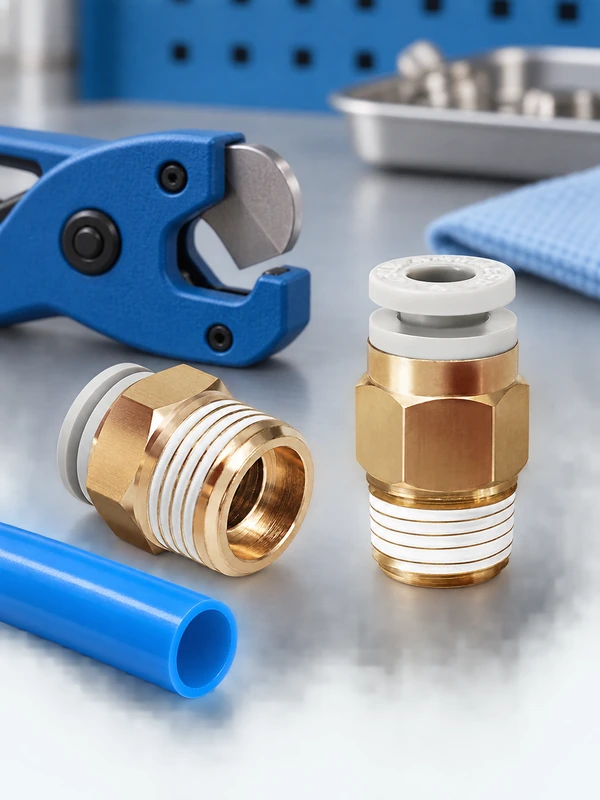
Use a sharp tube cutter that produces a square end without flattening the tube. Do not cut through a kink, and do not use a knife that leaves a tapered or ragged edge. Remove swarf and wipe the tube so particles cannot enter the seal. If the end has been inserted previously, cut back beyond the old witness mark when the supplier permits it; a scored section can leak even when the tube feels tight. Keep the cut length long enough to route without tension, but do not leave an unsupported loop that can whip when the line is pressurised.
How does full insertion create a reliable joint?
Hold the tube in line with the bore and push it through the collet until it reaches the documented stop. A shallow insertion can hold at zero pressure but release when the tube expands, vibrates or sees a pressure pulse. Marking the tube before insertion can provide a simple visual check, but the mark must be based on the supplier instruction rather than an invented universal depth. After insertion, apply the permitted pull check without twisting the tube. If the tube moves, depressurise and investigate; pushing harder is not a repair for a damaged seal.
How should routing and support be handled?
The connector seals the interface, but the surrounding tube route determines whether the seal is repeatedly loaded. Keep the first bend outside the manufacturer’s minimum bend radius and support long runs near elbows, valves and moving axes. Leave access to the release collar and avoid rubbing against sharp sheet metal. In a moving assembly, confirm that the stroke does not pull the connector sideways at either end of travel. Use a separate clamp or guide when the tube weight or vibration would otherwise be transferred to the fitting. Check the support arrangement at the actual installed position and through the permitted movement, not only while the tube is stationary.
How can the installation be checked when access is limited?
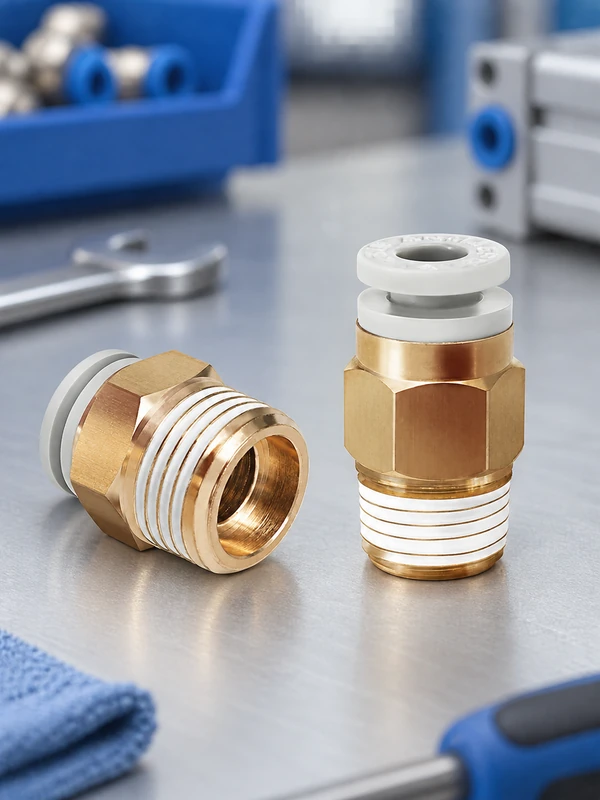
Plan the installation sequence before mounting a guard, valve island or adjacent manifold. A fitting that can be installed with a socket may still need room for the release collar during servicing. Test the actual assembly layout for hand and tool access while it is depressurised. If a tube cannot enter straight, change the route or select a documented elbow form rather than forcing a bend beside the collet. Provide a way to identify the correct branch, read the part reference and isolate that branch without dismantling unrelated piping. Access belongs on the design drawing because correcting it after commissioning can require more work than replacing the connector. When the approved layout calls for a straight male-thread push-in fitting, compare its tube interface, port designation and access envelope with the installation drawing before ordering.
What is a meaningful leak check?
A visual check can find a skewed tube or a missing collar, but it cannot prove that a joint is leak-tight. Follow the site-approved method: isolate the test section, restore pressure in a controlled manner, and observe the permitted pressure-decay, bubble or instrument reading for the specified period. Test the complete circuit as well as suspect joints because a restriction upstream can hide a leak. Record the test condition, part reference, tube type and result. Never exceed the lowest documented limit of the tube, connector or machine.
What should be done if the first leak check fails?
Return to the approved isolation procedure before disturbing the connection. Identify whether leakage is at the tube entry, the threaded port or another component nearby. Remove the tube only after pressure is released, inspect the cut and sealing zone, and compare the part markings with the work record. If the tube is damaged, prepare a new permitted end; if retention, body or sealing features are damaged, replace the connector. Repeat the same acceptance test so the result can be compared with the failed check.
When should the fitting be replaced?
Replace rather than reuse a connector when the body is cracked, the seal is cut or flattened, the collet fails to retain the tube, the thread is damaged, or the tube has scored the sealing surface. Unknown service history is also a valid reason to replace a critical connection. A fitting that passed an earlier test is not automatically safe after a removal operation. Follow the supplier’s reuse policy, use a fresh square tube end, and do not sand, glue or reshape sealing surfaces.
How do standards fit into the installation record?
ISO 4414:2010 addresses pneumatic system safety, stored energy and the need for controlled isolation; ISO 12100:2010 provides the broader machinery risk-assessment framework. These standards do not specify one universal push-in depth or certify a particular connector. The work pack should therefore identify the applicable standard, the supplier drawing, the machine risk controls and the local acceptance test. Keeping those records together makes later troubleshooting faster and prevents technicians from relying on memory.
What should a commissioning handover include?
The handover should let another technician reproduce the installation without guessing. Retain the connector part number, tube specification, port identification, assembly drawing and acceptance procedure. Record any adapter separately and identify where residual pressure can remain after the main supply is isolated. The U.S. OSHA control-of-hazardous-energy rule includes release or restraint of stored energy during covered servicing; applicable local rules and the machine procedure still determine the actual steps. Where reaccumulation is possible, checking the supply valve alone is insufficient. Include the final leak-test condition and result, then observe the route during the approved machine cycle for rubbing or tension. A stationary joint can look correct while movement pulls the tube against the fitting. Resolve that load before closing the work order.
What must pass the installation acceptance check?
| Шийдвэрийн цэг | Хадгалах нотлох баримт |
|---|---|
| Хоолойн интерфейс | Measured OD, material, clean square end and no scoring |
| Port thread | Drawing or gauge confirmation of BSPP, BSPT or NPT |
| Mechanical load | Bend-radius and support review with no side load |
| Acceptance test | Approved method, test condition and recorded result |
What should an installer record?
- Lock out and exhaust the circuit before cutting or releasing a tube.
- Confirm tube, seal and thread compatibility from the drawing.
- Cut, clean, insert and mark the tube without forcing it sideways.
- Support the route and preserve access to the release collar.
- Restore pressure gradually, test, label and record the completed joint.
Олонтаа асуугддаг асуултууд
Can a push-in fitting be installed on an angled cut?
No. An angled or crushed cut can prevent the tube from seating correctly. Isolate the line and make a new square cut using a suitable tube cutter. Inspect the circumference and remove loose particles before reconnecting.
Should thread type be guessed from a nominal size?
No. A nominal size does not distinguish BSPP, BSPT and NPT. Use the port drawing, a suitable thread gauge or written manufacturer identification, then confirm the sealing method before assembly.
Is lubricant always required?
No. Use lubricant only when the connector and tube instructions allow it. An incompatible lubricant can affect the seal or contaminate the circuit. Do not lubricate a joint simply to force an oversized or damaged tube into place.
How is insertion verified?
Use the manufacturer’s documented stop, insertion instruction or permitted witness mark, followed by the specified retention check. If the tube does not seat or backs out, inspect the interface instead of increasing force. Complete the approved leak test afterward.
Can a leaking tube simply be pushed harder?
No. Release pressure before disturbing it and identify whether the tube entry or threaded port is leaking. Inspect the cut, seal, retention feature and route. A damaged sealing surface requires correction or replacement, not additional insertion force.
When is replacement mandatory?
Replace a connector with damaged retention or sealing features, a cracked body or damaged thread, and follow any supplier prohibition on reuse. Replace damaged tubing as required. Unknown history in a critical circuit should be resolved before returning it to service.
Дүрийн баримжаа
- SMC, archived KQ2 One-touch Fittings catalogue: construction and configuration illustrations; historical reference, not a specification for ANMASPC/Oulu fittings.
- U.S. Department of Energy, Minimize Compressed Air Leaks, Compressed Air Tip Sheet 3, revised August 2004: leak identification, repair and verification; historical maintenance guidance.
- OSHA 29 CFR 1910.147, Control of hazardous energy: applicable U.S. servicing requirements, including stored energy. Other jurisdictions require their own regulatory review.
Дүгнэлт
A durable push-in connection is the result of a controlled interface, not simply a tube pushed into a fitting. Confirm the tube and thread first, prepare a square and clean end, seat it to the supplier’s instruction, support the route, and test under the site method. Do not skip isolation or treat a visual inspection as proof of leak tightness. The ANMASPC/Oulu pneumatic parts range can help match the connector, but the selected drawing, service limits and recorded acceptance test remain the decision record for the installation. Review the pneumatic parts range with the verified tube, port and service requirements when requesting a configuration.