
Consider a hypothetical campus upgrade in Bristol: the installer finds room at the entrance of an existing conduit, but the replacement fiber cable stops at a crowded bend. The problem is not necessarily the cable. Several older cables share an unorganized pathway, and there is no separate route for the new one. Innerduct addresses that problem by dividing a larger pathway into smaller, identifiable cable paths.
Innerduct is a smaller protective duct commonly installed inside a larger conduit. It helps separate cables, preserve access and reserve capacity for later work. Its suitability still depends on dimensions, route geometry and installation environment. PPI’s TN-50 guide describes the historic use of 1-inch and 1¼-inch innerducts inside larger telecommunications conduits; those nominal names are not universal bore dimensions.
Innerduct separates cable routes inside a larger conduit
The outer conduit provides the main route through the ground, building or duct bank. An innerduct occupies part of that route and gives a cable its own passage. This separation can reduce direct rubbing against neighboring cables during an addition or replacement. It also helps an installer identify which pathway reaches a particular cabinet, chamber or building entrance.
A spare innerduct is useful even before a cable is installed. Provided it remains continuous, accessible and protected from contamination, the network owner can use it later without first moving the existing cables. That is the practical reason for installing more pathways than the first phase immediately needs. Unused space in a congested conduit does not offer the same predictable access.
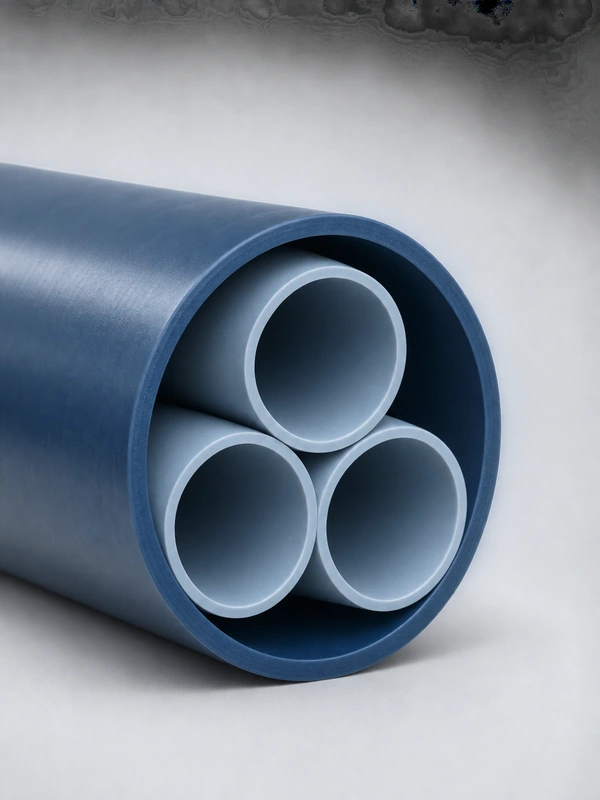
The terms are sometimes used loosely in quotations. A supplier may call a small standalone HDPE duct an innerduct even when it will be buried directly rather than placed inside another conduit. Specify the proposed installation explicitly. A product suitable for a protected position inside a host duct is not automatically suitable for direct burial, an exposed wall or an air-handling space.
| Term | What it describes | What the name does not establish |
|---|---|---|
| Conduit | The main protective cable pathway | Available bore, burial suitability or building fire classification |
| Innerduct | A smaller pathway, commonly placed inside another conduit | Actual ID, allowable pull or compatibility with a particular coupling |
| Микродукт | A small duct used with a matched micro cable or fiber unit | Universal cable compatibility or a guaranteed blowing distance |
| Duct bundle | Several identified pathways supplied together | How many channels the project should initially occupy |
Choose smoothwall or corrugated innerduct for the actual route
Smoothwall innerduct provides a continuous wall profile. Corrugated products use a shaped wall and can offer convenient flexibility in suitable installations. Those descriptions explain construction, not a complete performance ranking. The cable-contact surface, wall design, approved bend radius and intended installation method all need to be considered together.
For a long existing conduit, compare how each candidate will be installed and how the cable will later pass through it. For an indoor change of direction, check that the selected flexible product can follow the route without reducing its bore or violating the cable’s bend limit. A duct that bends easily in the hand can still force the enclosed cable into an unacceptable curve.
Corrugated innerduct should be used where its specific listing and installation instructions suit the route. It should not be selected merely because a short sample feels more flexible. Likewise, an outdoor HDPE product should not be taken indoors on the assumption that its color establishes a fire rating. FOA’s cable guidance distinguishes outdoor construction from indoor fire requirements, and the pathway needs its own appropriate approval.
Check the available accessories at the same time as the duct. A coupling made for a smooth outside wall may not grip or seal a corrugated profile. Where the project uses small fiber microducts, the microduct connector sizing guide explains the separate checks for duct OD, bore and the cable passage through the joint.
Plan the cable pull before installing the innerduct
The Fiber Optic Association recommends assessing the route and following the cable manufacturer’s limits for pulling tension, minimum bend radius and crushing loads. Begin with a route drawing that identifies bends, access chambers, changes in level and the available working area at each end. A drawing of straight-line distance alone is not a pull plan.
A pull string provides a way to establish the next pulling line through an empty duct. It is not automatically the line that should carry the final cable load. Check the string or tape rating, the pulling rope, the attachment and the permitted cable pulling method. FOA recommends using the cable’s designated strength members and a swivel pulling eye where appropriate to avoid transmitting twist into the cable.
FOA gives a common general guideline of 20 times cable diameter while pulling and 10 times diameter after installation, while explicitly directing installers to the actual cable specification. For an illustrative 10 mm cable, those multipliers would be 200 mm and 100 mm radius. These are examples of the calculation, not permission to apply the same values to every cable construction.
Keep the difference between radius and diameter clear when choosing rollers or handling loops. Plan compatible lubricant, controlled reel payout and a suitable tension-monitoring arrangement. If the cable stops unexpectedly, stop and investigate the obstruction or geometry. Raising pulling force can damage a cable that appeared undamaged at the entrance.
Keep innerduct joints aligned and accessible
Innerduct couplings connect separate lengths while maintaining a usable path. Select them for the actual outside diameter, wall profile, installation environment and required retention or sealing function. A coupling that slips over a sample is not proof that it will remain secure during installation or provide the passage needed by the pulling attachment.
Cut and prepare duct ends using the product instructions. Prevent burrs, displaced seals and abrupt internal steps from becoming obstacles. On systems intended for cable blowing, check the suitability of every connector and termination for that process. A mechanically connected route can still leak, and a leak-free joint can still contain an obstruction.
Тэр straight microduct coupler installation guide covers preparation and joint checks for the smaller duct systems commonly used for air-blown fiber. Do not transfer its component sizes or operating conditions to larger conventional innerduct without the relevant manufacturer’s approval.
Place joints where the route design and access arrangements permit inspection and future repair. Record each joint location rather than relying on photographs with no route reference. At a building entrance, distinguish a duct seal from a firestop: blocking dirt or water does not demonstrate that a penetration through a fire-rated assembly has been restored correctly.
Reserve spare pathways that crews can actually use later
Future capacity starts with an identifiable route. Record the duct identifier at both ends, its destination, occupied or spare status, and any intermediate access points. Keep the same identifiers in the as-built drawing and maintenance records. A spare path with an unknown destination often needs costly investigation before it can be used.
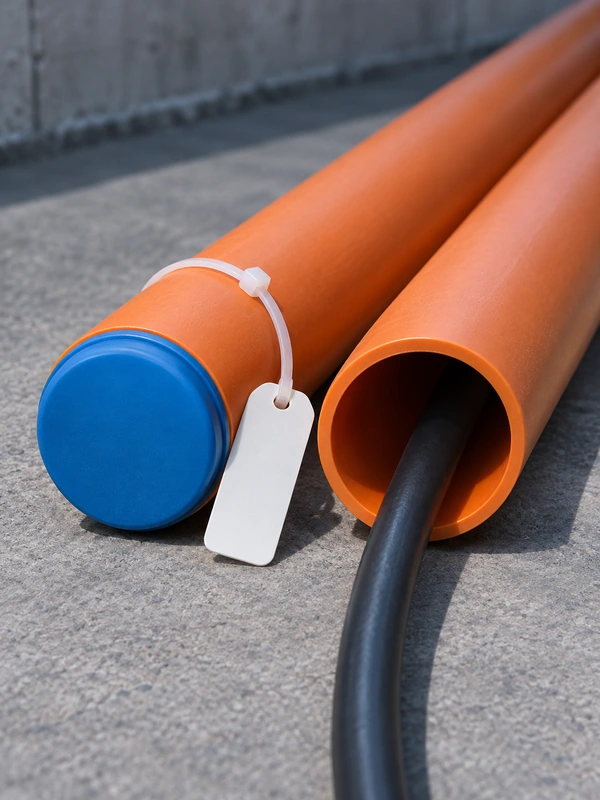
Protect unused ends with suitable caps and preserve the agreed pulling provision. Before a later cable addition, repeat the relevant continuity, cleanliness and access checks. A spare duct that passed handover years earlier may since have been opened, crushed or filled with water during unrelated construction.
| Planning decision | Information to record | Reason it affects later work |
|---|---|---|
| Initial cable allocation | Cable ID and assigned duct | Avoids disturbing a live cable when another route is available |
| Spare capacity | Number, destination and condition of empty paths | Makes expansion capacity usable rather than merely theoretical |
| Joint and access locations | Chamber references and route changes | Supports repair planning and equipment positioning |
| Installation constraints | Bends, pulling limits and cable specification | Prevents a later crew from treating every route as equivalent |
Compare the installed cost of extra pathways with the likely cost of reopening the route. Include excavation permissions, traffic management, labor, reinstatement and interruption risk where they actually apply. This is a project-specific comparison, not a promise that every spare duct pays for itself. A short accessible indoor run and a road crossing have very different expansion costs.
When requesting a quotation from ANMASPC, describe whether the need is conventional innerduct or a microduct system. Supply the host-conduit size, proposed cable dimensions, route environment and planned installation method. This avoids treating a small catalog microduct as a substitute for a much larger duct simply because both protect fiber.
Олонтаа асуугддаг асуултууд
What is innerduct used for?
Innerduct creates separate protective pathways for cables, often within an existing larger conduit. It helps organize installation and reserve routes for future additions. The selected product must still suit the environment and cable-handling method.
What is the difference between innerduct and conduit?
Conduit normally describes the main protective route. Innerduct commonly describes a smaller duct inside that route. The distinction concerns the duct’s role; it does not establish its material, actual dimensions or fire classification.
Why is innerduct used for fiber optic cable?
It separates fiber cables from neighboring cables and provides an identifiable passage for installation or replacement. It can also preserve spare paths. It does not remove the need to respect pulling tension, bend radius or cable-jacket requirements.
When should corrugated innerduct be used?
Use it when its flexibility, bore, listing and installation instructions fit the route. Confirm the matching couplings and the cable’s bend requirements. Corrugation alone does not establish suitability for burial, a plenum or air-blown installation.
Can fiber innerduct be used outdoors?
Yes, if the particular duct is intended for the proposed outdoor exposure and installation. Direct burial, exposure to sunlight and placement inside an existing underground conduit impose different requirements. Check the product documentation rather than relying on its color.
How do innerduct couplings connect separate duct runs?
They join prepared duct ends using the connection method designed for that product. The coupling must match the duct dimensions and wall profile, and the assembled joint must preserve the required cable passage. Follow the specified preparation, retention and sealing checks.
What is the purpose of a pull string in innerduct?
A pull string provides a means of drawing a suitable pulling line through the pathway. Its presence does not prove that it can carry the final installation load. Confirm its rating and use the cable manufacturer’s approved pulling arrangement.
Дүрийн баримжаа
- Plastics Pipe Institute: TN-50, Guide to Specifying HDPE Conduit, 2019 edition.
- Fiber Optic Association: Installing Fiber Optic Cable.
- Fiber Optic Association: Fiber Optic Cable Construction.
Summary
Innerduct makes a fiber route easier to expand when each pathway is correctly sized, continuous, identified and accessible. Choose the wall construction and couplings for the environment, plan the cable pull before installation, and hand over usable records for every occupied and spare path. Those decisions determine whether the duct remains useful after the first cable is installed.
For a project using smaller dedicated fiber channels, review ANMASPC’s single-way HDPE microduct and contact the team with the actual cable and route requirements to confirm the appropriate product scope.



