
Consider a hypothetical office refurbishment in Chicago. A delivery contains orange flexible innerduct, and the installer assumes it is suitable for the return-air ceiling space. The approval package, however, identifies neither the exact product listing nor the matching coupling. The issue is not whether the tube looks familiar. It is whether the supplied raceway and its installation are approved for that location.
Plenum innerduct must be selected using the applicable listing, product identity and installation instructions. Orange color, a smooth wall or a low-smoke description cannot replace that evidence. UL 2024 addresses communications raceways and cable routing assemblies, while the specific test route and local installation rules must be checked for the product category and adopted edition.
Confirm whether the route is actually in a plenum
A plenum-related requirement is determined by the building’s air-handling arrangement and applicable code, not simply by being above a ceiling. Review the drawings and the classification assigned by the responsible designer. Ask where the pathway enters or leaves an air-handling space and whether the route also passes through risers or rated walls.
The authority having jurisdiction decides acceptance under the adopted rules. An installer should not resolve an unclear ceiling-space classification by choosing a product based on color. Record the required pathway classification before procurement, including any project-specific requirements that exceed the minimum local rules.
Keep cable and raceway classifications separate. A cable’s jacket marking applies to the cable. A listed raceway applies to the raceway and its specified installation. Whether a particular cable is permitted within a particular pathway must be established under the applicable rules; neither component automatically changes the classification of the other.
FOA’s cable reference explains why indoor fire requirements and outdoor moisture requirements lead to different cable constructions. A similar distinction matters for ducts. An outdoor HDPE tube may be appropriate underground but still lack the listing needed for an indoor air-handling route. Plan a documented transition instead of extending the outdoor material by default.
Verify the exact plenum innerduct listing before approval
Start with the manufacturer’s name, exact catalog number, dimensions and the marking on the supplied reel or duct. Match those identifiers to the certification record and installation instructions. If the quoted product and the record use different names, obtain a clear manufacturer explanation rather than assuming they are equivalent.
UL Product iQ provides access to UL product certification information. Use the appropriate certification body for the actual mark on the product. A supplier’s test report may be relevant evidence, but it does not automatically establish a current third-party listing for every size, wall construction or accessory in the order.

Intertek’s published UL 2024 update, effective in 2016, is a useful example of why the product category matters. It distinguishes the use of NFPA 262 and UL 723 for communications raceways and cable routing assemblies. In that update, NFPA 262 is not permitted to qualify plenum cable routing assemblies, while UL 723 has a stated role for those assemblies and as an alternative for communications raceways.
This historical notice explains a distinction; it is not a statement that every current product follows the same edition or test route. Request the applicable current listing and contract edition. Quoting a test-method number without identifying the product category and record can produce an approval package that looks complete but does not answer the actual compliance question.
| Evidence or description | What it can establish | What still needs checking |
|---|---|---|
| Orange duct color | Visual identification used by that product or project | Actual fire classification and permitted installation |
| Low-smoke material claim | A claimed material characteristic | Test scope, finished-product listing and intended location |
| Fire test report | Results for the described sample and test | Relationship to supplied products and certification requirements |
| Product certification record | Listed product identity and classification within its scope | Current status, size coverage, accessories and installation conditions |
| Installation instructions | Permitted assembly and handling method | Compliance with the project route and local rules |
Do not use duct color or wall shape as a fire rating
Orange innerduct is a useful search term and may be an identification convention, but color is not a fire test. Manufacturers can supply different materials and classifications in similar colors. Likewise, a corrugated shape describes geometry rather than smoke production, flame propagation or the suitability of a complete installed system.
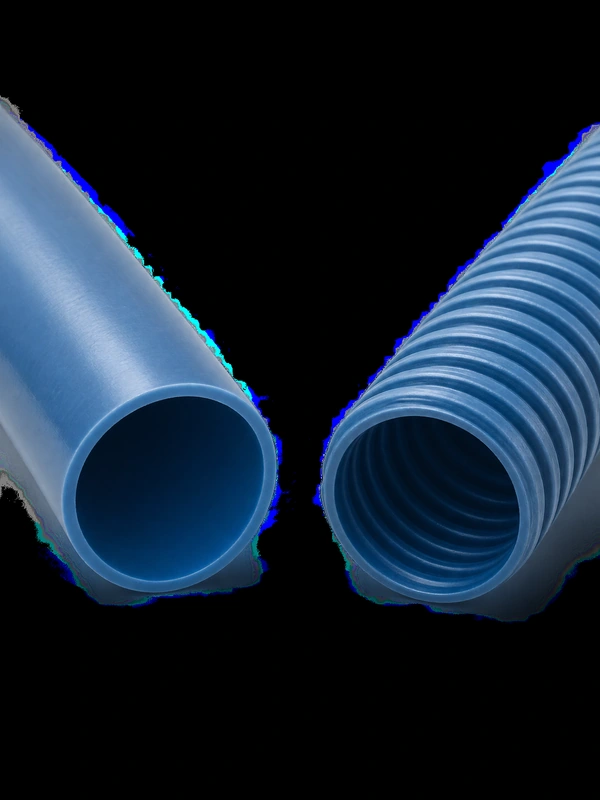
Smooth wall innerduct may offer a suitable cable-contact surface for a particular route, while a corrugated product may offer convenient routing flexibility. Compare the approved application, minimum bore and bending instructions for the actual products. There is no general rule that one wall shape is plenum-rated and the other is not.
Separate reaction-to-fire behavior from fire resistance of a building assembly. A plenum classification does not mean a duct will keep operating during a fire or preserve the rating of a wall penetration. Firestopping a penetration is a separate design and installation requirement involving the specific wall or floor and the approved penetration system.
Do not substitute a low-smoke, zero-halogen statement for a North American plenum listing. Those descriptions answer different questions, and the destination market matters. Ask the project designer to identify which evidence is needed rather than combining unrelated logos or test references into a general “fireproof” claim.
Match each coupling to the duct wall and actual outside diameter
Бир innerduct coupling must fit the actual product being joined. Confirm outside diameter, permitted tolerances, wall profile and the intended connection method. A fitting intended for a smooth tube can interact differently with corrugations, and a nominal inch size does not establish the sealing or gripping diameter.
Check whether the coupling is identified as part of the listed raceway system or is otherwise specifically permitted by its instructions and the project requirements. Do not assume every accessory needs a separate standalone listing, but do require evidence that the proposed assembly is allowed. An unrelated fitting with a generic flame-retardant material claim is not sufficient.
The same fit discipline applies to smaller fiber ducts. The microduct connector sizing guide explains OD, bore and cable-passage checks. That guidance helps with mechanical selection, but it does not establish a fire classification for any specific connector.
Do not substitute a pneumatic fitting merely because the tube enters it. The article comparing microduct fittings and pneumatic couplers explains the differences in intended use. For a plenum route, dimensional compatibility is only one part of approval; the permitted raceway assembly must also be established.
Build a submittal that the installer can check on site
A useful submittal connects the design requirement to the delivered material. Include the required route classification, exact duct item, current certification record, installation instructions and approved accessory list. Keep the package concise enough that the receiving crew can compare it with reel labels and part numbers without guessing.
Record dimensions in a consistent system. For the duct, identify OD, usable ID and wall construction. For a coupling, identify the supported duct family and dimensional range. If an approved substitution changes any of those items, review the complete affected assembly rather than replacing only the product name in the schedule.
| Submittal item | Minimum useful information | Site check |
|---|---|---|
| Route classification | Drawings and applicable local requirements | Delivered material assigned to the correct route segment |
| Duct identification | Manufacturer, catalog number, size and construction | Reel and duct markings match the approved item |
| Certification | Current record and covered classification | Supplied size and product fall within the stated scope |
| Couplings and transitions | Approved accessory list and assembly instructions | No undocumented substitutions at joints |
| Penetrations and support | Relevant installation details and assigned responsibility | Supports and firestopping follow the approved design |
Include the cost of documentation and rework when comparing bids. A cheaper tube that cannot be approved may require replacement after access becomes difficult. Conversely, avoid specifying a higher classification everywhere without reviewing the route: unnecessary requirements can restrict supply without addressing a real installation need. The decision should follow the documented building conditions.
ANMASPC’s microduct connector catalog can support a dimensional and application discussion, but the public product information used here does not establish a plenum listing for the illustrated connector. If that classification is required, request product-specific evidence before considering it for the route. The article’s connector image represents specification review, not proof of approval.
Көп берилүүчү суроолор
What is plenum-rated innerduct?
It is an innerduct or communications raceway with the appropriate classification for the specified plenum application. Verify the exact product listing and installation instructions. The description does not mean it is fireproof or suitable for every building location.
How can I verify an innerduct’s plenum listing?
Match the manufacturer, catalog number, size and markings to the relevant certification body’s current record. Check the permitted use and installation conditions. Ask the supplier to explain any mismatch between the quotation and the record before approval.
Is orange innerduct automatically plenum rated?
No. Color can support identification, but it does not establish flame or smoke performance. Obtain the product-specific listing and verify that the supplied construction is covered.
When should a plenum-rated corrugated duct be specified?
Specify it when the route requires that classification and the particular corrugated product suits the installation. Also check cable clearance, support and bend requirements. Corrugation by itself neither grants nor prevents a plenum classification.
Do innerduct couplings also need the appropriate fire rating?
The coupling must be permitted for the approved raceway system and application. Its status may be established through the system listing and instructions rather than a separate standalone rating. Verify the exact accessory instead of assuming any mechanically compatible coupling is acceptable.
Which dimensions should be checked when matching a coupling to innerduct?
Check actual OD, tolerance, wall profile and the coupling’s supported duct family. Review the usable passage through the assembled joint as well. Nominal size alone is not a sufficient dimensional match.
What documents should be requested before approving plenum innerduct?
Request the current product data, applicable certification record, installation instructions and approved accessory details. Include route classification and penetration requirements in the project package. Resolve substitutions and missing scope information before materials are installed.
Деректер
- Intertek: UL 2024 Standards Update Notice, effective January 9, 2016.
- UL Solutions: UL Product iQ certification information.
- Fiber Optic Association: Fiber Optic Cable Construction and Fire Requirements.
Summary
Approve plenum innerduct by matching the route requirement to the exact listed product and permitted accessories. Keep color, wall shape, material claims and firestop requirements separate from the raceway classification. A clear submittal and a receiving check prevent a familiar-looking product from being installed where its documentation does not support its use.
For a microduct joint requiring dimensional review, see the ANMASPC microduct straight connector and contact the team for the relevant drawing and application documents. Require separate product-specific evidence before considering any item for a plenum route.



