
Imagine a network contractor comparing 1-inch and 1¼-inch innerduct for a warehouse campus in Leeds. The smaller option appears cheaper and the cable fits into a sample. Yet the quotation omits the dimensional system, wall thickness and clearance through the proposed coupling. Choosing from the nominal name alone could leave too little usable space at the point that matters.
Fiber optic innerduct sizing starts with actual duct ID and OD, cable dimensions, route geometry and installation limits. A nominal 1-inch duct does not necessarily have a 25.4 mm bore, and 1¼-inch does not automatically mean a 31.75 mm bore. Those figures are unit conversions, not universal product dimensions. Obtain the drawing for each candidate.
Nominal innerduct size does not tell you its usable bore
PPI’s TN-50 guide describes several dimensional systems and wall types for HDPE conduit. Nominal trade sizes, outside-diameter-controlled products and inside-diameter-controlled products must not be treated as the same dimensional description. Two quotations can use similar inch labels while referring to different actual dimensions or wall requirements.
For a round solid-wall duct, the basic geometric relationship is ID = OD − 2 × wall thickness. Use it to understand the drawing, not to replace the manufacturer’s minimum-bore and tolerance information. Internal ribs, ovality and permitted manufacturing variation may affect the clearance that an installation actually needs.
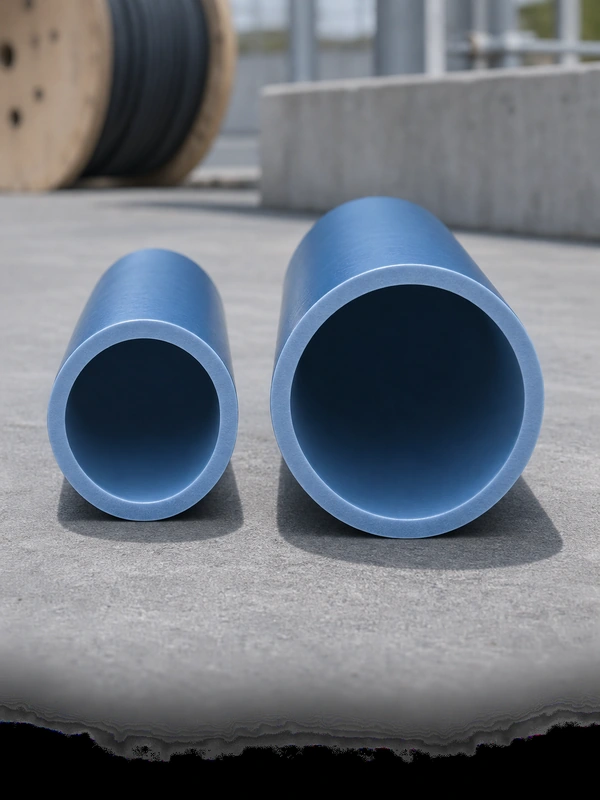
For illustration only, a 33 mm OD tube with a 2 mm wall has a calculated 29 mm ID. Increasing the wall to 3 mm reduces that calculated ID to 27 mm. These hypothetical values are not the dimensions of a named 1-inch product. They show why a stronger-looking or thicker wall does not preserve the same internal space.
Ask each supplier for the same fields: dimensional standard, nominal size, actual OD range, minimum ID, wall type and the supported coupling family. Compare those fields side by side. If the quotation offers only a nominal diameter and material, the information is incomplete for a cable clearance decision.
| Comparison field | 1-inch candidate | 1¼-inch candidate |
|---|---|---|
| Nominal designation | Record exact trade-size system | Confirm the same system is being compared |
| Actual OD and tolerance | Obtain product drawing values | Check fit within host conduit and accessories |
| Minimum usable ID | Check cable and pulling-attachment clearance | Compare the additional usable bore, not the name alone |
| Wall construction | Identify wall type and intended installation | Confirm whether the wall specification is comparable |
| Bend and handling limits | Review product-specific instructions | Allow for any larger handling envelope |
| Installed cost | Include fittings, labor and route constraints | Include any increase in host-route or chamber space |
Compare cable clearance using actual dimensions
Use the cable’s maximum specified OD, rather than estimating from fiber count. Cables with the same number of fibers can have different jackets, strength members, armor and buffer constructions. FOA’s cable reference describes these construction differences and why cable selection needs the installation environment as well as the optical requirement.
Diameter ratio and area fill are different measurements. For a single circular cable in an ideal circular duct, diameter ratio is cable OD divided by duct ID. Area fill is the square of that ratio. State which calculation is being used whenever a specification refers to a percentage, because confusing them can produce a substantial sizing error.
As a hypothetical comparison, a 12 mm cable in a 26 mm bore has a diameter ratio of about 46 percent and area fill of about 21 percent. In a 32 mm bore, the same cable has a diameter ratio of 37.5 percent and area fill of about 14 percent. These are arithmetic examples, not recommended fill limits for a particular cable or installation.
Use the applicable cable, duct and installation requirements to decide whether a combination is acceptable. For blowing, a supported pairing is more useful than a generic maximum-fill rule. For pulling, include the pulling eye or grip envelope and review bends, friction and access. A low calculated area fill does not guarantee a successful installation.
Check bends and pulling hardware before choosing the smaller duct
The Fiber Optic Association identifies pulling tension, bend radius and crush loads as essential installation limits. The route with the smallest cable clearance is not necessarily the only concern. Tight bends, unsuitable rollers, poor reel positioning and a bulky attachment can create a problem even when the cable fits comfortably in a straight duct.
FOA gives a common general bend-radius guideline of 20 times cable OD while pulling and 10 times OD after installation, with an explicit instruction to check the cable specification. For an illustrative 12 mm cable, these multipliers give 240 mm and 120 mm radius. The actual cable may require different values, especially for specialized or high-fiber-count constructions.
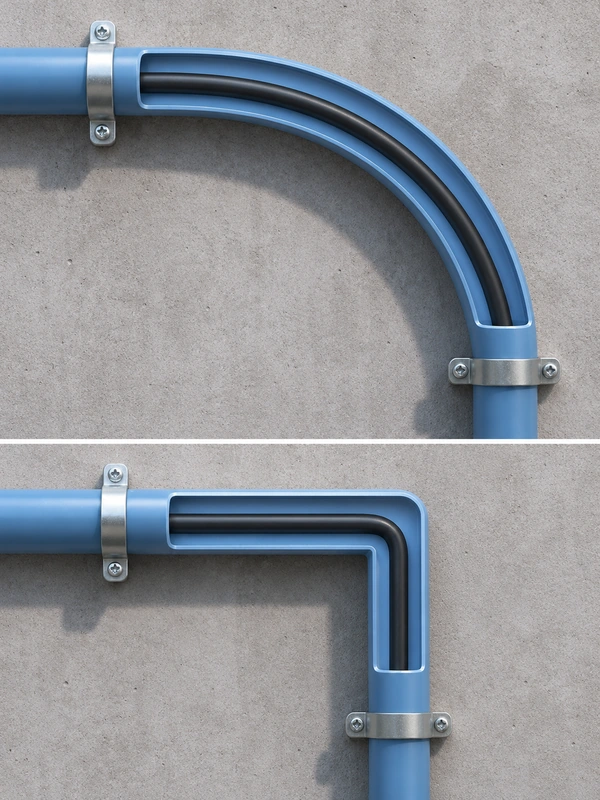
Do not confuse the duct’s minimum bend radius with the cable’s allowable bend. Both must be satisfied by the route. A flexible duct can follow a curve that is too tight for its cable, while a larger duct may require more space at a chamber or equipment entry. Draw the actual curve and handling arrangement rather than checking only straight-run dimensions.
Confirm how the pulling load reaches the cable. FOA recommends the specified strength members and suitable swivels, and warns against unapproved jacket pulling. Plan compatible lubrication and tension monitoring where needed. If the route requires excessive force, a larger bore may help some conditions, but it does not correct an abrupt bend or an unsuitable pulling attachment.
Decide whether future capacity needs a larger duct or another pathway
1-inch innerduct жана 1¼-inch innerduct should be compared against a defined service plan. Is the project installing one cable now, replacing it later, or adding a second independent cable? Those objectives can lead to different choices. Spare fibers in an installed cable, spare room in an occupied duct and a separate empty duct are three different forms of capacity.
A larger occupied duct does not guarantee that another cable can be added without affecting the first. Cable geometry, friction, pulling access and the condition of the existing cable all matter. If future installation without disturbing a live route is important, compare an additional dedicated pathway with the larger-duct option.
Check the host conduit before increasing every innerduct size. Its usable bore, bends and existing occupancy limit how many smaller ducts can be installed. A choice that increases one cable’s clearance may reduce the number of independent future routes. Include the space needed for couplings and handling, not just the cross-sectional area of straight tubes.
FOA’s air-blown fiber discussion makes the same planning point: future flexibility depends on the tubes installed initially, and extra fibers installed at the outset are an alternative worth evaluating. Use realistic expansion scenarios and site costs. Avoid choosing a fixed spare percentage without understanding where future services must actually go.
| Project situation | Option worth evaluating | Critical check |
|---|---|---|
| One known cable in a short accessible route | Smaller suitable duct | Actual clearance, bends and pulling arrangement |
| Known larger replacement cable later | Larger supported bore | Future cable dimensions and replacement access |
| Independent future service | Separate spare pathway | Destination, continuity, identification and caps |
| Limited host-conduit space | Whole-route layout comparison | Number of pathways, bend geometry and coupling envelope |
| Air-assisted installation | Approved cable-and-duct pairing | Equipment compatibility and route-specific installation plan |
Specify couplings and acceptance checks in the purchase order
A coupling must match the actual duct dimensions and preserve the required passage. Do not order it from the nominal inch label alone. Record the approved duct family, OD tolerance, wall profile and connection method. The assembled joint may impose a smaller passage than the tube itself.
For smaller fiber channels, the microduct connector sizing guide sets out the corresponding OD and bore checks. Conventional inch-size innerduct and millimeter microducts are different product scopes. A microduct connector photograph in a catalog should not be taken as evidence that it fits a 1-inch duct.
The comparison of microduct fittings with other couplers also explains why appearance and push-fit operation are not sufficient selection criteria. Use the intended application and documented dimensions, and check any pressure-related requirements separately when cable blowing is planned.
Ask ANMASPC or the selected duct supplier to identify any offered item outside the requested dimensional range before purchase. Include delivery lengths, reel handling, route environment, cable specification, compatible accessories and the agreed proving method. This keeps a commercially acceptable substitution from becoming an unreviewed engineering change.
Көп берилүүчү суроолор
How do I choose the size of fiber optic innerduct?
Start with cable OD, duct minimum ID, route bends and the installation method. Include the pulling attachment or blowing-system requirements. Compare actual dimensions and manufacturer limits before selecting a nominal size.
What should I compare between 1-inch and 1-1/4-inch innerduct?
Compare actual OD, minimum ID, wall type, dimensional standard, bend requirements and matching accessories. Also compare host-conduit space and installed cost. The larger nominal designation does not state how much usable capacity the specific products provide.
Does nominal innerduct size equal the usable inside diameter?
Not necessarily. Nominal size is a product designation within a dimensional system. Obtain the minimum usable ID from the product drawing and account for tolerances, ribs and any restrictions at joints.
How does cable count affect innerduct sizing?
More cables change the geometry, friction and installation sequence inside the duct. Do not simply add diameters or assume unused area can always accept another cable. Review the proposed arrangement and consider separate pathways where later installation must avoid disturbing live cables.
How much spare duct capacity should be considered for future fiber?
There is no single percentage suitable for every project. Base the allowance on likely future cable sizes, destinations and the cost of reopening the route. Distinguish spare fibers, spare space and a separate empty pathway in the plan.
How do bends and pulling limits affect innerduct selection?
Bends increase installation difficulty and must respect both cable and duct limits. Pulling tension, attachment size and equipment placement also matter. A larger duct does not compensate for an unacceptable bend or an unapproved pulling method.
Which innerduct sizes and installation details should be included in a quote request?
Include nominal designation, actual dimensional requirements, wall type, cable OD, route length, bends, environment and installation method. List the required couplings, caps and transitions. State the applicable standards and acceptance checks so quotations can be compared consistently.
Деректер
- Plastics Pipe Institute: TN-50, Guide to Specifying HDPE Conduit, 2019 edition.
- Fiber Optic Association: Installing Fiber Optic Cable.
- Fiber Optic Association: Fiber Optic Cable Construction.
- Fiber Optic Association: Air Blown Fiber Installation.
Summary
The choice between 1-inch and 1¼-inch innerduct should follow actual dimensions and a realistic installation plan. Check the narrowest passage, cable and duct bend limits, pulling hardware and the purpose of any spare capacity. Comparing the complete route prevents a nominal size from hiding a poor fit or unnecessary cost.
If the design instead uses smaller millimeter-size channels, review ANMASPC’s straight push-on microduct connectors and contact the team for a dimensional match. These products require their own size confirmation and are not presented as substitutes for inch-size innerduct couplings.



