
A clear microduct connector makes some installation details easier to see, but transparency does not prove that the joint is airtight. A visible tube end can still be damaged, incorrectly seated or incompatible with the fitting. The useful approach combines observation, dimensional checks, passage verification and a documented leakage test.
This guide focuses on interpreting those checks before cable blowing. It does not assign a universal test pressure. Use the exact component documentation and network owner’s procedure, with equipment rated for the complete assembly. Isolate and depressurize before adjusting, disconnecting or replacing a joint.
Which pressure rating is safe to use when connector data conflicts?
Record the product variant, both duct dimensions, material and installed location. For a reducer, record the size of each end and the smaller downstream bore. A clear body does not identify its pressure limit, environmental suitability or permitted cable passage.
Check that the catalogue’s working, proof and burst figures are consistent and clearly labelled. If a headline and technical table disagree, request written clarification. Do not select the highest number or assume that a proof-test figure is a continuous working limit. The connector should not be tested until the applicable limit is established.
The site’s clear reducer listing contains pressure information that needs this distinction resolved before use. Accordingly, this article does not turn those figures into an operating recommendation. Ask for the current model-specific datasheet and the approved duct combination with the quotation.
What can a clear connector body reveal about duct seating?
Inspect whatever the product design actually makes visible: tube position, obvious contamination, cracks and discoloration. Compare seating with the manufacturer’s specified indication. Do not infer hidden O-ring compression or retention condition merely because the outside housing looks intact.
Check the duct outside surface before assembly as well as after insertion. A scratch can be hidden inside the connector once seated. A transparent wall may help locate an obvious problem, but lighting, body curvature and internal components can obscure the relevant contact area.

Hexatronic’s MPB30601+ page describes its clear body alongside separate pressure seals and gripping components. That is a useful reminder that visibility is only one feature. The completed joint still requires the prescribed dimensional, installation and acceptance checks.
| Visible observation | Useful conclusion | Conclusion that requires more evidence |
|---|---|---|
| Tube appears at the indicated position | Seating can be compared with instructions | The complete seal passes its leakage requirement |
| No obvious body crack | No crack was seen in the inspected area | The assembly retains its original pressure rating |
| Foreign material is visible | Cleaning or replacement needs investigation | The contamination is harmless |
| Reducer ends are identified | Both interfaces can be recorded | The cable fits the limiting internal passage |
How to prepare a microduct route for pressure testing
Define the test boundaries, identify every closure and confirm the condition of hoses, gauges, adapters and regulators. Follow the approved procedure for restraining components and controlling discharge areas. A temporary test adapter is part of the pressurized assembly and must not be treated as an unimportant accessory.
Inspect supports and the final position of the ducts. Side loading, tight bends and unintended contact with a release collar can undermine a correctly prepared connection. If the joint requires a protective cover, check that it fits the specified configuration and does not hide an unresolved installation defect.
For problems involving an external shell, consult the microduct cover-shell troubleshooting guide. A cover may provide mechanical protection, but it should not be used to conceal a leaking or dimensionally incompatible connector.
Does a pressure-tight connector also have a clear cable passage?
A duct passage check addresses continuity and obstruction. A leakage test addresses pressure behaviour under specified conditions. Neither result replaces the other. A reducer can hold pressure while presenting an unassessed bore transition, and a route can be open enough for a test object while still leaking air.
Use only the network-approved passage method for the duct and cable system. Do not choose a projectile, clearance or air setting from a generic article. Record which section was checked and whether the test occurred before or after final placement.
For broader acceptance planning, the HDPE microduct connector test guide helps organize the questions to ask. The exact equipment settings and acceptance limits must still come from the project documentation and component instructions.
Why does duct pressure fall when no leak is visible?
A changing pressure reading is an observation, not a complete diagnosis. Check stabilization, temperature, gauge behaviour and test connections before concluding that the clear connector is defective. Pressurization can change air temperature, and a subsequent temperature change can influence a closed-section pressure reading.
Where the procedure permits, isolate smaller sections or inspect individual interfaces to locate leakage. Record the investigation rather than repeatedly filling the same route without changing anything. Do not increase the pressure beyond the approved limit to make a suspected leak easier to hear.
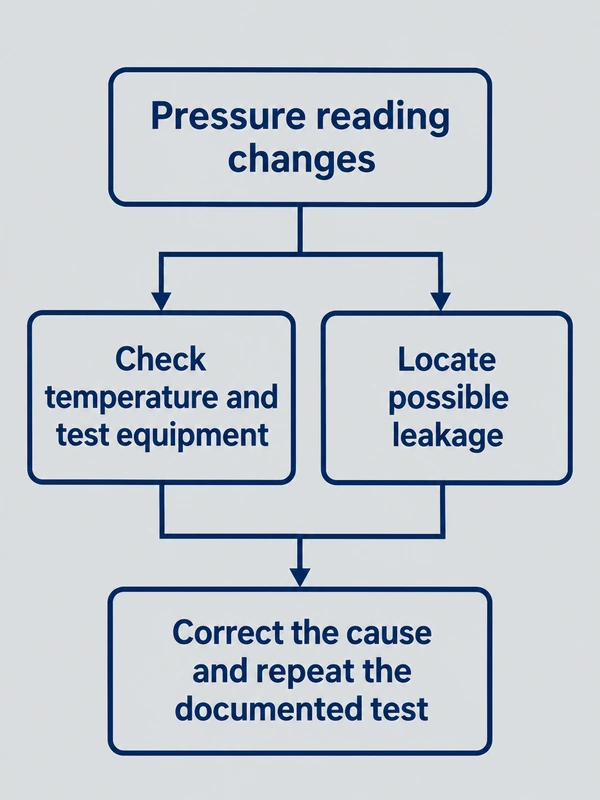
The US Department of Energy’s compressed-air guidance advocates identifying, tracking, repairing and verifying leaks. That management approach is relevant to troubleshooting, but its industrial-air examples are not a telecom duct test standard. Use the operator’s specified acceptance criteria for the final decision.
| Test observation | Investigate next | Before another test |
|---|---|---|
| Reading falls soon after filling | Required stabilization, temperature and leakage | Confirm the approved timing and conditions |
| Leak localized at one duct entry | Size, cut, surface, seating and seal condition | Repair or replace the affected interface |
| Test result changes after moving the route | Side load, bend and accidental collar contact | Correct support and installed position |
| Joint passes but passage check fails | Bore transition, burr or downstream damage | Resolve the obstruction separately |
When should a leaking microduct connector be reseated or replaced?
Follow the connector manufacturer’s service and reuse instructions. A permitted reseating operation requires an undamaged compatible duct and serviceable fitting. It is not a remedy for a cracked body, distorted collet or an unidentified internal seal.
Inspect the tube area that was previously gripped. If cutting back is required, preserve sufficient route length and support. Repeated trimming can eventually create tension at the joint, replacing one failure mechanism with another. Use an approved repair arrangement when the remaining duct cannot be connected without stress.
Do not install a loose replacement O-ring selected only by approximate size. Material, cross-section and design matter. If the connector is not intended for field repair, replace the assembly and retain the failed part’s identity for the maintenance record.
Does a clear duct connector also block water or gas around the cable?
Transparent reducer couplers join duct sections; they should not automatically be described as gas blocks. Emtelle’s gas-block documentation identifies a separate seal between the connector, tube and fibre cable. When the route needs that function, specify a compatible cable-entry gas block and verify its own cable range and sealing conditions.
Similarly, transparency does not prove outdoor durability or direct-buried suitability. Specify water exposure, temperature, sunlight and mechanical loads. Hexatronic’s referenced family requires an external cover for its direct-buried configuration, showing why the complete arrangement matters more than the appearance of the bare body.
For an upgrade, retain a record of connector location, size pair, cable dimensions, acceptance results and required accessories. A later cable change may affect passage or sealing requirements even when the existing duct joint looks unchanged.
What test results should accompany a replacement connector request?
Include the reason for replacement, not just the old part number. A leak caused by a scratched duct needs a different corrective action from one caused by side loading or an unsuitable size. Photographing the installed arrangement can help the team explain the fault, while dimensional and test records provide the technical basis.
State unresolved information explicitly. If working-pressure documentation is missing or inconsistent, leave the approval open until the supplier resolves it. This is more useful than filling the record with a guessed value that the next crew may treat as authoritative.
Көп берилүүчү суроолор
How can a clear connector be installed without restricting the cable?
Match both duct interfaces, prepare square round ends, preserve the bore and seat the ducts correctly. Assess the reducer’s limiting passage if present. Follow the approved route check rather than assuming that a visible tube end proves unobstructed cable passage.
Which pressure and leakage tests apply to a clear microduct connector?
Use the network owner’s procedure within the limits of every component in the test assembly. Resolve conflicting catalogue figures first. Record the specified pressure, duration, temperature and acceptance result; there is no universal setting for all clear connectors.
Can clear connectors be used outdoors or directly underground?
Only when the exact product and protective configuration are documented for that environment. Clear plastic does not establish UV resistance, water exposure limits or crush protection. Ask whether covers or other installation measures are required.
What should be inspected on a clear connector before cable installation?
Check identification, dimensions, cut quality, sealing surfaces, visible seating, body condition and route support. Verify the approved passage and leak-test records. Keep dust out of prepared ends and investigate any movement or damage before cable installation.
How does a clear connector differ from a standard telecom coupler?
Clear describes body visibility, not a separate universal performance class. A transparent connector may also be a standard straight coupler or reducer. Compare the actual function, dimensions, retention, sealing and environmental documentation.
How should a clear microduct connector be replaced during an upgrade?
Plan the outage and isolate stored pressure, follow the release instructions, inspect the duct and install a documented compatible replacement. Reassess cable passage and any cable seal for the new cable. Record and verify the completed repair before handover.
Деректер
- Hexatronic, MPB30601+ connectors and end stops: clear-body construction, retention and installation environment.
- Emtelle, Gas Block Connector: separate cable-annulus sealing function.
- US Department of Energy, Minimize Compressed Air Leaks: systematic leak investigation and verification.
Summary
Use the clear body to inspect what is visible, then verify the functions that cannot be judged by appearance. Confirm ratings, check passage, test leakage under documented conditions and correct the actual cause of failure. A useful test record explains both the result and the configuration that produced it.
When considering the clear-body microduct reducer connector, request the confirmed size pair, bore drawing, applicable pressure-temperature information and installation instructions. Use those documents to decide suitability rather than relying on transparency as a quality guarantee.



