
Choose the connection system before the fitting shape
そのフレーズ push lock air fittings can describe different connection systems. For maintenance technicians, that ambiguity affects tubing selection, replacement parts and safe disassembly. For buyers, it can turn a plausible description into the wrong order. Start with the sealing mechanism, then establish tube size, port thread, routing geometry and operating requirements.
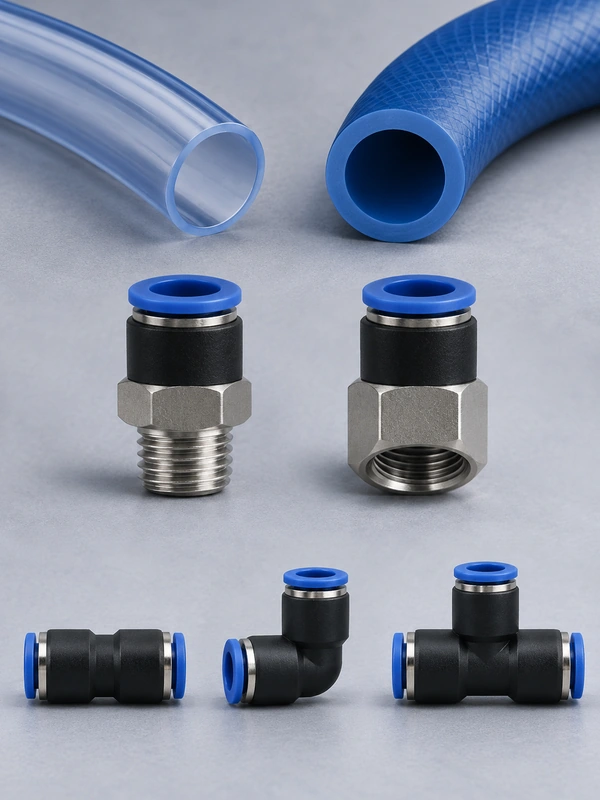
A useful specification describes both ends independently: for example, a tube socket sized for a stated outside diameter and a male thread of a stated standard and nominal size. “Elbow” describes geometry, not the complete connection. Likewise, a metal body does not establish the thread form, compatible tube material or suitability for repeated movement.
Does the line seal on the outside of a tube or inside a hose?
A pneumatic push-in connection generally accepts the outside of a prepared tube into a socket. A retention mechanism grips the tube, while an internal seal contacts its outside surface. The SMC KQ2 catalog illustrates this distinction with its chuck, collet and sealing components, and identifies compatible tubing materials for that product family. Those details are manufacturer-specific, not specifications for every push-in fitting.
Barbed Push-Lok hose products use a different interface: a stem enters the hose bore, and the specified hose-and-fitting combination provides retention and sealing. Hose identification therefore commonly starts with inside diameter rather than tube outside diameter. Do not transfer hose assembly practices to push-in tubing, or assume every barbed connection requires—or permits—the same clamping arrangement. Follow the particular hose system’s instructions.
A third system helps clarify the distinction. The Swagelok Tube Fittings catalog describes a two-ferrule mechanical-grip design, with separate sealing and gripping functions developed through nut assembly. Although its front ferrule seals against the tube outside diameter, it is not a push-in release-collet connection. Sharing an outside-diameter sealing surface does not make installation procedures or components interchangeable.
| Connection system | Primary size reference | Selection distinction |
|---|---|---|
| プッシュイン式チューブソケット | チューブ外径 | Requires approved tube material, dimensions and surface condition |
| Barbed hose connection | Specified hose inside diameter | Requires the intended hose-and-stem assembly system |
| Two-ferrule tube fitting | チューブ外径 | Uses its own nut-and-ferrule assembly procedure |
For a closer explanation of retention and sealing, see how push-to-connect tube connections work. Identify the actual mechanism before ordering replacement pieces; a familiar-looking release ring or body outline is not a compatibility specification.
Read tube dimensions and thread designations separately
Tube outside diameter, abbreviated OD, is the dimension matched to a push-in socket. Tube inside diameter affects flow and depends on wall thickness, but does not replace the OD requirement. Metric and inch dimensions must remain explicit: 6 mm and 1/4 inch are different sizes, even when they appear close during a quick inspection.
The SMC TU Polyurethane Tubing catalog identifies tubing by series and outside diameter. It also directs selection through its own fluid and temperature information. This illustrates why a purchasing description should include tube material and series, not merely “plastic air tube.” The tube and fitting must each be suitable for the service; approval of one component does not qualify the assembly.
Thread sizes belong to a separate naming system. A nominal pipe-thread designation is not the measured tube OD or necessarily the measured thread diameter. Record the thread standard as well as size: NPT, BSPT and BSPP are not interchangeable labels. Similar appearance or partial engagement does not establish a correct match.
Also establish where the threaded joint seals. Tapered-thread connections and parallel-thread connections can use different sealing arrangements; parallel threads may rely on a specified washer, gasket or O-ring at a defined seat. Use the port drawing and fitting instructions to identify the arrangement. Do not choose sealant solely because a fitting has metal threads.
Match male and female ends to the receiving component
A male straight fitting has an external thread; a female straight fitting has an internal thread. Choose the version that mates with the equipment connection after confirming its standard, size and sealing geometry. A female equipment port typically needs a matching male fitting, while an exposed male connection may require a female fitting.
“Metal fitting” does not mean metal tubing is acceptable in its push-in socket. Body material and tube compatibility are separate specifications. Buyers comparing push lock fittings pneumatic listings should request the supported tube materials, body and seal materials, environmental limits and dimensional drawing rather than infer suitability from construction alone.
Consider tool access and loading as well. A straight connector can simplify routing where the tube naturally leaves along the port axis. Adding adapters to correct a mistaken thread choice introduces extra joints and length. If the route requires a bend immediately beside the equipment, compare a suitable elbow with the space needed for an acceptable tube bend.
Separate elbow positioning from continuous rotation
A fixed elbow has a defined relationship between its connection ends. Depending on its design and mounting arrangement, achieving the desired outlet direction can be difficult without a dedicated orientation provision. Do not back off a threaded joint merely to aim the tube if that compromises the manufacturer’s sealing or assembly instructions.
A swivel or orientable elbow can provide installation positioning, but “swivel” does not automatically mean a rotary joint for continuous movement. The SMC KQ2 catalog describes configurations in which the body and threaded portion turn independently. That statement applies to the documented configurations; it does not establish a continuous-rotation rating or describe every elbow sold under similar terminology.
Use an orientable elbow when documented adjustment helps align a stationary tube route without twisting the tube or disturbing the threaded connection. For moving machinery, evaluate motion, bend radius, fatigue and support separately. Repeated rotation requires explicit manufacturer approval, not just a body that can be turned by hand.
~のガイド push-to-connect air fitting shapes and routing choices provides context for comparing straight connectors, elbows and branches. Geometry should solve the route while preserving release access, clearance and adequate tube support.
How a panel changes the choice of union
A normal inline union joins two tube ends but does not necessarily provide a designed panel mounting. A bulkhead union adds a mounting arrangement that locates the connection through a panel. This can create an orderly transition between enclosure tubing and external tubing without relying on the tubes themselves to hold the connection in place.
Check panel thickness, required hole diameter, mounting hardware, socket access and clearance on both sides. Keep tubing clear of sharp panel edges and allow enough space to insert or release it correctly. A bulkhead union is not automatically a pressure-tight enclosure penetration or an environmental seal around the mounting hole.
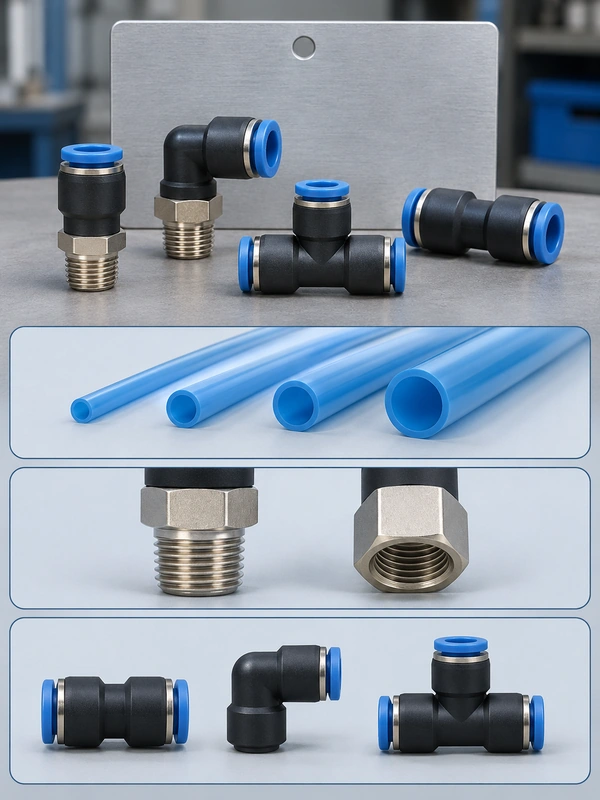
Distinguish a tube-to-tube bulkhead union from a bulkhead connector with a threaded end. The mounting thread and retaining nut are not necessarily a fluid port. Read the drawing to identify which features secure the body and which carry compressed air.
Use reducers, stems and branches deliberately
A reducing union connects different tube ODs through appropriately sized sockets. A stem adapter instead has a defined insertion stem intended for a compatible push-in socket, with another connection at its opposite end. Confirm that the receiving fitting explicitly accepts that stem; a similar diameter alone does not demonstrate suitability.
Reducers can accommodate a smaller branch, but they do not preserve the flow capacity of the larger line. Evaluate the smallest passage, tube bore, length and downstream demand together. Avoid unnecessary adapter stacks, which add interfaces and can place leverage on a small equipment port.
A union tee typically provides three tube connections with a branch arranged perpendicular to the main run. A Y fitting provides branching along angled paths. Neither shape inherently guarantees equal flow division, isolation, non-return behavior or pressure regulation. Choose the branch layout for routing, then check documented flow information where pressure loss matters.
| Assembly need | Candidate configuration | Essential confirmation |
|---|---|---|
| Enter a threaded equipment port | Male or female connector | Thread standard, size and sealing interface |
| Turn beside equipment | Fixed or orientable elbow | Clearance and permitted adjustment |
| Cross a panel | バルクヘッドユニオン | Panel mounting dimensions and access |
| Change tube size or branch | Reducer, stem adapter, tee or Y | Each interface and required flow path |
Connecting a 6 mm supply to a 4 mm instrument branch
Suppose a drawing calls for a 6 mm OD polyurethane supply tube, an equipment port documented as female G1/8 with a specified sealing seat, a panel crossing and a 4 mm OD instrument branch. This is a hypothetical selection exercise, not a recommendation for a particular product or operating condition.
The order would describe a compatible male G1/8 connector with the required sealing arrangement and 6 mm tube socket, a panel-compatible 6 mm bulkhead union, and a branch arrangement that provides the required 4 mm outlet. A reducing tee or a tee plus a documented reducing connection could be considered, subject to available specifications and space.
Before ordering push lock fittings, verify the actual port documentation, tube markings, panel dimensions and operating conditions. If inspection requires disconnecting a line, isolate the air supply, release stored pressure and verify depressurization first. Never press a release collet to investigate a live leak. Any in-service leak assessment must follow the site’s approved procedure without loosening connections.
With the system isolated and depressurized, inspect the tube end for scoring, ovality, contamination and cutting damage. Prepare and insert it according to the selected manufacturer’s instructions. Return-to-service verification should follow the equipment procedure; do not invent universal insertion depths, tightening turns or acceptance limits.
よくある質問
What does push-lock mean for a pneumatic air fitting?
It often means a push-in tube connection, but can also be confused with barbed hose systems. Confirm the sealing and retention mechanism from documentation before selecting tubing or replacement parts.
How are push-lock air fitting sizes specified?
Specify each tube socket by tube OD and each threaded end by thread standard, nominal size and gender. Include unequal socket sizes separately, along with tube material and service requirements.
How do I choose between a male straight fitting and a female straight fitting?
Match the opposite thread gender on the equipment, then confirm standard, size and seal arrangement. Gender alone cannot establish compatibility, and an adapter may introduce avoidable joints.
When should a swivel elbow be used in a pneumatic line?
Use a documented orientable design when installation alignment is needed in a confined route. Do not treat adjustment capability as approval for continuous rotation or repeated machine movement.
What is a push-lock bulkhead union used for?
It joins tubing across a panel while securing the connection at the panel. Confirm mounting dimensions, panel thickness and access; enclosure sealing requires separate evidence.
How do a union tee and a Y fitting differ?
Their principal distinction is branch geometry: a tee has a perpendicular branch, while a Y uses angled paths. Neither inherently controls direction or guarantees equal branch flow.
Which tube and thread details should be checked before buying a push-lock fitting kit?
Check metric or inch tube OD, material, wall requirements, thread standard, nominal size, gender and sealing method. Verify quantities by configuration rather than relying on the kit’s total piece count.
参考文献
- SMC KQ2 Fittings catalog: push-in retention, sealing components, tube compatibility and documented positioning features.
- SMC TU Polyurethane Tubing catalog: tubing identification and application-specific selection information.
- Swagelok Tube Fittings catalog: contrasting two-ferrule sealing and mechanical-grip construction.
要約
If comparing elbow options, consider the S-KQ2V ユニバーサルエルボコネクタ 空気圧継手 as a contrasting fitting candidate and request its specifications before purchase. Its tube sizes, threads, materials, operating limits and permitted movement are not established by the supplied evidence.
Choose the connection mechanism first, then match tube OD, port thread and routing configuration independently. The concrete next step is to build an end-by-end order description from equipment drawings and verified tubing identification, resolving every unspecified interface before buying or disconnecting components.



