
A ストレート直接取り付けカップリング ケーブル敷設に必要な経路を維持しながら、互換性のあるマイクロダクトの2つの区間を接続します。その役割は明確です:ダクト同士を接続し、規定の気密性を保ち、局所的な障害物を生じさせないことです。ケーブル、経路、機器の種類に関わらず、特定の送り込み距離を保証することはできません。.
ダクトの寸法を確認し、端部をきれいに切断して正しく挿入し、最終的な配管経路を適切に支持することで接合部を準備します。その後、ケーブルの通線状況と気密性を別々に評価してください。本ガイドでは、実際の組み立てに不適切となる可能性のある圧力や試験時間の設定は示していません。.
ストレートカップラーを両方のマイクロダクト部に適合させる方法
外径、内径、材質、および両側の許容公差を確認してください。外径が一致していても、内径が必ずしも同じとは限りません。壁厚がより厚い代替ダクトを使用すると、コネクタの取り付け部には適合するものの、ケーブルの通る経路が変更される場合があります。.
ケーブルのクリアランスが重要な場合、コネクタの最小通路寸法情報を入手してください。写真や外装寸法からその寸法を推測しないでください。 マイクロダクト用プッシュフィットコネクタ選定ガイド サイズ、圧力、用途要件がすべて同じ購入仕様に記載されることを説明します。.
| 選択項目 | インストール前に確認してください | 理由 |
|---|---|---|
| ダクト外径 | 両端とも承認済みのコネクタサイズに適合しています。 | グリップとシーリングはインターフェースに依存します。 |
| ダクトID | 両方のルート区間は十分な通行を確保しています。 | 壁厚はクリアランスを変える可能性があります |
| コネクタの内径 | 最小通過時間が記録されています | 接合部は、評価されていない制約を生じさせてはなりません。 |
| ケーブル構造 | 直径および設置要件は既知です。 | 繊維本数だけでは適切性は判断できません。 |
| 環境 | 完全組立品は、その設置場所に対して承認されています。 | 地上設置と埋設設置では仕様が異なる場合があります |
ルートが異なるダクトサイズに移行する場合は、不適切な管に直通継手を無理に取り付けるのではなく、レデューサーを指定してください。ケーブルの敷設方向で、より小さな内径とその移行箇所を確認してください。外側の表面をうまく接合しても、内部の通線経路の問題が解消されない場合があります。.
マイクロダクトの端部を、バリを残さず、内径を潰さずに切断する方法
ダクトに指定されたカッターおよび加工方法を使用してください。端部は四角く、円形で、かつ清潔な状態を保ち、内側のバリや壁の潰れがないようにします。外側のシール面だけでなく、内側の縁も点検してください。不適切な工具で速く切断すると、見た目はきれいでも内部の通路が損傷する可能性があります。.
組み立てまで、加工済みの端部は砂や異物から保護してください。損傷した部分は、残りのダクト長が位置合わせと支持を確保できる場合にのみ取り除いてください。切り詰めにより継手に張力がかかる場合は、ダクトを無理に引っ張って設置するのではなく、認可された補修方法で経路を交換または延長してください。.
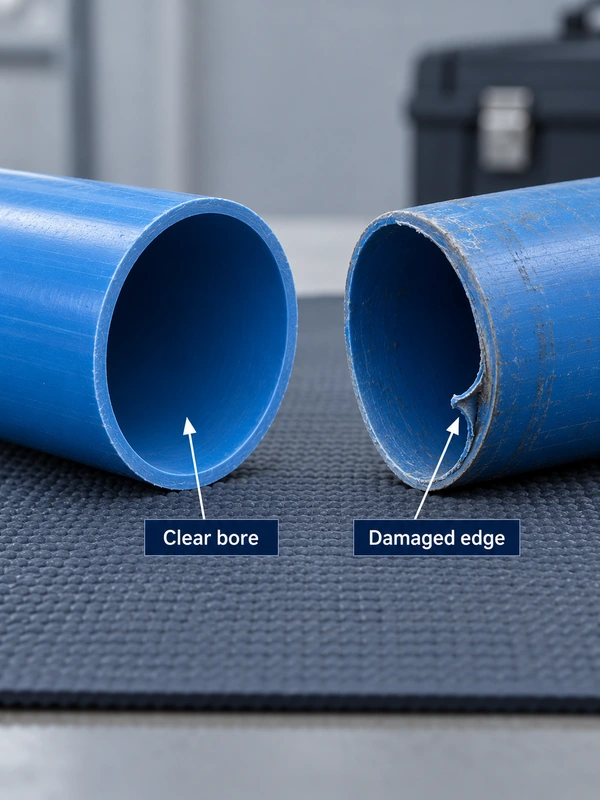
挿入抵抗を低減するために外表面を削ったり、チューブ周囲にシーラントを追加したりしないでください。これらの操作は接合面の特性を変化させます。規定の方法で適切なサイズのダクトが確実に挿入できない場合は、さらに力を加える前に、コネクタ、温度、寸法公差、および汚染の有無を確認してください。.
ストレートカップラーへのダクトの挿入と支持方法
メーカーの指示に従い、挿入深さと保持条件を厳守してください。深さ目盛りまたは目視可能な表示がある場合は、それを活用してください。透明なハウジングは観察に役立ちますが、チューブ端が一部見えるだけでは、規定の確認を代替するものではありません。所定の位置に確実に収めた後、必要なロック用アクセサリーを取り付けてください。.
周囲のダクトをチャンバーやルートに設置した後、継手の状態を確認してください。本体に直接接するような急な曲げは避け、支持されていないダクトの重量が接続部に負荷をかけないようにしてください。点検および許可された保守方法を行うためのアクセススペースを確保してください。ルートは、カップリングをヒンジとして機能させることに依存してはなりません。.
HexatronicのMPB30601+に関するドキュメントには、独自のシーリング機能とグリップ機能、ならびに直接埋設仕様用の外部カバーについて記載されています。これらの詳細は、完全な設置状態が重要である理由を示しています。これらは、同ブランドのカバーや部品を他社製のカップリングと混ぜて使用するための指示ではありません。.
マイクロダクトの継手に通気試験と漏れ試験の両方が必要な理由
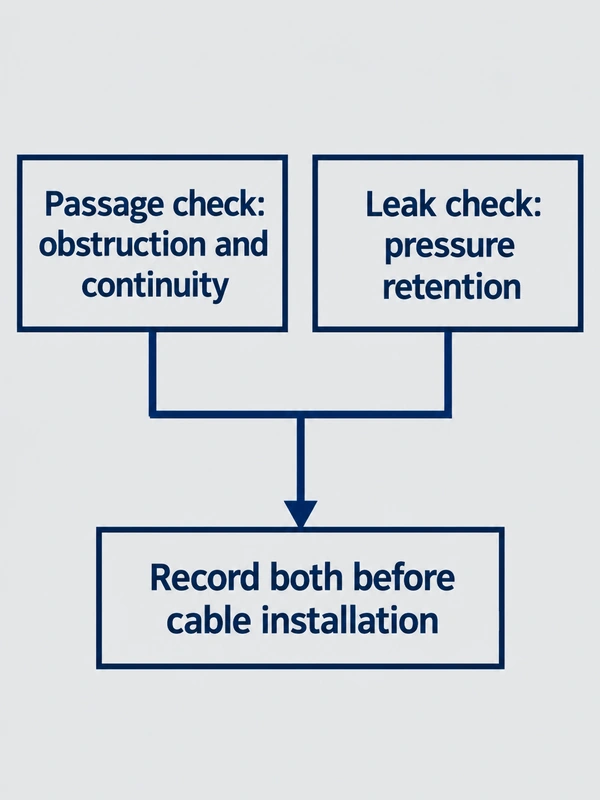
A ケーブル通し口の確認 閉塞および経路の連続性を調査します。リークテストは、承認済み試験区間の圧力挙動を検証します。両者は相互に成立するものではありません。密閉された継手であっても内側にバリが残っている場合があり、漏れのある接続部がある経路でも通路が確保されていることがあります。.
各検査については、装置、受入手順、および合格基準を含め、オペレーターが承認した手順に従って実施してください。一般的なオンライン寸法に基づいて試験対象を選定したり、ダクト内に押し込んだりしないでください。手法は、ダクト、経路、装置に適したものでなければならず、排出口付近には作業員を立ち入れさせてはなりません。.
| 確認 | 提供する証拠 | Remaining limitation |
|---|---|---|
| Dimensional review | Documented component compatibility | Does not reveal every installation defect |
| Seating and retention inspection | Joint assembled as specified | Does not establish complete route passage |
| Approved passage check | Continuity under the chosen method | Does not prove airtightness |
| Approved leakage test | Pressure behaviour under recorded conditions | Does not guarantee blowing distance |
Record both results against the same route identifier. If they were performed before the duct was moved into its final location, determine whether the project requires a further check after placement. Handling can introduce bending or damage that the earlier result did not cover.
What pressure can be used to test the assembled microduct route?
Review the limits of every pressurized component: duct, couplers, end closures, hoses, adapters and test equipment. Use the approved pressure, duration, temperature conditions and acceptance criteria. A burst-test figure from a catalogue is not an operating instruction, and another manufacturer’s test result cannot qualify this assembly.
Locate and correct leakage using the documented process. Check the temporary test connections before replacing installed joints. Temperature changes and instrument behaviour can affect a reading, so record the conditions and stabilization requirements. Never release a collar or cut a duct while pressure remains trapped.
The US Department of Energy’s leak-management guidance supports a useful maintenance habit: identify, track, repair and verify. For telecom work, apply that habit alongside the network owner’s acceptance procedure rather than adopting industrial compressed-air examples as duct-test limits.
Why a coupler’s pressure rating cannot predict cable-blowing distance
Blowing distance depends on more than the connector. Cable construction, duct bore and condition, bends, route length, equipment and installation method all influence the job. An installer should assess the route as a system rather than promise a distance from a connector pressure rating.
Consider a hypothetical joint replacement that removes a leaking coupler but leaves a flattened duct farther along the route. The repaired joint may now pass a leakage check, while the cable still encounters restriction. The appropriate next step is route investigation, not automatically raising pressure or repeatedly replacing the same coupler.
Plan access points and record transitions so the installation team can locate a restriction without guessing. Keep the cable and duct manufacturers’ requirements available with the route plan. When field conditions differ from the design, pause the affected operation and obtain a revised method rather than treating the original plan as unconditional approval.
Does a direct install coupler qualify for direct burial?
A product name containing direct install does not by itself prove suitability for direct contact with soil. Ask whether the exact connector requires an external cover, chamber protection or another approved arrangement. The direct-buried microduct connector guide discusses why environment and mechanical protection need their own specification.
Similarly, joining ducts does not seal the annular space around an installed cable. Emtelle’s gas-block description identifies that as a separate sealing function. If the route crosses a boundary that needs such protection, assess an appropriate マイクロダクト用ガス遮断コネクタ instead of assuming the straight joint performs both jobs.
よくある質問
Can one straight coupler support multiple cable types?
A duct coupler primarily matches the duct interfaces. Different cables may be possible only when their dimensions and installation requirements fit the complete route. If the component also seals around cable, its specific cable-diameter range becomes an additional restriction.
Which test reports should accompany a straight microduct coupler?
Request the standards required by the network specification, reports identifying the exact model or covered family, test conditions and acceptance criteria. A standard number in a listing is not equivalent to a certificate or evidence that every size was tested.
Where can a straight direct install coupler be used?
Only in the environments and configurations documented for that variant. Clarify chamber, above-ground and direct-buried use separately. Required covers, duct materials and temperature conditions form part of the approval, not optional details to resolve after installation.
How is the coupler matched to cable and microduct diameter?
Match each duct OD to its connector entry, then verify duct ID and minimum connector passage against the cable requirements. Do not use fibre count as a substitute for cable diameter, or assume equal duct ODs guarantee identical bores.
How can a straight coupler be installed without obstructing the cable?
Prepare square, round ends, remove damage using the approved method, achieve correct seating and support a smooth route. Check bore continuity separately from airtightness. These steps address joint-related problems but cannot guarantee performance for every route and cable.
What leakage tests are needed after installing a straight microduct coupler?
Use the network owner’s procedure within the limits of the complete assembly. Record the specified pressure, duration, temperature and result. No single pressure value is suitable for all couplers, ducts, end closures and installation equipment.
参考文献
- ヘキサトロニック、MPB30601+コネクタおよびエンドストップ: sealing, retention and application configuration.
- Emtelle, Gas Block Connector: distinction between joining ducts and sealing around cable.
- US Department of Energy, Minimize Compressed Air Leaks: systematic leak repair and verification, not a telecom acceptance standard.
要約
A well-installed straight coupler preserves both the duct connection and the cable route. Match dimensions, prepare clean ends, seat and support the joint, then document separate passage and leakage checks. Assess blowing performance from the complete route, and keep direct-buried protection and cable sealing as explicit additional requirements.
For procurement, send the duct dimensions, cable details, environment and acceptance requirements with an enquiry for the straight microduct telecom coupler. Ask for the exact variant and installation documentation, then retain those details with the completed route record.



