
FTTH describes a fiber connection that reaches an individual home. FTTx is the broader family of access networks in which fiber ends at different locations, such as a building, street cabinet or premises. For a contractor or procurement team, that endpoint changes the civil route, distribution equipment, property access and final connection work. Buying the same duct package for every architecture can leave the difficult part of the route unresolved.
یک ابزار مفید فیبر نوری تا خانه plan therefore starts with addresses and connection points, then works backward through the distribution network. This guide explains the terminology and turns it into decisions about pathways, access chambers, cable matching and spare capacity. It draws on the Fiber Optic Association’s access-network and outside-plant guidance; construction dimensions and acceptance requirements must still come from the approved project design.
FTTH and FTTx describe where the optical path ends
The letter after FTT identifies the approximate reach of the fiber access network. FTTH carries the optical connection to the home; FTTB reaches a building, where the onward connection to individual occupants may use another medium. FTTC ends at a curbside or neighborhood point and retains a different last segment, commonly copper. These terms describe architecture rather than a guaranteed service speed.
FTTP means fiber to the premises and commonly includes both residential and business premises. Providers sometimes use FTTP and FTTH interchangeably in residential offers. For engineering and purchasing, the precise termination location is more useful than the marketing label: identify the equipment room, external box or indoor optical terminal on the drawings.
| معماری | Typical fiber endpoint | Pathway planning question |
|---|---|---|
| فیبر نوری تا خانه | Individual home | How will the drop reach the agreed property entry? |
| FTTB | Building distribution point | Who owns the riser and onward connections? |
| FTTC | Curbside or neighborhood node | Where are the node, power and remaining access segment? |
| FTTP | Residential or business premises | Which premises and handover locations are included? |
A route described only as “FTTx ready” is incomplete. Specify which buildings can actually receive service, where future extensions would leave the installed pathway and what permissions remain outstanding. A spare duct outside an inaccessible property does not by itself make that property serviceable.
Trace the fiber route from the central office to each home
A typical passive optical access route includes equipment at a central office or similar network location, feeder fiber, a distribution area, passive optical splitting and a drop to the customer’s optical network terminal. The splitter can be placed differently depending on the chosen architecture. Its position influences feeder counts, distribution routes, splicing and maintenance access.
Map these functions separately from the civil assets. A handhole is an access location, a duct is a pathway and a splitter is an optical component; none automatically defines the others. One chamber may support through ducts as well as a closure, but its dimensions and access conditions must accommodate the approved arrangement without compromising cable bends.
For multi-occupancy buildings, confirm the transition from external construction to internal building work. The civil contractor may stop at the boundary while another team manages risers and apartment drops. Record responsibilities for entry sealing, internal cable requirements and fire-stopping before materials are ordered. An undocumented handover point often becomes an installation delay.
Choose PON or active access before finalizing distribution points
A passive optical network uses unpowered optical splitters in its distribution path. Powered electronics still operate at the network and customer ends. An active access arrangement can use dedicated fiber links or powered switching equipment in the field. “Passive” therefore describes the distribution function; it does not mean that the complete service works without electricity.
The difference matters to route planning. A powered field node needs an appropriate site, power arrangements and operational access. A passive splitter still needs suitable protection and maintainable optical connections. Neither option eliminates the need for route records, protected pathways or an optical loss budget.
Do not choose a splitter ratio from a generic example. The network designer must check optical loss, reach, connector and splice allowances, equipment compatibility and service objectives. Civil procurement should receive the approved connection schedule rather than assume that increasing spare ducts automatically increases the number of supported customers.
Plan access points before allocating spare ducts
Spare pathways are useful only when crews can find and use them. Position access points with the installation method, route changes, future branches and maintenance access in mind. Consider traffic management, property boundaries and the space needed to handle cable without forcing bends. A convenient point on a map may be impractical when parked vehicles or locked gates restrict access.
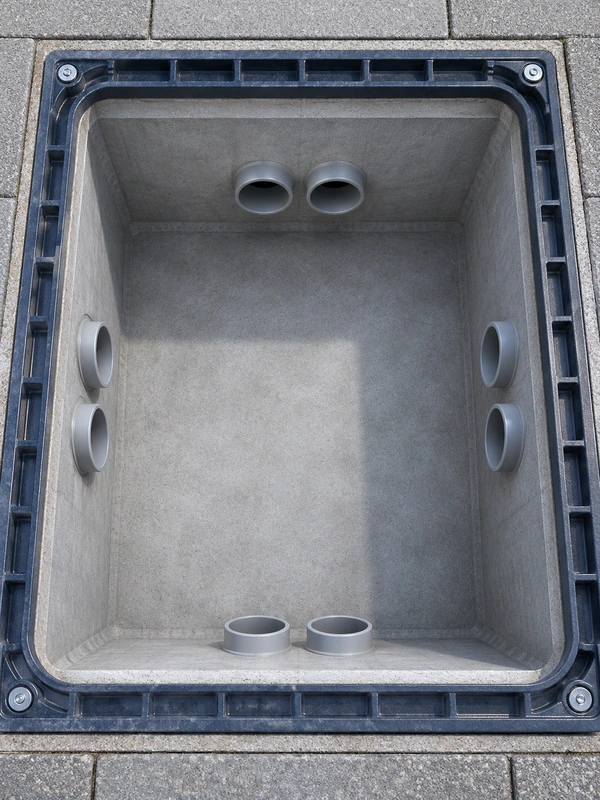
Keep the chamber layout understandable. Document which duct enters from each direction, which ducts continue through and which are reserved. Protect open ends during construction and distinguish an empty-duct closure from a seal around an installed cable. Their functions and size requirements are different, and neither should be selected by appearance alone.
Where existing conduit will be subdivided, first establish its usable condition and occupancy. The guide to HDPE innerduct selection helps identify the pathway and installation requirements for the proposed arrangement. Existing drawings are a starting point, not proof that an apparently spare path remains clear.
As a hypothetical planning example, a development may install an initial distribution route while reserving a separate path toward a later building phase. The useful deliverable is a documented, sealed and accessible continuation point. No fixed spare percentage is universally correct: expansion assumptions, repair strategy and the cost of reopening the surface should drive the decision.
Match cable and duct dimensions before procurement
برای یک fiber optic network, fiber count alone does not specify the cable’s outside diameter or construction. Two cables with similar fiber counts can have different jackets, strength members and installation requirements. Obtain the actual cable data and compare it with the duct’s inside diameter, wall construction and permitted installation method.
Duct outside diameter is relevant to connectors, supports and space allocation; inside diameter determines the opening available for the cable. A nominal size without its dimensional convention is insufficient. The microduct and fiber cable matching guide covers the checks needed before treating two components as a compatible pair.

| Dimension or limit | Where to obtain it | چه چیزی را کنترل میکند |
|---|---|---|
| Duct OD and ID | Selected duct drawing | Connector fit and internal pathway |
| Cable OD and construction | Cable manufacturer’s data | Fit and deployment suitability |
| Installation bend limits | Cable and duct instructions | Route and access-point geometry |
| Pulling or blowing limits | Approved installation procedure | Equipment settings and section planning |
| Closure fit and function | Closure supplier’s documentation | Protection of empty or occupied ducts |
Do not convert a general diameter ratio into a guaranteed blowing distance. Route curvature, joint alignment, duct condition, cable stiffness and equipment all affect installation. If the combination is unfamiliar, resolve the uncertainty with the relevant manufacturers and a project-specific installation plan before releasing a large material order.
Compare last-mile costs over the life of the route
When comparing telecom conduit options, count more than the purchase price per meter. Permits, surface reinstatement, crossing work, property access, installation crews and later repair can materially affect the project. The FOA’s construction guidance discusses coordinating underground work and installing pathways that can support later cable deployment; the value depends on the actual route.
Separate confirmed costs from assumptions. Price the initial build, then show a clearly labeled expansion scenario with the assumed number of future connections and any new excavation. This exposes whether a cheaper initial option simply postpones difficult work. Do not publish a universal savings percentage without project quantities and comparable scope.
Before handover, collect route drawings, duct identification, accepted section records, cable test reports and details of remaining limitations. A route register should say which pathways are occupied, reserved or unavailable. This information lets future crews plan work without opening every chamber or guessing which duct serves a customer.
سوالات متداول
What does FTTH mean?
FTTH means fiber to the home. The optical access connection reaches the individual residence, where an optical terminal connects it to customer equipment. It describes the physical reach of fiber, not a universal bandwidth promise or a particular indoor Wi-Fi arrangement.
What is the difference between FTTH and FTTx?
FTTx is the umbrella term for access architectures with different fiber endpoints. FTTH is one member of that family. Check the actual handover point because it determines the remaining connection medium, equipment location and responsibility for the final route.
How does FTTH differ from FTTC?
FTTH extends fiber to the residence. FTTC generally ends fiber at a curbside or nearby node and uses another medium for the final segment. The civil and equipment plans must account for that intermediate point and its onward connections.
Are FTTH and FTTP the same?
They overlap in residential use. FTTP is broader because a premises can be a home or a business. Use the project’s defined endpoint and scope when comparing quotations rather than assuming that both labels include identical installation work.
Which components make up an FTTH network?
A PON-based example includes network-side optical equipment, feeder and distribution fiber, splitters, connections, drops and customer optical terminals. Ducts, chambers and closures provide physical infrastructure. The exact combination and splitter placement depend on the approved network design.
How do active and passive optical networks differ in FTTH?
A PON divides optical service through passive splitters, while active arrangements can use dedicated links or powered field switching. Both require powered endpoint equipment. Choose the architecture with network performance, maintenance, power access and expansion requirements considered together.
What should be planned before installing an FTTH connection?
Confirm the service address, permissions, endpoint, route condition, duct and cable compatibility, installation method and testing responsibilities. Also decide how spare ducts and occupied entries will be protected and how the final route will be recorded for maintenance.
مراجع
- Fiber Optic Association: Fiber to the Home — access-network context.
- Fiber Optic Association: FTTH Architectures — endpoints, active networks and passive splitting.
- Fiber Optic Association: Underground Construction — civil pathways, access and route protection.
خلاصه
FTTH planning works best when the service endpoint, optical architecture and civil route are specified together. Confirm access points before allocating spares, match actual cable and duct dimensions, and leave records that make future connections practical. For protecting an empty route, review the pull-ring microduct end stopper and provide the duct dimensions, installation environment and required sealing conditions so the exact version can be confirmed.



