
Underground fiber installation involves two different decisions: how to construct the route and how to place the cable in it. Trenching, plowing, microtrenching and horizontal directional drilling address civil construction. Pulling or blowing cable into an accepted duct is a later operation. Mixing these decisions too early can produce a route that is easy to build but difficult to cable, maintain or expand.
This fiber optic cable installation checklist is intended for project planners, contractors and buyers preparing a work package. It follows the Fiber Optic Association’s outside-plant guidance while leaving excavation dimensions, utility clearances and acceptance values to local authorities and the approved design. There is no single installation method that is best for every soil condition and street layout.
Survey the route before choosing construction equipment
Walk the route and divide it into sections with similar conditions. Record surfaces, slopes, access restrictions, existing utilities, crossing points, drainage and locations where equipment can be staged. A continuous line on a drawing may contain a soft verge, a congested sidewalk and a road crossing, each requiring a different construction approach.
Existing utility drawings help planning but do not replace the required locating and verification process. Follow the jurisdiction’s rules for permits, utility notification and exposure of services. The contractor should resolve discrepancies before excavation or drilling begins. Never treat an unmarked area as evidence that no underground service exists.
Check ownership and working access as carefully as soil. A technically suitable alignment may cross a private drive or leave no room for reels and machinery. Record when work can occur, how residents will retain access and who approves reinstatement. These constraints can determine the practical method more strongly than the equipment’s nominal production rate.
Choose the civil method for each route segment
Conventional trenching opens the route so crews can place the specified pathway and inspect its arrangement before backfill. It can suit sections with frequent branches or obstacles requiring local work. Its disadvantages include excavation volume, traffic disruption and surface restoration. Costs must include reinstatement rather than compare excavation alone.
Microtrenching cuts a relatively narrow slot, often in a paved surface. It can reduce the width of disturbance where the road authority accepts the design, but it is not automatically suitable for every pavement or future maintenance regime. Confirm the permitted position, slot construction, backfill system and how later road works may affect the installed route. If a quotation instead describes mini-trenching, request the actual approved cross-section and installation method rather than assume that the label defines a universal width or depth.
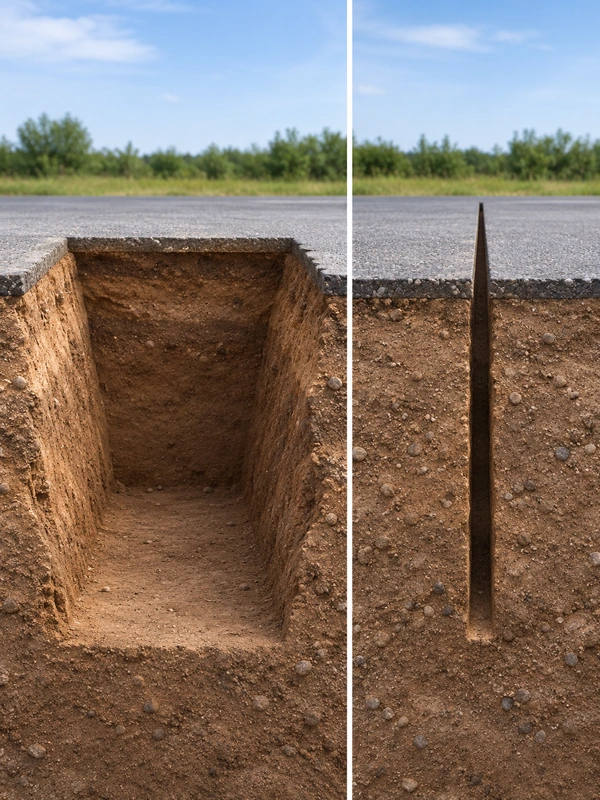
| Method | Situation to investigate | Main questions before approval |
|---|---|---|
| Trenching | Routes needing open access or frequent branches | Utility conflicts, support, backfill and reinstatement |
| Plowing | Open routes with suitable ground and fewer obstacles | Ground continuity, equipment access and feed control |
| Microtrenching | Approved narrow-slot installation in suitable surfaces | Road-owner permission, surface construction and future maintenance |
| HDD | Crossings where surface excavation is restricted | Ground investigation, utility clearance, bore design and working areas |
Horizontal directional drilling, or HDD, provides a steered underground route and is commonly considered for difficult crossings. It still needs entry and exit areas, a suitable bore design and verified utility locations. Specialist planning must address ground behavior, drilling-fluid management and pullback conditions; the absence of an open trench does not remove construction risk.
Plowing can be attractive along open routes where the ground and obstructions allow continuous progress. It should not be selected solely because the route is rural. Rock, abrupt terrain changes, buried services and interruptions can make a planned section unsuitable. The FOA discusses plowing in open areas, but the actual choice requires the contractor’s site assessment.
Decide between direct burial and a ducted route
A direct buried fiber optic cable must be specified for that environment and installation method. A cable intended for a protected duct should not be assumed suitable for direct contact with soil. Jacket construction, mechanical protection, water exposure and any metallic-component requirements need confirmation from the cable manufacturer and project specification.
A ducted route separates the civil pathway from cable placement. It may support later cable replacement or additional installation, provided the route remains accessible and the duct system is suitable. The extra pathway materials must be evaluated against construction, maintenance and expansion objectives, not treated as an automatic cost saving.
For a proposed ducted design, review HDPE innerduct selection alongside the route drawings. Specify whether the product is to sit inside another conduit or be installed in a separately approved outside-plant arrangement. The name “HDPE duct” alone does not establish burial suitability, wall class or allowable construction loads.
Specify the cable construction as well as the fiber count
Different fiber optic cable types can carry similar fiber counts while presenting very different installation requirements. Obtain the cable outside diameter, jacket construction, strength-member arrangement, bend limits and allowable installation loads. Confirm suitability for the full route, including entries and transitions, rather than only its longest underground section.
The guide to microduct and fiber cable matching explains the checks needed to select a compatible pathway and cable. A cable’s installation behavior depends on its complete construction. A buying request that lists only single-mode fiber and a fiber count leaves major mechanical questions unanswered.
| Required input | Record it for | Do not substitute |
|---|---|---|
| Cable outside diameter | Selected cable model | Fiber count as a diameter estimate |
| Duct inside and outside diameters | Selected pathway product | A single unexplained nominal size |
| Bend and installation-load limits | Actual cable and duct instructions | A generic value copied from another project |
| Approved excavation arrangement | Each route segment | A universal trench depth |
| Entry and closure dimensions | Chambers and building transitions | Visual estimation on site |
If metallic armor or strength members are specified, the designer should address applicable bonding and grounding requirements. If an all-dielectric cable is selected, confirm its other environmental and mechanical requirements separately. Neither construction description is a universal solution for every underground hazard.
Release the duct route before cable installation
Set a clear acceptance point between the civil team and the cable team. The completed route should be identified, accessible and checked using the approved duct inspection and proving procedure. Check the continuity of section records, the condition of entries and joints, and the protection of unused ends. Photographs alone do not establish that an internal pathway is usable.
Dirt, standing obstructions, crushed sections or misaligned joints can turn a completed excavation into a failed cable installation. Record and resolve defects before mobilizing the cable crew. If pressure testing or other tests are specified, use the approved equipment, isolation and acceptance criteria; this article does not supply universal test pressures.

Keep an acceptance record for each section rather than a single statement that the entire route is ready. It should identify the endpoints, duct designation, inspection date, method, result and open issues. Where one section fails, this makes it possible to continue planning around confirmed sections without losing track of the defect.
Plan cable placement and handover as separate work packages
For cable pulling, consider the complete path, including bends and entry geometry, against the manufacturer’s limits. For blowing, confirm the cable, duct, connector and equipment combination and the relevant installation procedure. Neither method should begin merely because a cable physically fits through a short duct sample.
As a hypothetical planning example, one route could use trenching along an accessible verge and HDD at a road crossing, followed by cable placement through the accepted pathway. This is a sequence illustration, not an instruction to use those methods at a specific site. The crossing’s geometry and transition points must remain compatible with the later cable operation.
At handover, preserve as-built alignment, access locations, duct occupancy, splice information and optical test reports. Include approved deviations and remaining restrictions. The operating team needs to know what was actually installed, not just what the original design intended. An expansion route that has been sealed, identified and documented is easier to assess than an unrecorded spare.
Define who owns the records and how changes will be controlled. Subsequent connections, repairs and road works can invalidate an accurate handover drawing if nobody updates it. A useful maintenance package links the physical route identifiers to the associated inspection and cable test records without requiring field crews to search through unrelated project folders.
Preguntas frecuentes
What is the most common method for installing fiber optic cables underground?
There is no universal answer across all regions and ground conditions. Trenching is a conventional approach, while plowing, microtrenching and HDD serve different route needs. For ducted networks, cable pulling or blowing is a separate decision after the pathway is constructed and accepted.
How do ground conditions affect fiber installation?
Soil, rock, groundwater, slopes and existing services affect excavation stability, equipment suitability and the route design. They also influence restoration and access requirements. A site investigation and utility verification should precede method selection rather than follow an equipment booking.
When should trenching be used for underground fiber?
Consider trenching where open access is appropriate and the approved route can accommodate excavation and reinstatement. It can help with local branches and complex placements. The decision still depends on permits, utility conflicts, ground conditions and protection of people and existing services.
When can plowing be considered for a fiber route?
Plowing may be considered on open routes with suitable ground and relatively few obstacles. Confirm cable or duct suitability, equipment access and route continuity. Frequent crossings or difficult ground can change the economics and require another method for part of the route.
How do microtrenching and conventional trenching differ?
Microtrenching uses a narrow surface slot; conventional trenching creates a broader excavation. The difference affects restoration and pathway arrangement. Neither method carries a universal depth rule, and microtrenching requires the relevant surface owner’s approval and an appropriate installation design.
When is horizontal directional drilling considered for fiber installation?
HDD is often considered at roads and other crossings where surface excavation is difficult or restricted. It requires specialist planning, suitable ground information, utility verification and space for equipment and pullback. It should not be treated as a way to avoid route investigation.
What site information is needed before choosing an underground installation method?
Collect alignment, ownership, utility locations, ground and water conditions, surfaces, crossings, access constraints and restoration requirements. Add the proposed cable and duct specifications, future expansion needs and local approvals. This allows contractors to compare equivalent work scopes.
Referencias
- Fiber Optic Association: Project Preparation — site assessment and outside-plant planning.
- Fiber Optic Association: Underground Construction — construction methods and pathway considerations.
- Fiber Optic Association: Underground Cable Installation — cable placement after civil construction.
- Fiber Optic Association: Fiber Optic Cables — cable construction and applications.
Resumen
A dependable underground build starts with a verified route, an appropriate construction method and a cable specified for its environment. Accept and document the pathway before cable placement, then hand over records that support repairs and expansion. When preparing a duct quotation, review the one-way HDPE microduct with the required dimensions, route arrangement and installation conditions so its suitability can be checked against the project.



